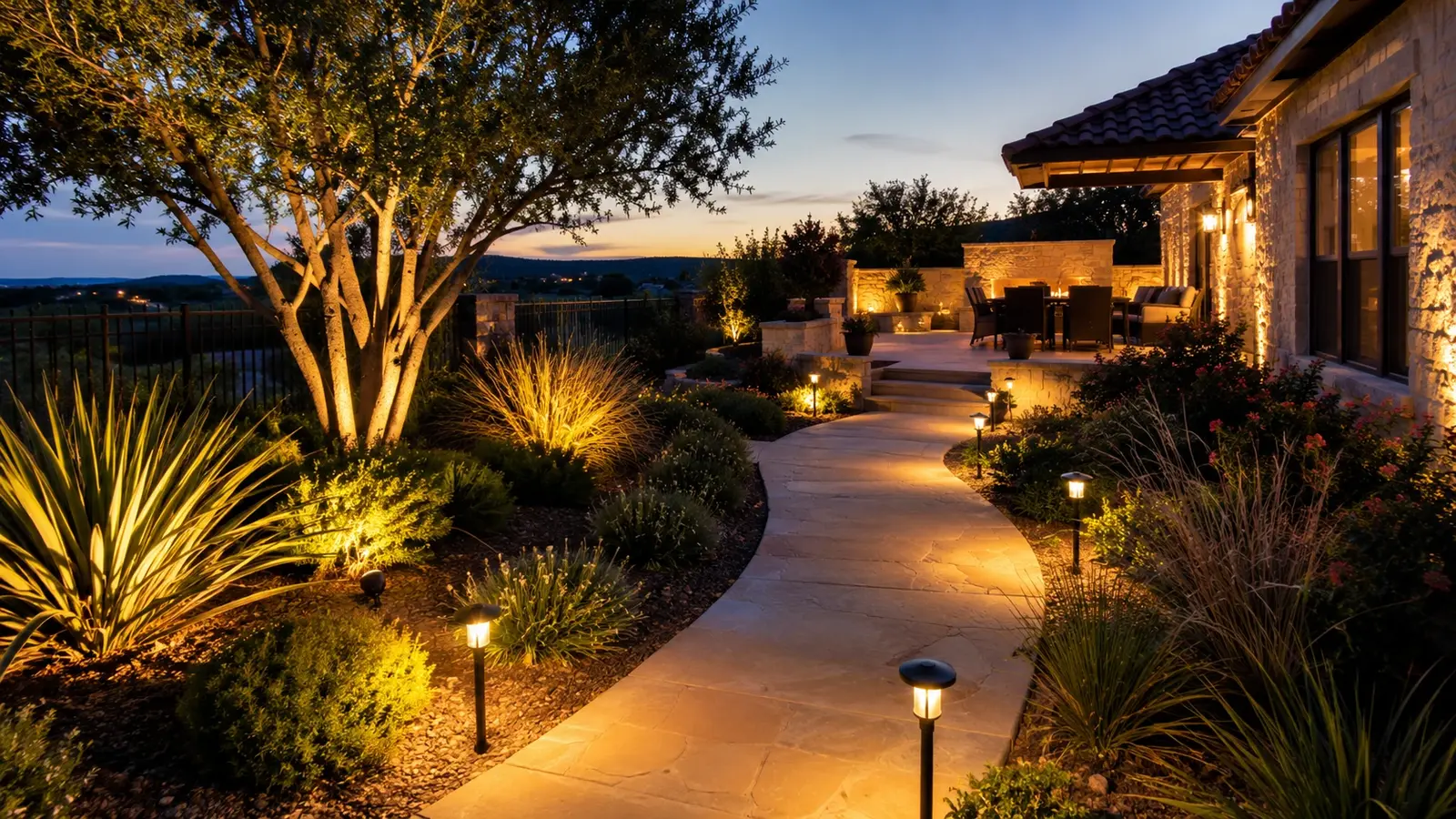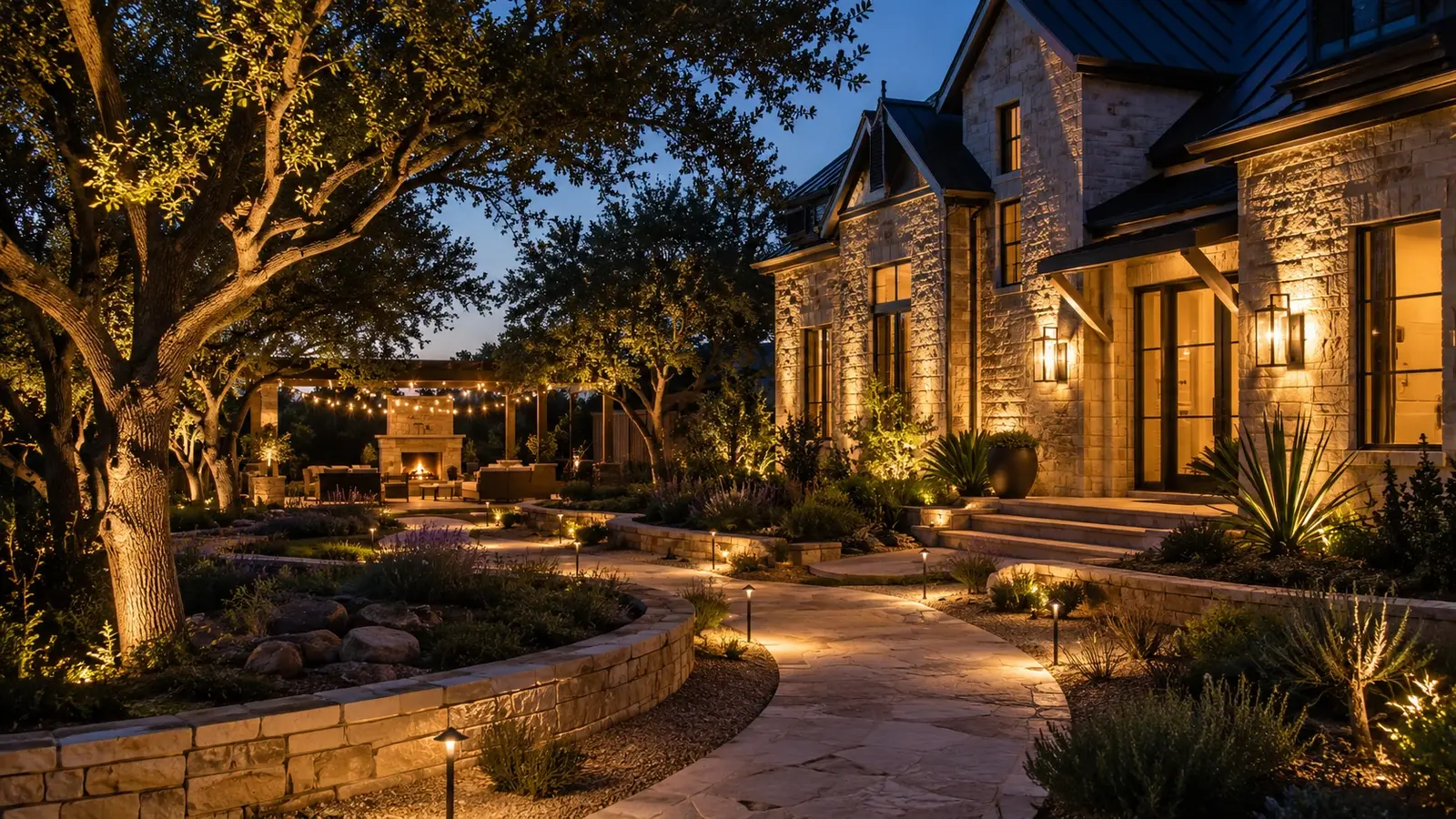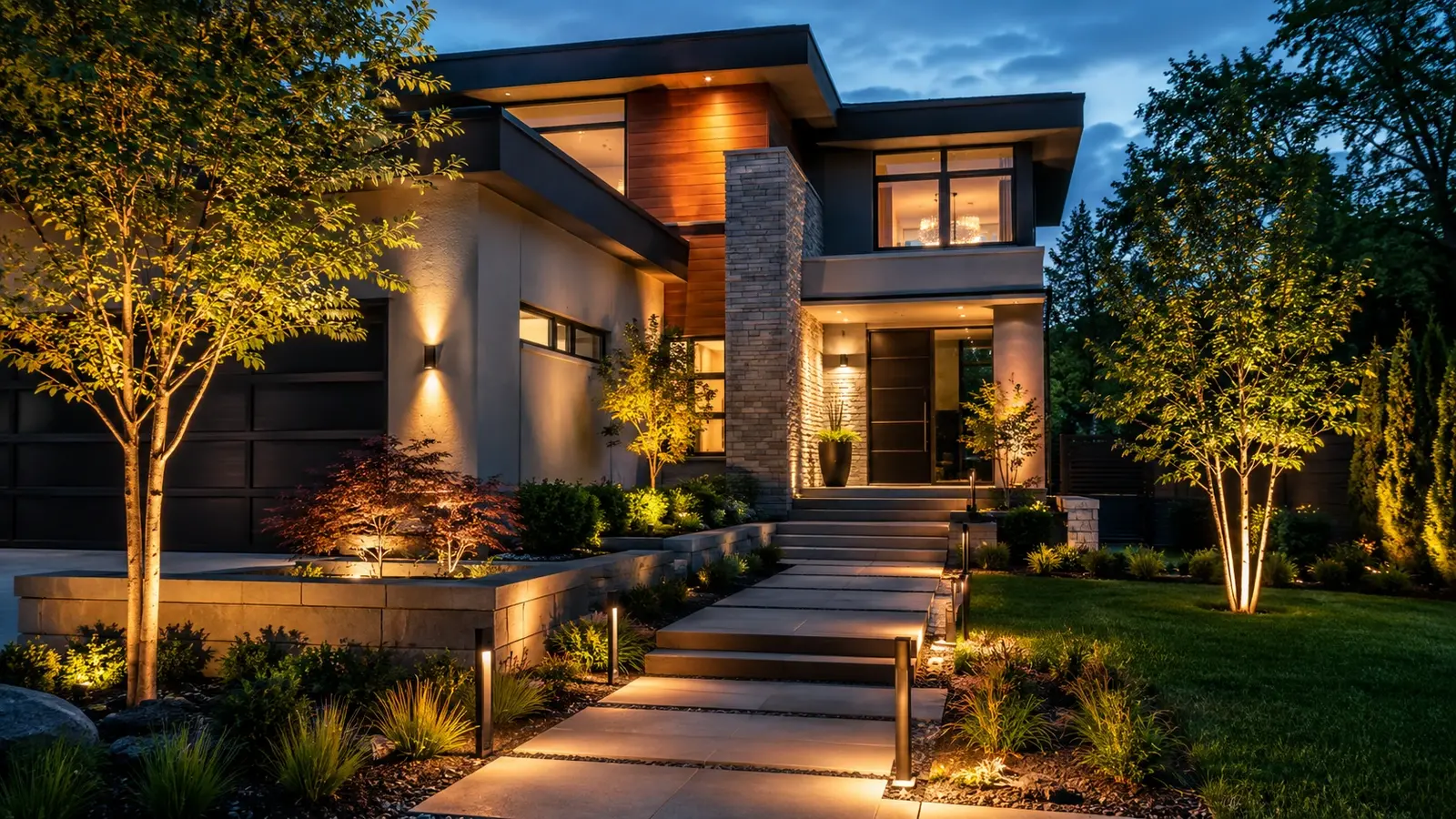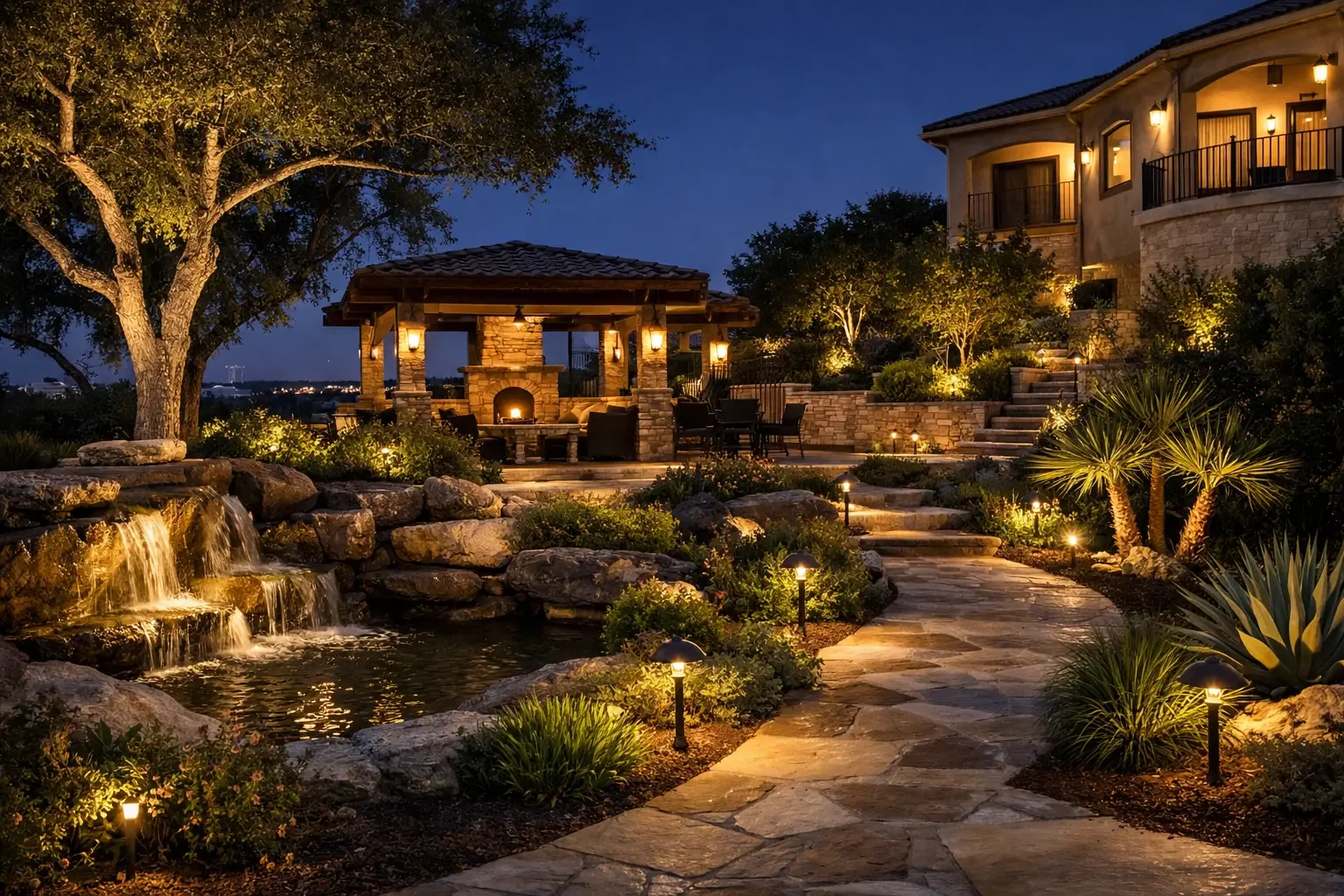
Landscape lighting cost is the first question nearly every homeowner asks, and the honest answer is a range rather than a number. A professionally installed 12V low-voltage LED system in Austin typically falls between 2,500 and 6,500 dollars for a front yard and between 6,000 and 20,000 dollars or more for a full property, depending on fixture count, fixture quality, terrain, and controls. Those are planning ranges based on what Austin Landscape Lighting sees across more than 500 local projects, not quotes. This guide breaks the total into its parts, shows what small, medium, and large projects usually include, and explains the factors that move the number so you can budget with confidence before anyone walks your yard.
Why Landscape Lighting Is Priced the Way It Is
A landscape lighting system has five cost components: fixtures, the transformer and controls, cable and connectors, design and installation labor, and any site-specific extras such as trenching under hardscape or climbing for moonlighting. Fixtures and labor dominate. On most residential projects, fixtures make up 40 to 50 percent of the total, labor 30 to 40 percent, and the transformer, cable, and controls the remainder.
Because the system is modular, cost scales almost linearly with fixture count. That makes per-fixture installed pricing a useful planning tool. In the Austin market, professionally installed brass or copper LED fixtures generally land between 250 and 450 dollars each all-in, including the share of transformer, cable, and labor. Premium specialty fixtures and difficult placements push higher.
Cost by Component
Fixtures
Fixture quality is the biggest variable. Solid brass or copper path lights, uplights, and well lights with integrated or interchangeable LED lamps run 90 to 250 dollars each for the hardware alone. Powder-coated aluminum fixtures cost 40 to 120 dollars but typically fail within three to six years in Austin's heat and sprinkler scale, so most professionals do not install them. Specialty items such as hardscape lights for retaining wall caps, recessed step lights, and submersible pool or fountain fixtures range from 120 to 350 dollars.
Transformer and controls
A quality multi-tap magnetic transformer in the 150 to 300 watt range costs 250 to 600 dollars. A built-in photocell and astronomical timer adds 40 to 120 dollars. Smart controllers that bring zone control, dimming, scenes, and app or voice control add 300 to 900 dollars depending on how many zones the property needs. Larger estates with two or three transformers multiply this line.
Cable and connectors
Direct-burial 12-gauge cable runs roughly 1 to 1.50 dollars per foot, and 10-gauge for long runs about 1.75 to 2.50 dollars. A typical front yard uses 200 to 400 feet. Gel-filled waterproof connectors add 3 to 6 dollars per splice. Cable rarely exceeds 10 percent of a project's total.
Design and labor
Installation labor for a trained two-person crew in Austin generally runs 85 to 150 dollars per hour, and most residential systems install in a single day. Design time is often included in the installed price by full-service companies. Standalone lighting design, if you want a plan to bid out or install yourself, runs 300 to 1,200 dollars depending on property size.
Site extras
Boring under a driveway or sidewalk adds 150 to 400 dollars per crossing. Rocky Hill Country soil in Westlake, Lakeway, and Bee Cave slows trenching and can add a few hundred dollars. Moonlighting that requires climbing or a lift to mount fixtures 25 feet up in a live oak adds 100 to 250 dollars per fixture. A new GFCI outlet, if one is not available near the transformer location, requires an electrician at 200 to 450 dollars.
Planning Ranges by Project Size
The table below groups typical Austin projects into three tiers. Every figure is a planning range for professionally installed brass or copper LED systems. Your property may land outside these bands, and only an on-site visit produces a real estimate.
| Project tier | Typical scope | Fixtures | Transformer | Planning range |
|---|---|---|---|---|
| Small | Front walkway, entry, one or two accent trees | 8 to 12 | 150 W, timer and photocell | 2,500 to 4,500 dollars |
| Medium | Full front yard with facade, trees, path, plus patio or back trees | 14 to 24 | 300 W, or two 150 W, smart controller optional | 4,500 to 9,500 dollars |
| Large | Whole property: facade, multiple trees, paths, patio, pool, steps, moonlighting, zoned smart control | 25 to 50 or more | Two or three transformers, multi-zone smart system | 9,500 to 20,000 dollars and up |
| Add-on zone | Extending an existing system to a new area | 4 to 8 | Uses existing capacity or adds a unit | 1,200 to 3,000 dollars |
| Design only | Written plan with fixture schedule and wiring layout | n/a | n/a | 300 to 1,200 dollars |
For a quick personalized estimate, the cost estimator walks through fixture counts and features and returns a planning range for your property.
What Drives Cost Up
Several factors reliably push an Austin project toward the upper end of its tier.
Mature live oaks are the most common. A single multi-trunk live oak with a 50-foot canopy often needs three uplights cross-lighting the trunks plus one or two moonlights in the canopy, which is five fixtures for one tree. A cedar elm or cypress needs one.
Hill Country grade changes add steps, retaining walls, and terraces, each of which needs safety lighting. Hardscape lights under wall caps and recessed step lights cost more per unit than path lights and require more careful installation.
Hardscape crossings add boring. A front yard divided by a driveway and two sidewalks may need three bores. Large lots in Steiner Ranch or Circle C mean long cable runs, heavier gauge wire, and sometimes a second transformer to control voltage drop.
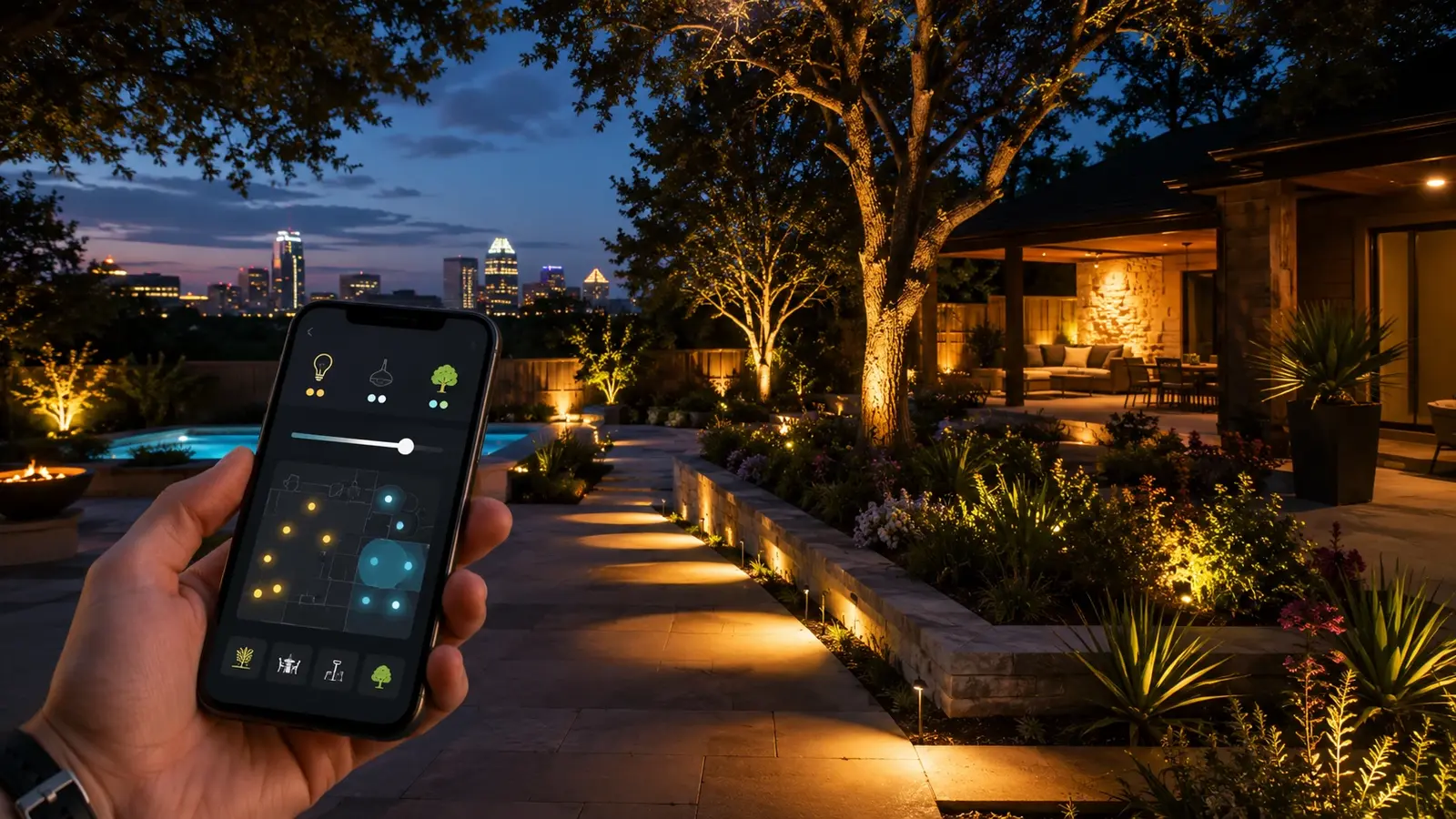
Smart controls add a few hundred to nearly a thousand dollars, but they also let you dim zones, satisfy HOA lights-off hours, and keep the design dark-sky friendly without manual effort. Pool and water feature lighting requires submersible fixtures and specialized wiring, which adds to both hardware and labor.
What Keeps Cost Down
Good design is the biggest cost control. A clear hierarchy with one hero element and restraint elsewhere needs fewer fixtures than a yard that tries to light everything. Twelve well-placed fixtures routinely outperform twenty scattered ones.
Phasing helps. Many Austin Landscape Lighting clients install the front yard first with a transformer sized for the whole property, then add the back patio or pool zone a year later. The 20 percent headroom rule for transformer sizing makes this easy, and the add-on zone range in the table above reflects what a second phase typically costs.
Existing infrastructure matters. A GFCI outlet in the right place, open beds instead of mulched rock, and a layout without driveway crossings all trim labor. Standard brass fixtures rather than custom finishes keep hardware cost predictable without sacrificing lifespan.
LED Operating Cost
Running cost is small. A 20-fixture LED system averaging 6 watts per fixture draws 120 watts. At six hours per night, that is 0.72 kWh per day or about 263 kWh per year. At Austin Energy residential rates in the neighborhood of 13 to 15 cents per kWh including fees, the system costs roughly 35 to 40 dollars per year to operate. A comparable halogen system from fifteen years ago would have drawn 700 to 1,000 watts and cost 230 to 330 dollars per year.
LED lamps also last 40,000 hours or more, which at six hours a night is well past 15 years. Maintenance consists of an annual check of connections, aiming, and lens cleaning rather than lamp replacement. If you have an older halogen system, the LED savings calculator shows how quickly an LED retrofit pays for itself.
DIY vs Professional Cost
A do-it-yourself installation with brass fixtures from a landscape supply house, a quality transformer, and proper cable typically costs 50 to 60 percent of the professional price in materials alone. The savings are real, but so are the trade-offs. Design, voltage drop calculations, hub wiring, boring under hardscape, and night aiming are where most DIY systems fall short, and fixing an undersized transformer or a dim far zone later often costs more than doing it right the first time. Big-box kits with aluminum or plastic fixtures cost far less upfront and usually need full replacement within three to five years in Austin conditions.
A middle path is to pay for a professional design and install it yourself, or to have a professional install the transformer, trunk lines, and hubs while you place the fixtures. Either approach captures most of the quality while trimming labor.
What a Written Estimate Should Include
Any estimate you receive should itemize fixture count by type, the brand and material of each fixture, lamp wattage and color temperature, transformer brand and capacity, cable gauge, control type, and labor. It should also state the fixture warranty, the workmanship warranty, and whether night aiming and a follow-up adjustment visit are included. Austin Landscape Lighting provides written estimates after a free on-site consultation, and every installation carries a 2-year workmanship warranty on top of manufacturer fixture warranties. Vague per-project pricing with no fixture schedule is a sign to keep shopping.
Is Landscape Lighting Worth the Cost?
Beyond curb appeal, landscape lighting delivers safety on steps and paths, a measurable deterrent to intrusion, and extended use of patios and outdoor kitchens through Austin's long warm season. Real estate agents consistently cite lit exteriors as a factor in showing appeal and photography. Against a 20-year fixture life and under 40 dollars a year in electricity, most homeowners find the planning ranges above reasonable for the value returned. For more detail on fixture counts behind these ranges, see how many landscape lights do I need.
Landscape lighting cost becomes concrete only when someone walks your property, counts the trees, measures the runs, and understands what you want to see at night. Austin Landscape Lighting offers that consultation free, with a night demonstration and a written estimate that itemizes every component. Call +1 (281) 704-7210 or reach out online to schedule, and we will give you a planning number you can trust.
Frequently asked questions
How much does landscape lighting cost per fixture in Austin?
Professionally installed brass or copper LED fixtures in the Austin market generally land in a planning range of 250 to 450 dollars each, including the share of transformer, cable, and labor. Specialty fixtures such as submersible pool lights, hardscape cap lights, and moonlights that require climbing fall higher. These figures are planning ranges and not quotes.
What is a realistic budget for front yard landscape lighting?
A small front yard project with 8 to 12 fixtures covering the walkway, entry, and one or two accent trees typically falls between 2,500 and 4,500 dollars installed. A fuller front yard with facade grazing, several trees, path lights, and step lights usually runs 4,500 to 9,500 dollars. Mature live oaks and hardscape crossings push toward the upper end.
How much does it cost to run LED landscape lighting each month?
Very little. A 20-fixture LED system averaging 6 watts per fixture uses about 263 kWh per year at six hours per night, which at Austin Energy residential rates is roughly 35 to 40 dollars annually, or about 3 dollars per month. An equivalent halogen system would cost 230 to 330 dollars per year.
Is it cheaper to install landscape lighting myself?
Materials for a quality DIY system with brass fixtures and a proper transformer cost about 50 to 60 percent of a professional installation. The savings are real, but design, voltage drop, hub wiring, boring under hardscape, and night aiming are where DIY systems usually fall short. Budget big-box kits cost less but typically need replacement within three to five years in Austin conditions.

Written by the design team at Austin Landscape Lighting. We design, install and maintain low-voltage LED landscape lighting across Austin and the Hill Country. Questions about your property? Book a free dusk consultation or call +1 (281) 704-7210.