
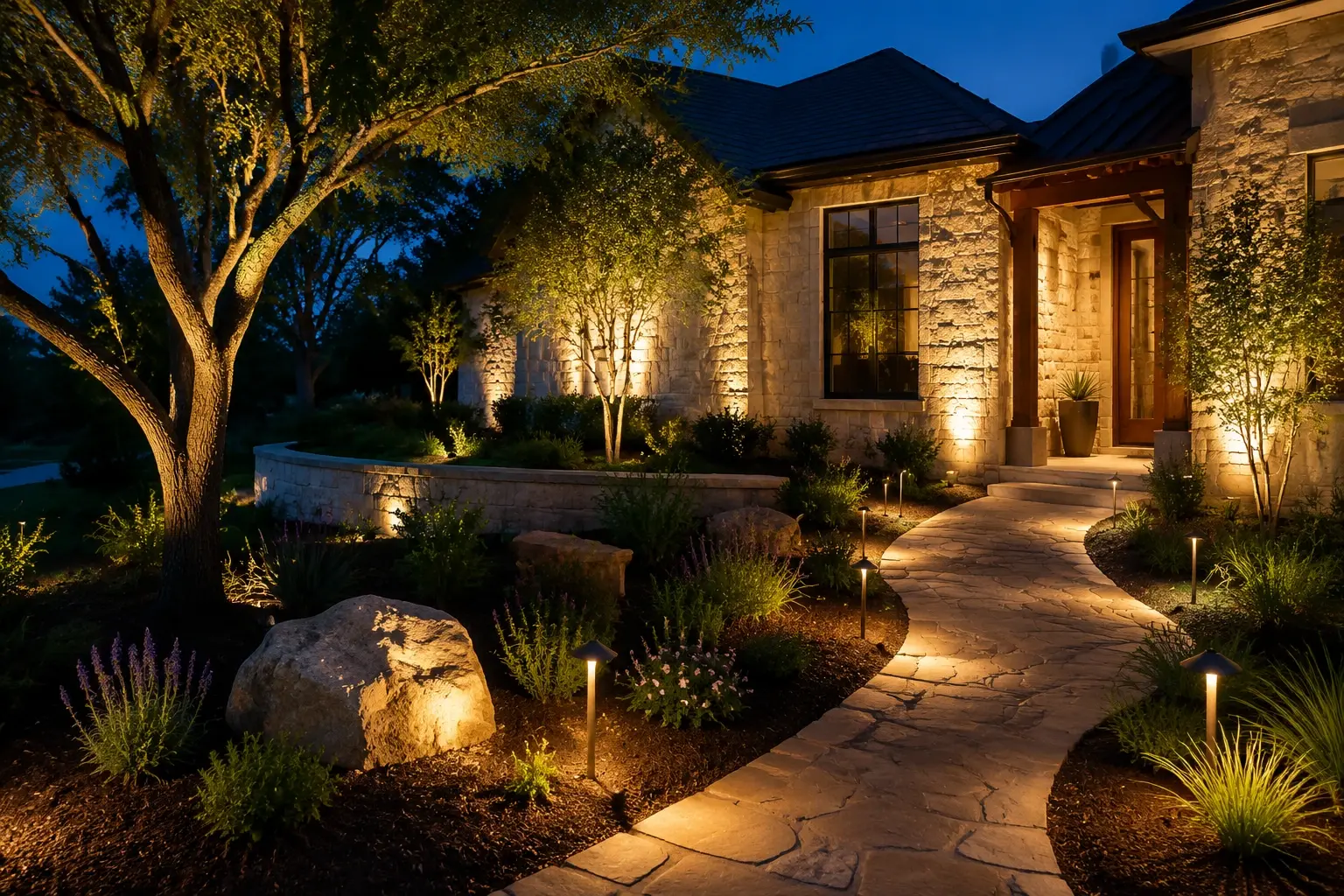
- Safe 12V power, cool fixtures
- Transformer sized to real load
- Hub wiring for even voltage
- Gel-filled waterproof connections
Why Low Voltage Is the Standard for Landscape Lighting
Low voltage landscape lighting Austin homeowners install today runs at 12 volts, stepped down from household 120 volts by a transformer. That single decision shapes everything else about the system. Twelve volts cannot deliver a dangerous shock, so cable can be buried at shallow depth in planting beds without conduit, fixtures can be touched by children and pets, and a fixture can be moved three feet to the left when the agave grows without calling an electrician. Modern LED lamps have made 12V systems efficient enough that a 30-fixture property draws less power than a hair dryer.
Austin Landscape Lighting has installed more than 500 low-voltage systems since 2020. Because the fixtures get all the attention and the wiring is buried, the quality of the underlying system is where good contractors and poor ones differ most. This page explains what we do beneath the surface.
Components of a Properly Built System
Transformer
The transformer converts 120V to 12V and houses the photocell and astronomical timer. We install stainless steel units with multiple voltage taps, sized so the connected LED load falls between roughly 40 and 80 percent of capacity. Undersized transformers run hot; grossly oversized ones can cause flicker with some LED drivers and waste money. The unit mounts at least 12 inches above grade on a wall near a GFCI-protected outdoor outlet, in shade where possible. For larger properties we use two or three transformers near the fixture groups rather than one giant unit, which keeps cable runs short and troubleshooting simple.
Cable
Direct-burial low-voltage cable in 12 gauge is our standard, with 10 gauge for long home runs. Cable is trenched 6 inches deep in beds and deeper where it crosses turf, and sleeved in conduit under driveways, walks and anywhere a shovel is likely. Voltage drop is the enemy: a long run of undersized cable leaves the last fixtures dim and yellow. We design every run so the farthest fixture sees within one volt of the nearest.
Wiring method
There are three ways to connect fixtures to a transformer, and we choose based on the layout:
- Hub method. A home run from the transformer to a central waterproof hub, with short equal leads to each fixture. Every fixture sees the same voltage, which keeps LED color consistent. Our default for groups of 4 to 8 fixtures.
- Loop (T) method. Cable runs out along a line of fixtures and back to the transformer, feeding both ends. Good for long path runs.
- Daisy chain. Fixtures connected in series along one cable. Simple, but the last fixture always gets less voltage. We use it only for very short runs.
Connections
Every splice uses a gel-filled, waterproof connector rated for direct burial. We do not use pierce-point clips or indoor twist-on connectors, which are the number one cause of the repair calls we take on other companies' systems. Connections are placed in accessible spots near fixtures and documented on your plan.
Fixtures
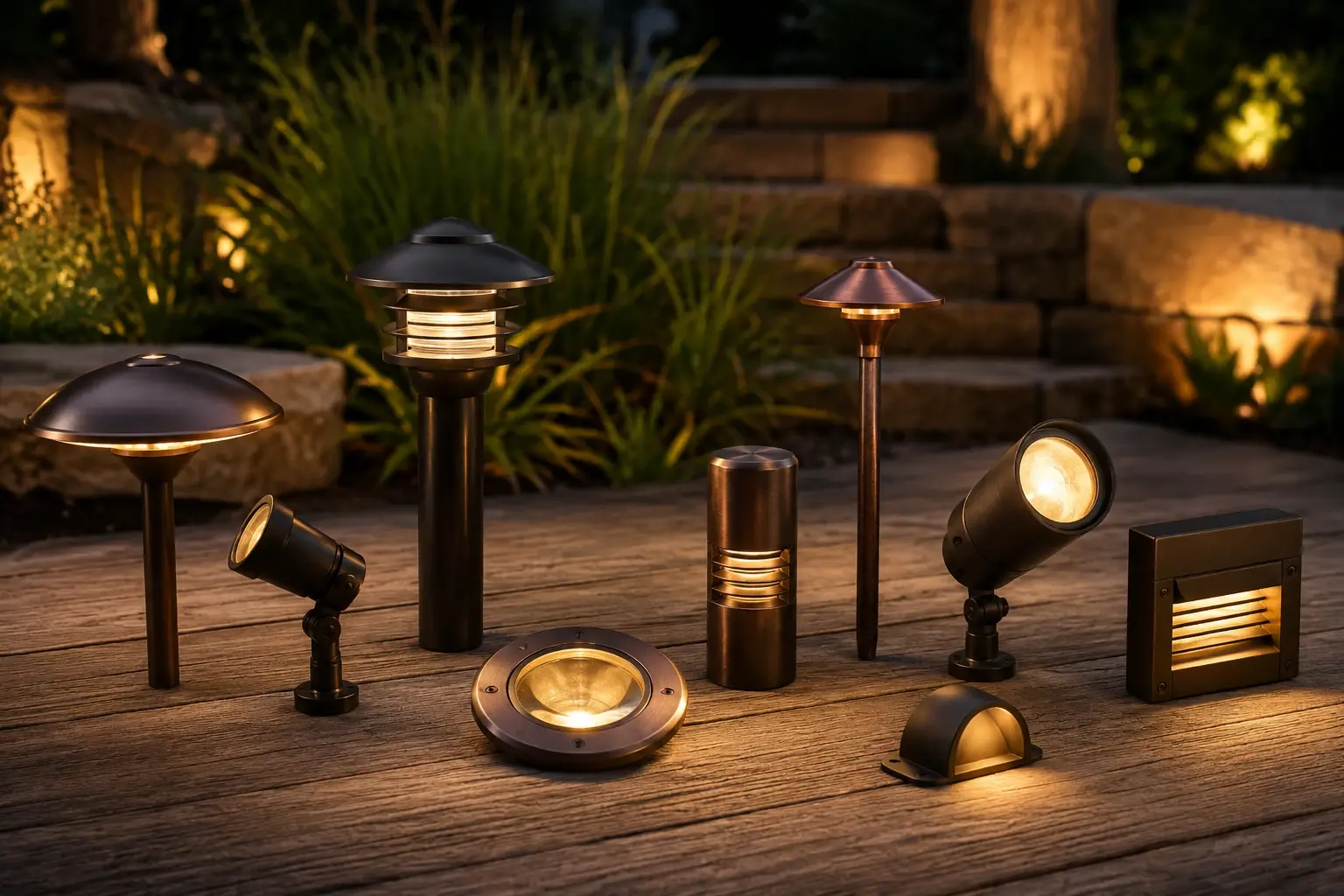
Solid brass or copper bodies with 2700K LED lamps or integrated LED modules rated for enclosed fixtures and high ambient temperature. Brass develops a dark patina within a year and then lasts for decades. Aluminum pits and plastic cracks in Austin heat, so we do not install them.
Voltage Drop in Practice
| Run length (12 gauge) | LED load on run | Approximate drop | Our approach |
|---|---|---|---|
| 50 feet | 60 W | Under 0.5 V | Single run, 12 V tap |
| 100 feet | 60 W | About 1 V | Hub at end, 13 V tap |
| 150 feet | 90 W | Around 2 V | 10 gauge home run or second transformer |
| 200 feet | 120 W | 3 V or more | Second transformer near fixtures |
Figures are planning approximations. The transformer calculator lets you test your own fixture counts and distances, and this guide helps estimate how many fixtures a property needs before sizing the system.
Austin-Specific Installation Notes
Caliche and rock. Trenching in Central Texas is slow and sometimes requires a rock bar or trenching machine. Where rock is shallow we route cable along bed edges and under mulch, protected by conduit where depth cannot be achieved.
Irrigation. Nearly every Austin bed has drip or spray irrigation. We locate lines before trenching and keep lighting cable separated from irrigation so future repairs to either do not damage the other.
Heat. Transformers mount in shade and fixtures use drivers rated for high ambient temperatures. Cheap electronics fail in their second Austin summer.
Tree roots. Live oak and cedar elm roots are shallow and valuable. Cable near trunks is hand-dug and routed around roots rather than through them.
Dark-sky and HOA. Low-voltage LED fixtures are inherently low output and easy to shield, which is why a well-designed 12V system is the dark-sky friendly choice compared with 120V floods. We specify 2700K throughout and provide layouts for HOA review when requested.
Installation Day and Beyond
After your free on-site design consultation and written, no-surprise estimate, licensed and insured technicians arrive with the fixtures, transformer and cable for the full system. A typical day runs: mark irrigation and utilities, mount the transformer, trench and lay cable, set hubs and connections, place and wire fixtures, power up and test voltage at every fixture, back-fill and restore mulch and turf. Most residential systems are complete by late afternoon, and we return after dark to aim each fixture and set the timer. Every system includes a 2-year workmanship warranty from Austin Landscape Lighting plus manufacturer warranties on fixtures and the transformer. The planning range above is a planning figure, not a quote.
Build It Right Underneath
Low voltage landscape lighting Austin properties can rely on for twenty years is mostly invisible: the right transformer, the right cable, the right connections, buried properly. Austin Landscape Lighting builds that foundation on every project. Call +1 (281) 704-7210 or request your free design consultation to get started.
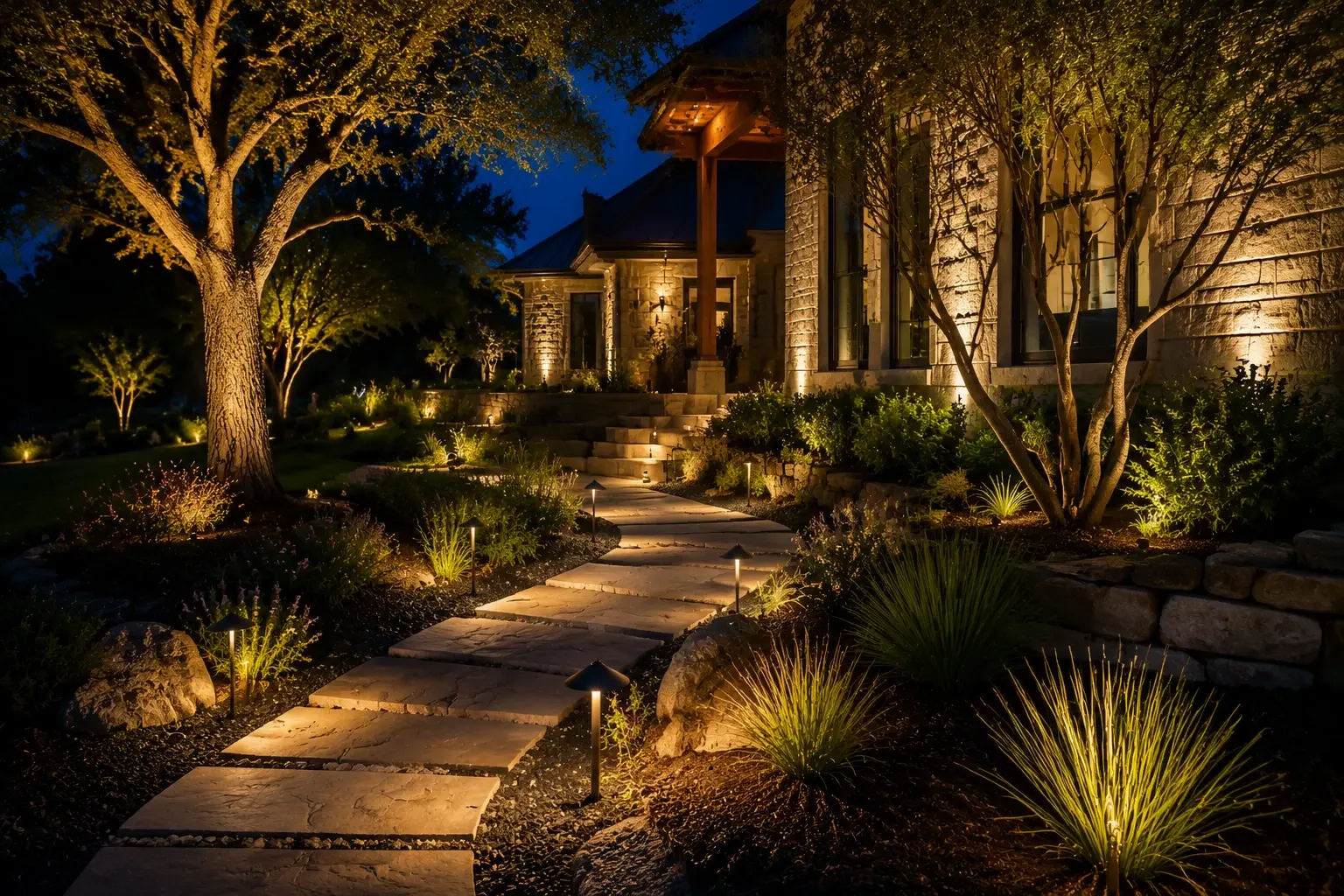
Recent low-voltage lighting installation work
Low-Voltage Lighting Installation FAQ
Is low-voltage landscape lighting safe for children and pets?
Yes. The system runs at 12 volts, which cannot deliver a harmful shock, and LED fixtures stay cool enough to touch. The transformer plugs into a GFCI-protected outlet, cable is buried in beds and fixtures are solid brass. It is dramatically safer than 120-volt outdoor fixtures and is the standard for residential landscape lighting.
How deep is the cable buried?
Low-voltage cable is buried about 6 inches deep in planting beds and deeper where it crosses turf, with conduit sleeves under driveways, walkways and anywhere digging is likely. In shallow caliche where that depth is not possible we protect the cable with conduit and route it along bed edges under mulch.
What size transformer do I need?
Add up the wattage of all fixtures, then choose a transformer so that load falls between about 40 and 80 percent of its rating. A 25-fixture LED system drawing 150 watts fits a 300-watt unit well. Long runs or large properties often do better with two smaller transformers placed near the fixture groups.
Does the system need an electrician?
Only if a new outdoor GFCI outlet is required at the transformer location, which a licensed electrician installs. Everything on the 12-volt side, including the transformer mounting, cable, connections and fixtures, is installed by our licensed and insured technicians. Most homes already have a suitable outlet in the garage or on an exterior wall.
Can a low-voltage system be expanded later?
Yes, when it is designed for it. We size the transformer with headroom and route cable with future zones in mind, so adding backyard trees or a patio layer later means connecting to capacity that already exists. Expansions are common and are one reason we document hub and connection locations on your plan.