
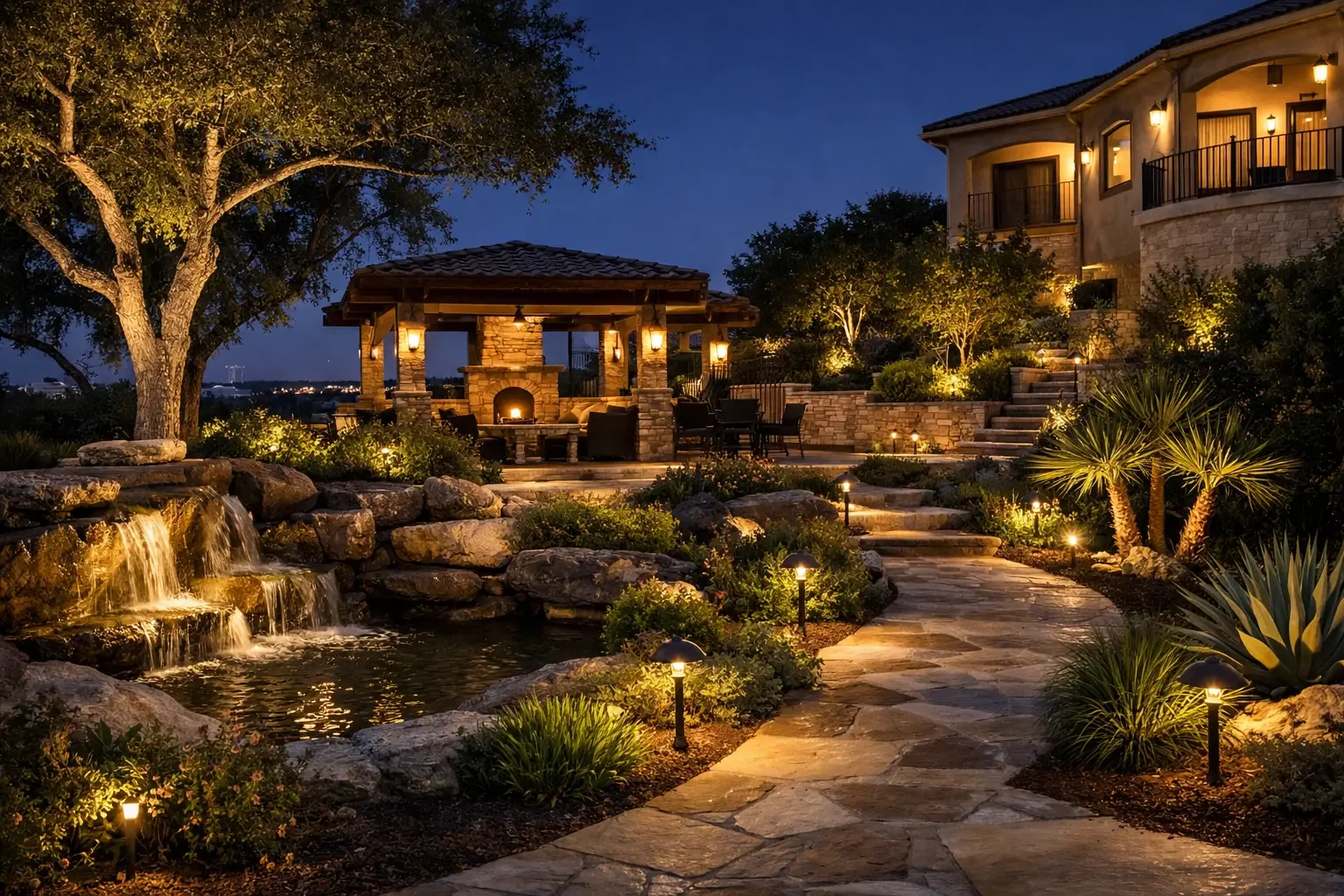
- No runway effect, staggered placement
- Shielded hats, zero glare
- Step and stair lights included
- Mower-safe fixture positioning
Why Walkways Deserve More Than a Row of Stakes
Picture a guest arriving at a Westlake Hills home at 8:30 on a December evening. The driveway drops toward the garage, the front walk curves around a live oak, and three limestone steps rise to the porch. Without lighting, every one of those transitions is a guess. With a row of identical stakes every four feet, the walk is lit but looks like an airport taxiway. The path lighting Austin TX homeowners actually want sits between those extremes: enough light to see every edge and change in elevation, placed so quietly that nobody thinks about the fixtures at all.
Path lighting is also the layer that carries the most liability. Trip-and-fall injuries happen on steps and at grade changes, and Hill Country lots have plenty of both. Austin Landscape Lighting treats walkway lighting as a safety system first and a design element second, which is why it is included in nearly every one of the 500+ projects we have completed since 2020.
Our Approach to Designing Path Lighting
Light the surface, hide the source
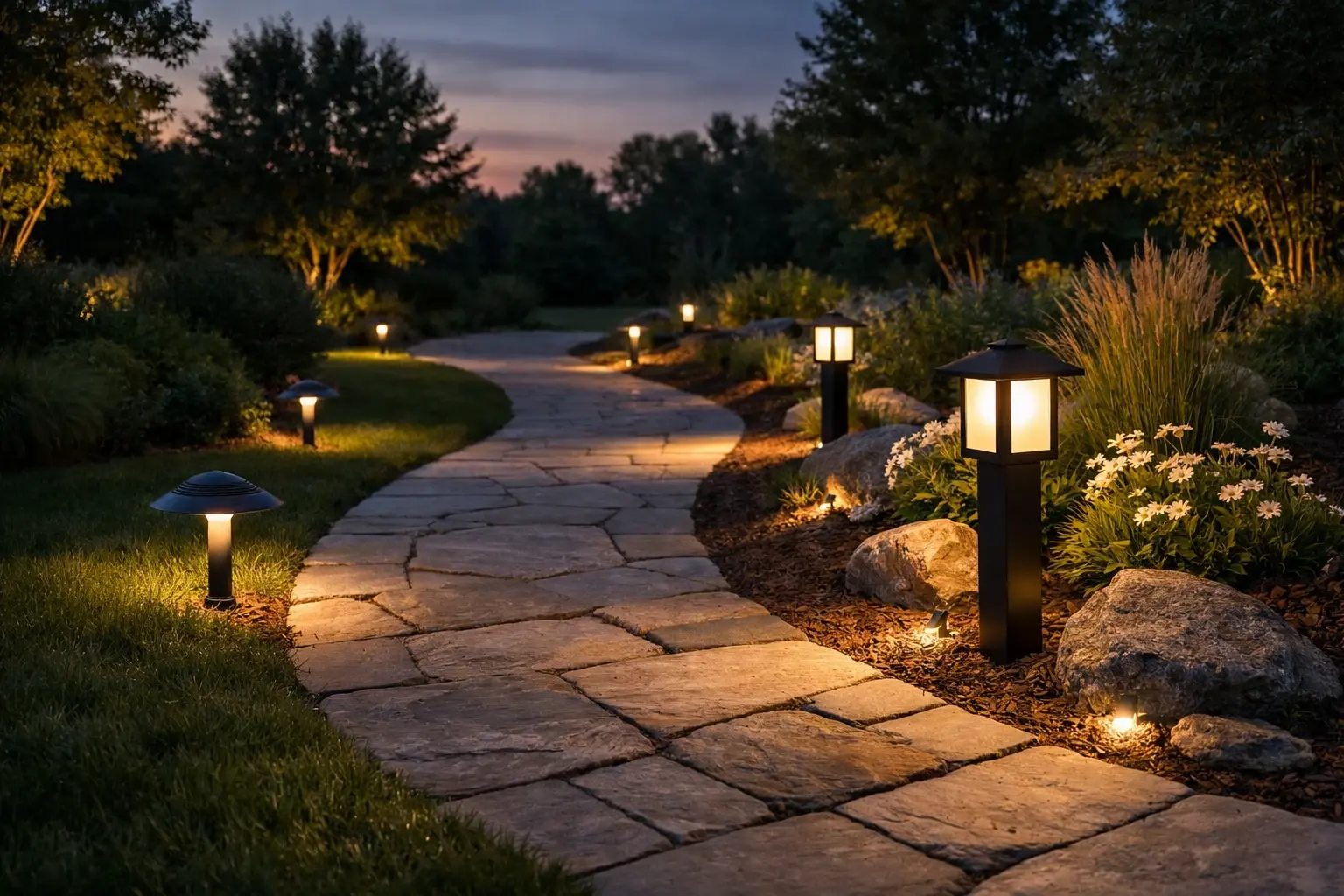
Every path fixture we install is fully shielded. The lamp sits under a brass or copper hat so you see a pool of light on the ground, not a glowing bulb. This matters for comfort, for dark-sky courtesy and for your eyes: a single unshielded path light can make the rest of the yard look darker than it is because your pupils adjust to the bright point.
Spacing by surface and situation
We do not space fixtures at a fixed interval. Instead we place them where the walk turns, where it narrows, where steps begin and end, and where a planting bed meets the paving. Alternating sides of the path breaks the runway look and lets each pool of light overlap slightly with the next. The table below shows the planning spacings we start from before adjusting for your specific layout.
| Situation | Fixture type | Typical spacing |
|---|---|---|
| Straight concrete or paver walk | 18 to 22 inch brass path light, staggered | 8 to 12 feet |
| Curving flagstone path | Path light at each bend plus midpoint | 6 to 10 feet |
| Limestone or concrete steps | Recessed step light or hardscape light under the tread lip | Every step or every other step |
| Driveway edge | Low bollard or well light at corners | 15 to 25 feet, corners first |
| Narrow side yard | Wall-mounted downlight on fence or house | 12 to 16 feet |
Fixture styles that fit Austin homes
- China hat and mushroom path lights in natural brass that patinas to a dark bronze within a year.
- Hardscape lights that mortar into limestone retaining walls and under step treads for an almost invisible source.
- Low bollards for driveways and commercial walks where a taller light shaft is appropriate.
- Downlights mounted in trees or on eaves to light a path from above, often the cleanest solution under a live oak canopy.
Color temperature, lumens and wiring
Path lights run at 2700K and typically 100 to 200 lumens each, far less than people expect. The goal is a soft, even surface, and overlapping low-output pools beat a few bright ones every time. Fixtures connect to 12-gauge direct-burial cable with waterproof connectors and run back to a stainless transformer with a photocell and astronomical timer. Because path runs are long and spread out, we size the cable and split circuits to keep voltage drop under one volt at the farthest fixture. The transformer calculator shows how fixture count and run length interact if you want to understand the sizing.
Austin Considerations We Design Around
Terrain and grade changes. Few Austin lots are flat. Steps, terraced beds and sloped drives are the norm from Bee Cave to Georgetown, and every grade change gets its own fixture rather than relying on light spilling over from the walk.
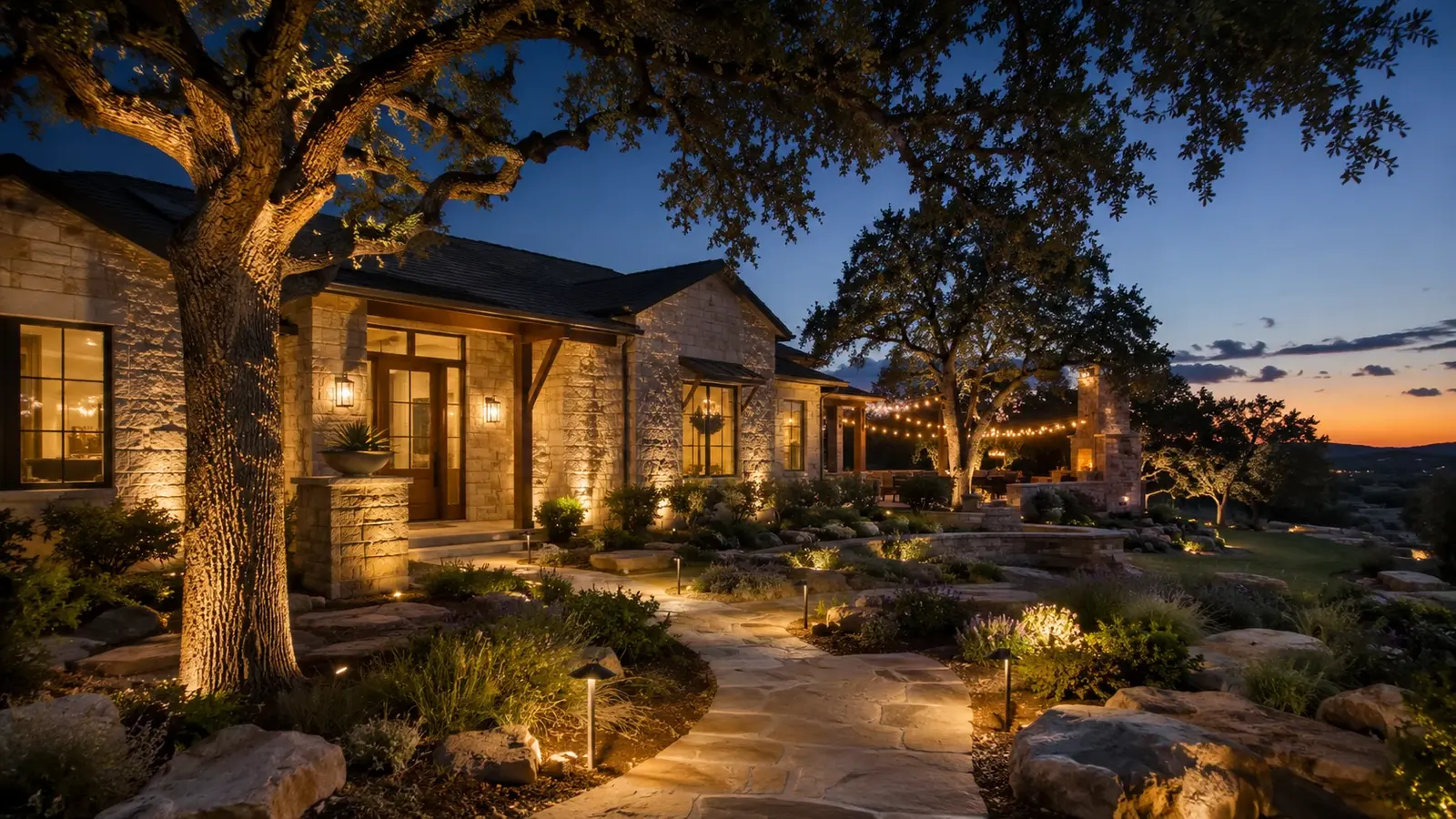
Live oaks and leaf litter. Live oaks drop leaves in spring and acorns in fall, and either can bury a low path light. We set fixture height with the canopy in mind and often recommend one or two tree-mounted downlights where a path passes under heavy cover. Our garden and tree lighting page covers that technique.
Mowing and string trimmers. Fixtures placed in turf get hit. We position path lights inside bed edges whenever possible and use heavy brass stems that survive a glancing blow when turf placement is unavoidable.
Deer. In Lakeway, Rollingwood and Dripping Springs, deer walk the same paths you do. They rarely damage brass fixtures, but they do knock plastic ones over, which is one more reason we do not install them.
Dark-sky and HOA guidance. Fully shielded path lights at 2700K with modest output are about as dark-sky friendly as outdoor lighting gets. Light goes down, not out or up. HOAs across the region accept this approach, and we provide a layout drawing when a committee requests one.
What the Project Looks Like
It starts with a free on-site design consultation. We walk every route you use after dark, from the driveway to the trash cans to the back gate, and note each step and turn. You receive a written, no-surprise estimate that lists fixtures by location. Installation is handled by licensed and insured technicians and most residential path lighting projects are completed in one day, including trenching, wiring and timer setup. We return after dark to confirm overlap between pools of light and adjust any fixture that is too bright or too dim.
Everything carries a 2-year workmanship warranty from Austin Landscape Lighting on top of the manufacturer warranties on fixtures and the transformer. Brass path lights routinely last decades; the LED modules inside are rated for 40,000 hours or more, which at six hours a night is roughly eighteen years.
Planning ranges for path lighting Austin TX projects depend mostly on linear footage and the number of steps. A straightforward front walk might sit at the low end of the range above, while a full perimeter path with multiple stair runs sits higher. Our article on how many landscape lights you need is a helpful read before your consultation.
Let Us Light the Way
Walkway lighting is the part of a landscape lighting system that your family and guests will use every single night. Austin Landscape Lighting designs it to be safe, subtle and durable, with brass fixtures and buried wiring that will outlast the plants around them. Call +1 (281) 704-7210 or schedule a free design consultation and we will map out every path on your property.
Recent path & walkway lighting work

Path & Walkway Lighting FAQ
How far apart should path lights be placed?
As a planning figure, 8 to 12 feet apart on a straight walk, staggered from side to side, with closer spacing on curves and at steps. Fixed intervals create a runway look, so we place fixtures where the path changes direction or elevation and then fill gaps so the pools of light overlap slightly.
Are path lights bright enough to be safe on steps?
Path lights alone are not the right tool for steps. We add recessed step lights or hardscape lights under the tread lip so each riser is visible from above. On limestone steps that light is mortared in and nearly invisible by day. This combination is what makes a sloped Austin walk safe at night.
Will the fixtures survive my lawn crew?
Brass and copper path lights on heavy stems handle incidental contact from mowers and trimmers far better than aluminum or plastic. We also place fixtures inside bed edges wherever we can so equipment never reaches them. Any fixture damaged by our installation workmanship is covered for 2 years.
Can path lighting be added to my existing landscape lighting system?
Usually, yes. We check the capacity of your current transformer and the condition of the cable, then extend or add a circuit for the path run. If the existing transformer is undersized or the cable is failing, your written estimate will show both the add-on option and a replacement option so you can choose.
What does path lighting cost in the Austin area?
Most residential path lighting projects fall within a planning range of roughly $1,800 to $4,800 depending on linear footage, the number of steps and whether a new transformer is needed. These are planning figures rather than quotes. Your written estimate after the free on-site consultation is exact and has no surprise add-ons.