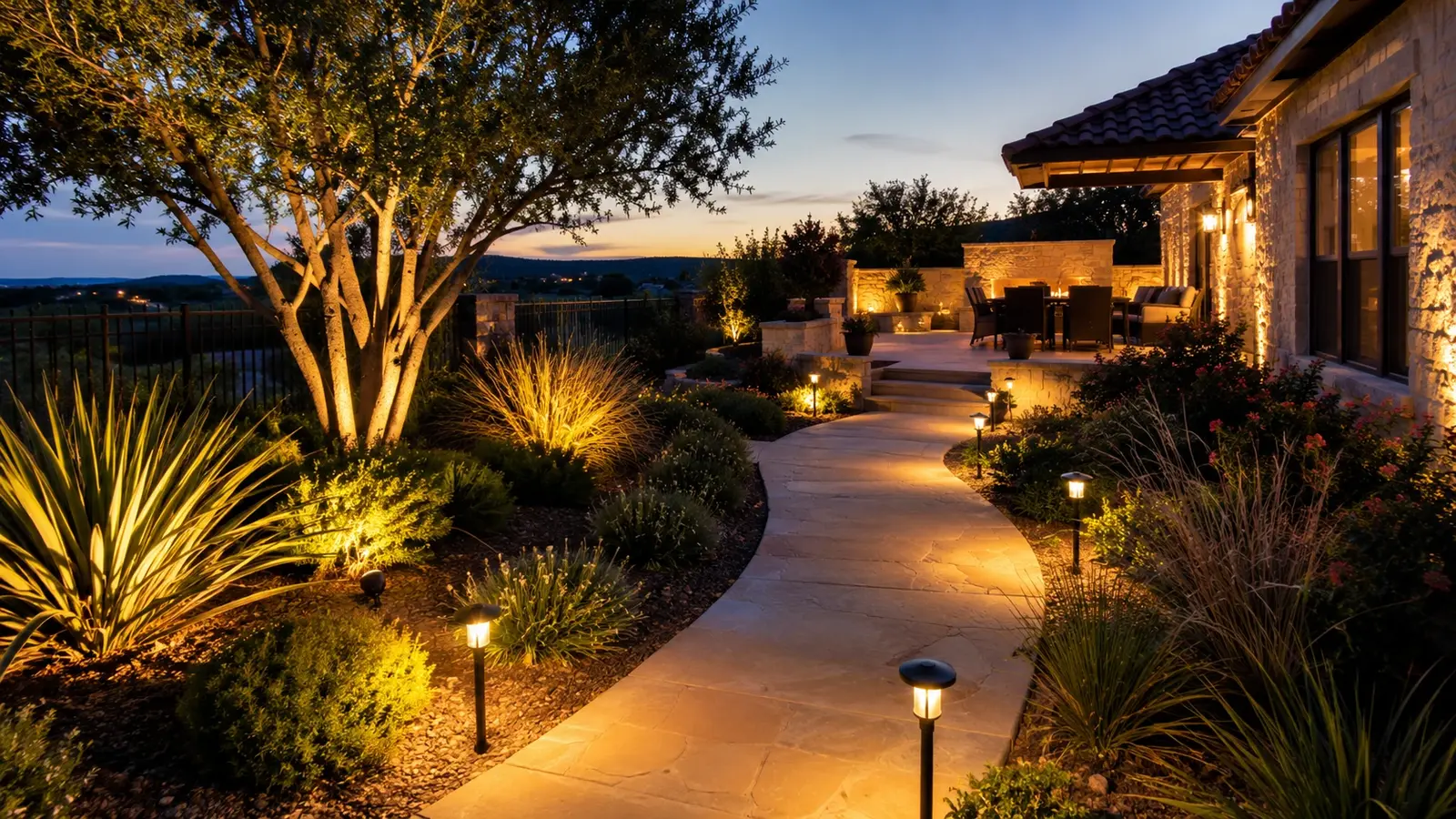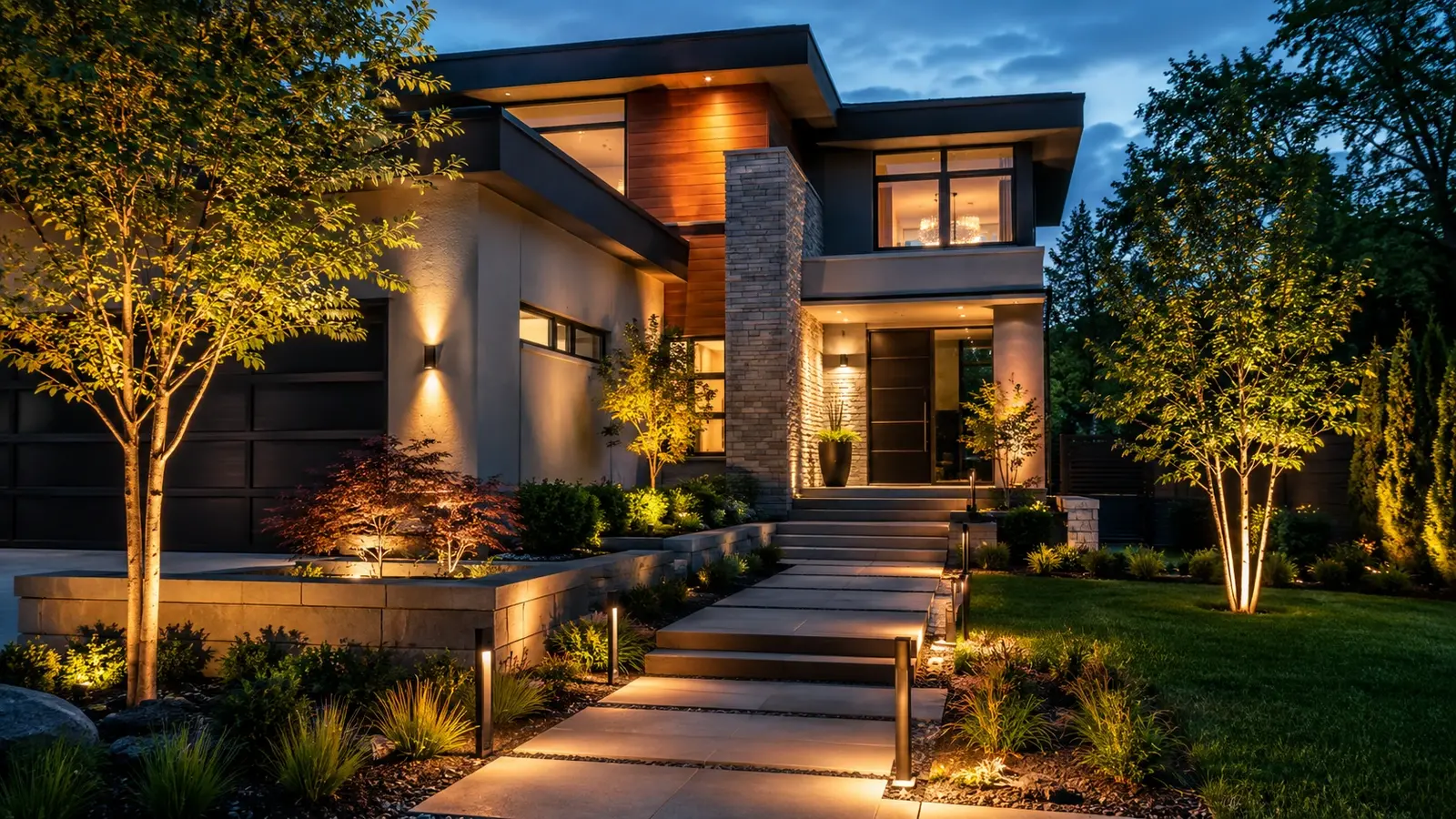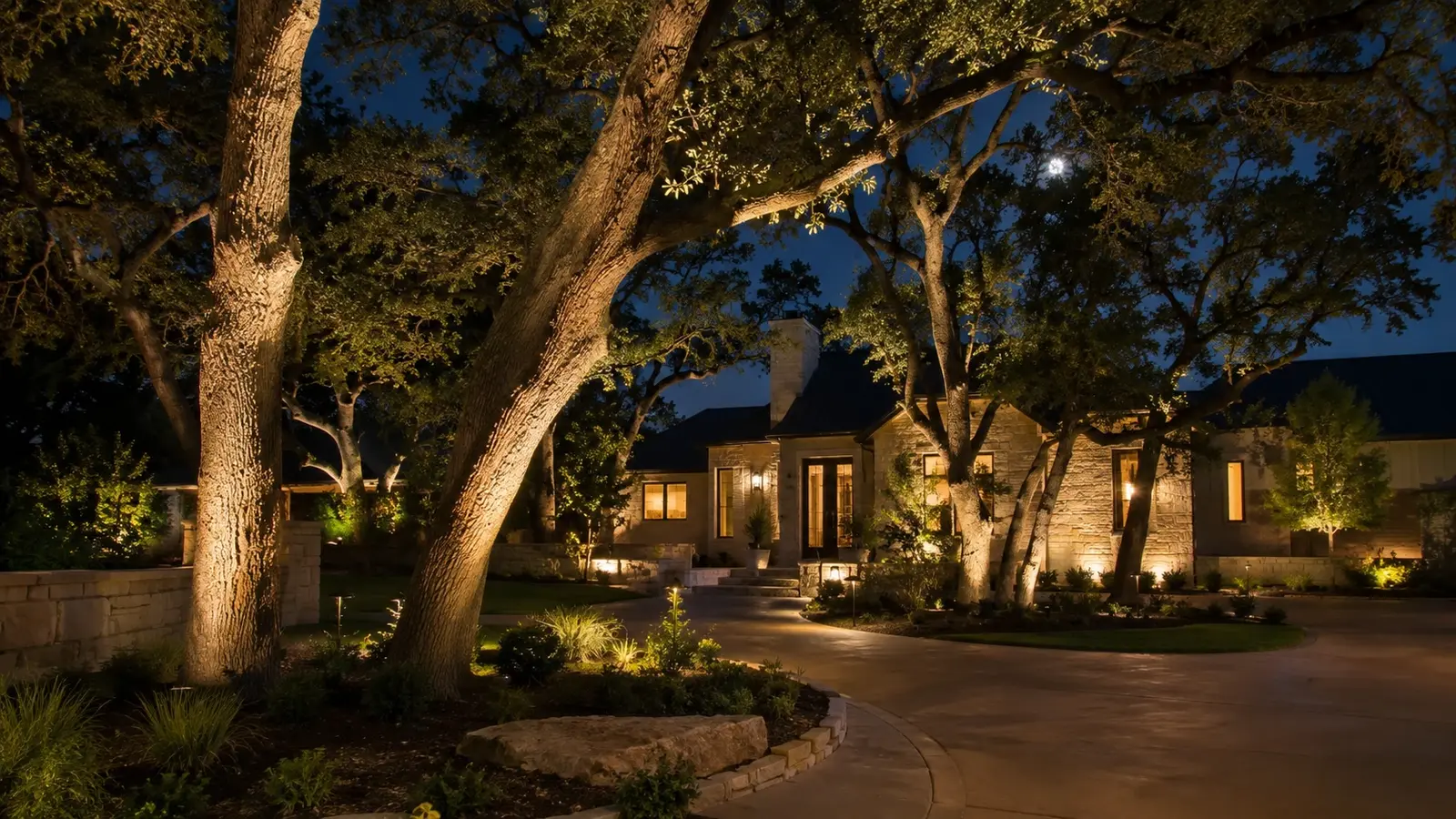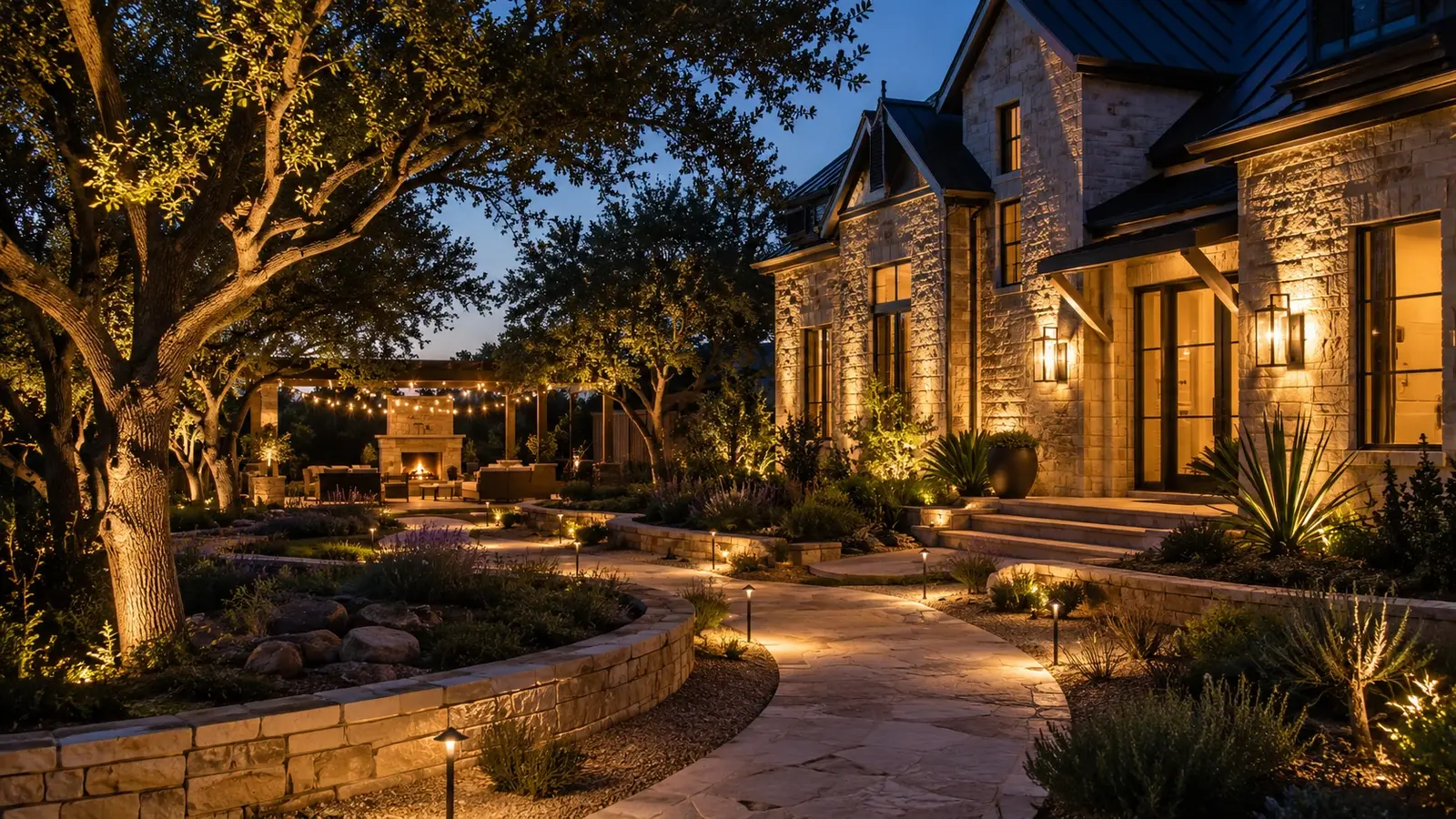
Great outdoor landscape lighting ideas share a few traits: they put light on something worth seeing, they hide the fixture, and they use warm 2700K color so stone and foliage look natural. The ideas below are organized by area of the property, from the front facade to the back fence, with the technique, fixture type, and placement that make each one work. Most are drawn from projects Austin Landscape Lighting has completed across Central Texas, where live oaks, limestone, Hill Country slopes, and long warm evenings shape what looks good. Pick the ideas that fit your yard, and remember that a dozen deliberate fixtures almost always beat two dozen scattered ones.
Facade and Entry Ideas
1. Graze the stone
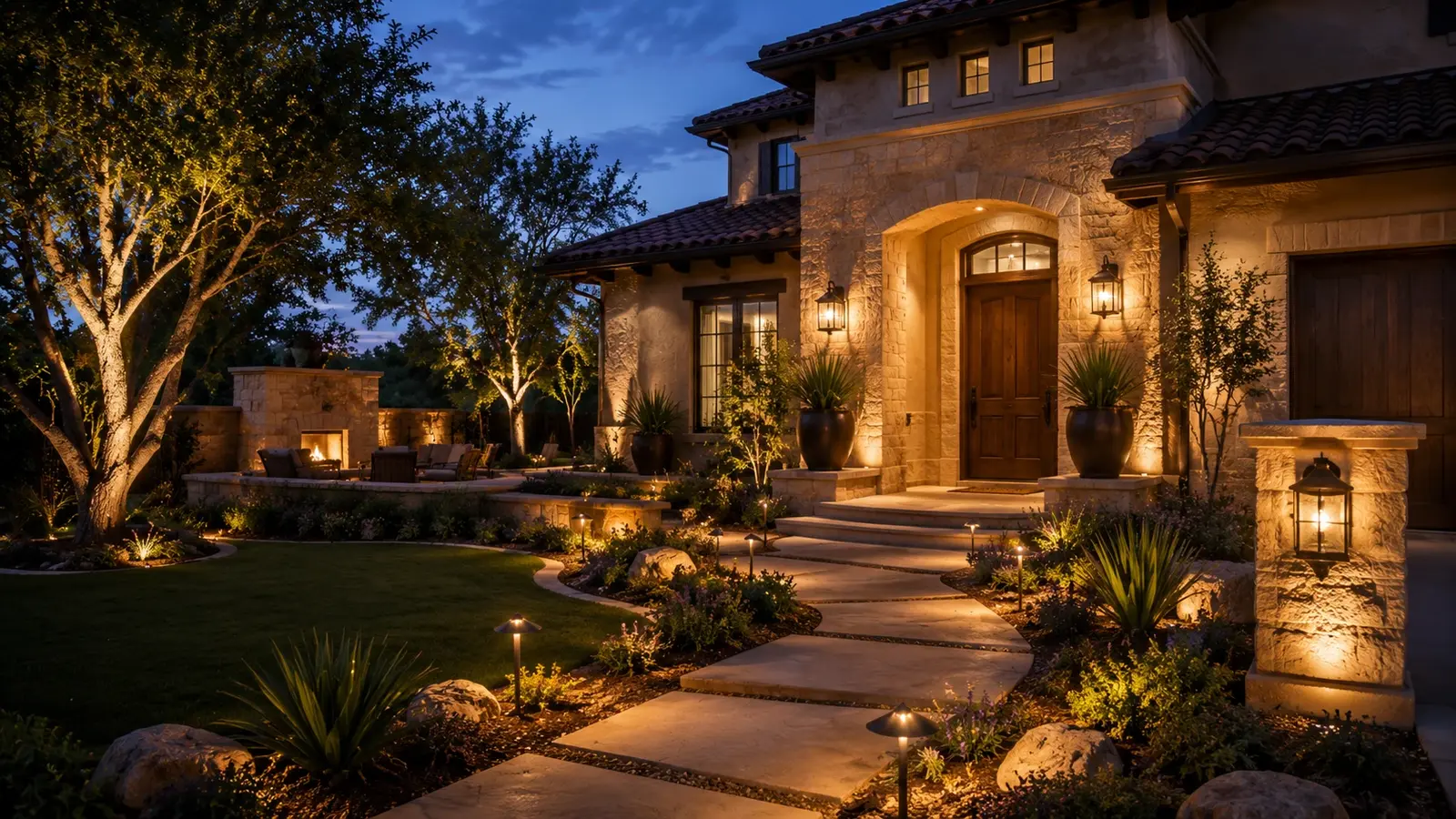
Austin stone and chopped limestone have deep texture that disappears at night. Set a brass well light or shrouded uplight 8 to 12 inches from the base of the wall, aimed straight up with a 45 to 60 degree spread, and every joint and face casts a shadow. Space fixtures 6 to 8 feet apart along the wall for even coverage.
2. Frame the entry with column uplights
A 15 degree spot at the base of each porch column draws the eye to the front door. Keep the beam tight so it stays on the column and does not spill onto the ceiling.
3. Downlight the porch ceiling
Small recessed or surface-mounted downlights in the porch ceiling wash the entry door and welcome mat without glare. Dim them to 50 percent so they do not compete with the facade.
4. Highlight gables and dormers
A narrow 15 degree spot aimed at a gable peak or dormer adds height to a single-story home and creates a focal point above the roofline. Shield it carefully so no light escapes above the roof.
Path and Walkway Ideas
5. Stagger path lights
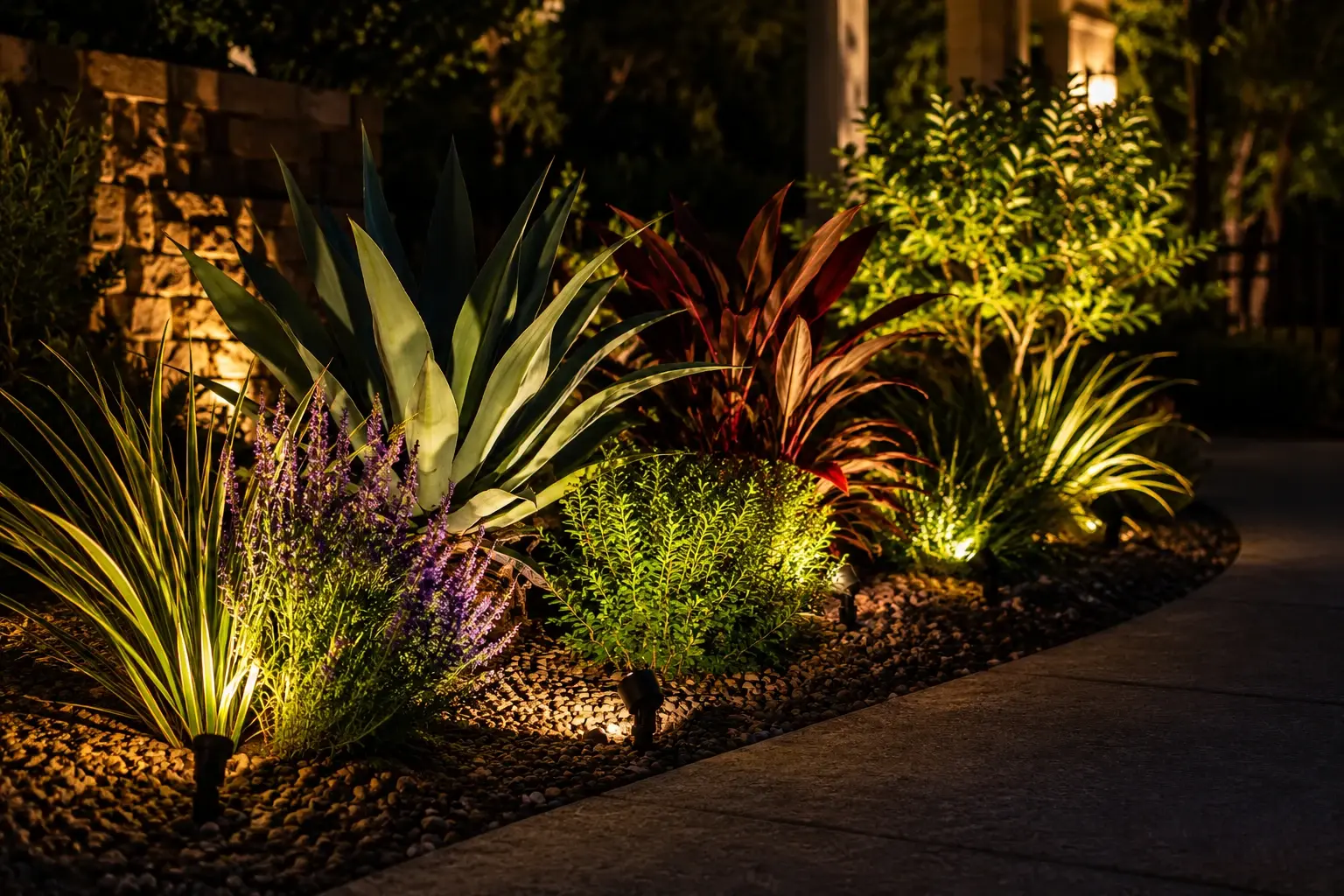
Place 18 to 22 inch brass path lights every 6 to 8 feet, alternating sides of the walk, 12 to 18 inches back from the edge. Pools of light should just touch. This is the opposite of the runway effect.
6. Light the walk from above
Where a walkway passes under a live oak or a pergola, a downlight mounted 10 to 20 feet up replaces several path lights with a single soft pool. Fewer fixtures in the beds, less to trim around.
7. Use bollards on modern homes
Low cylindrical bollards with downward louvers suit contemporary architecture better than traditional hat-style path lights. Space them wider, 8 to 10 feet, since they cast a broader pool.
8. Mark the driveway edge
Short, sturdy path lights or recessed in-grade markers along a long Hill Country driveway guide guests and protect the lawn edge from tires. Keep them low and shielded for dark-sky compliance.
Tree Ideas
9. Cross-light a live oak
Multi-trunk live oaks need two or three uplights at the drip line edge, each with a 30 to 38 degree flood at 400 to 900 lumens, aimed from different angles. One beam flattens the tree; three reveal it.
10. Spot a cedar elm or cypress
Tall, narrow trees want a single 15 degree spot placed 2 to 3 feet from the trunk. The beam climbs 30 feet or more and lights the canopy from below.
11. Moonlight from the canopy
Mount two or three fixtures 20 to 30 feet up in a mature oak or pecan, aimed down through the branches with a 60 degree spread. The dappled shadow pattern on the lawn is the most natural effect in landscape lighting and the best ambient layer for a yard.
12. Silhouette a specimen against a wall
Place a fixture behind a yucca, agave, or Japanese maple and aim it at the wall. The plant becomes a dark sculpture against a warm glow.
Our landscape lighting ideas for trees post goes deeper on each species common to Austin.
Patio and Outdoor Living Ideas
13. Downlight the dining table
A fixture in a pergola beam or nearby tree aimed at the table gives enough light to eat by without a glaring overhead. Dim to taste with an app-controlled zone.
14. Light the grill and counters
Task lighting under an outdoor kitchen counter overhang or a small downlight above the grill makes cooking safe after dark. Keep it on its own zone so it can go off when dinner is done.
15. Wash a privacy hedge
A 60 degree flood 4 to 6 feet from a hedge or fence creates a lit backdrop that makes the patio feel enclosed and larger at the same time.
16. Underlight built-in seating
LED strip or small hardscape lights tucked under the cap of a stone bench or fire pit wall float the seating and light the floor without any visible source.
Pool and Water Feature Ideas
17. Light the pool surround, not just the water
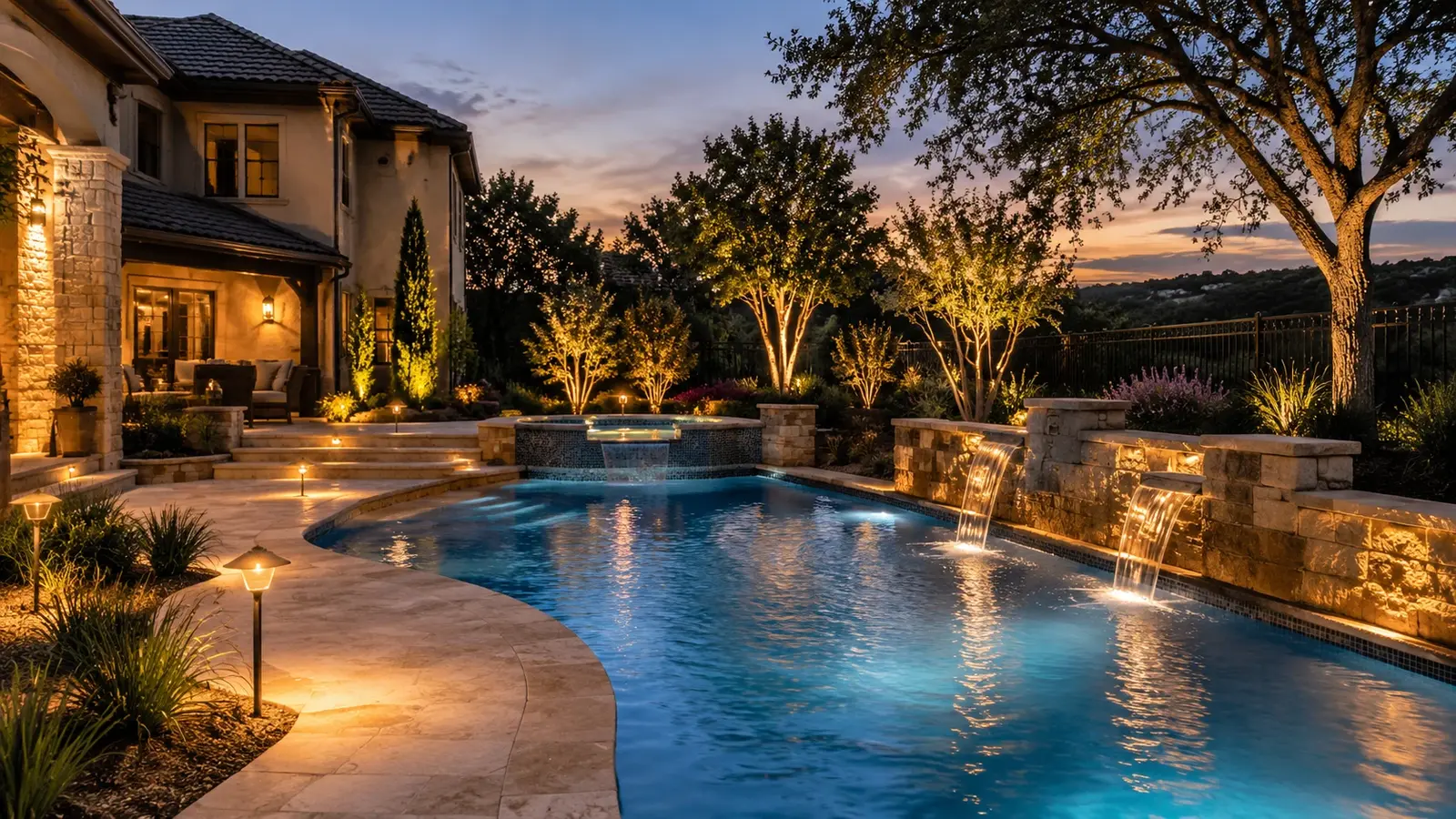
Submersible pool lights do their job, but the surrounding landscape needs its own layer. Uplit palms or oaks behind the pool reflect in the water and double the effect.
18. Underwater fountain and spillway lights
Small submersible 12V fixtures at the base of a spillway or fountain make moving water sparkle. Aim them up through the stream, never at the viewer.
19. Hardscape lights on the coping
Recessed lights under the pool coping edge or along a raised spa wall mark the water's edge for safety and add a continuous warm line.
20. Moonlight over the pool
Downlighting from a nearby tree creates soft, reflected light on the surface and avoids the harshness of pool lights alone. Details are in our landscape lighting ideas for pools guide.
Steps, Walls, and Slope Ideas
Hill Country grade changes make step and wall lighting a safety requirement, and the table below summarizes the fixture choices that work best for each situation.
| Situation | Fixture and technique | Placement | Note |
|---|---|---|---|
| Stone steps, 3 to 6 treads | Recessed step lights with louvers | One per tread or every other tread, in the riser | Light the tread, not the eye |
| Long flight on a slope | Hardscape lights under cap stones plus a downlight | Every 4 to 6 ft along the side wall | Add a downlight from a tree if available |
| Retaining wall, textured | Grazing with 60 degree flood | 8 to 12 in from base, every 6 to 8 ft | Austin stone and limestone excel here |
| Retaining wall, smooth | Hardscape lights under cap | Every 4 to 6 ft under the cap stone | Washes the face downward with no glare |
| Seat wall or planter | Hardscape strip or puck lights under cap | Continuous or every 3 to 4 ft | Doubles as patio ambient light |
| Terraced beds | Low path lights plus uplit specimen plants | Path lights at terrace edges, uplights at plants | Layer so each level reads separately |
| Driveway grade change | In-grade markers or low bollards | Both sides every 8 to 10 ft | Shield for dark-sky compliance |
Garden Bed and Plant Ideas
21. Uplight ornamental grasses
Gulf muhly, Mexican feather grass, and Lindheimer muhly glow when uplit from the base with a 36 degree spread. The seed heads catch light and move in the breeze.
22. Backlight agave and yucca
Architectural desert plants common in Austin xeriscapes look best silhouetted or backlit so their sharp outlines show. A fixture placed behind and slightly to one side does it.
23. Soft wash on foundation plantings
A low 60 degree wash across dwarf yaupon or Texas sage keeps the base of the house from reading as a dark band beneath a lit facade. Keep the lumen level low so the facade stays the hero.
24. Light a garden sculpture or boulder
A single 30 degree uplight on a limestone boulder or a piece of garden art gives the back corner of a yard a destination.
Seasonal and Occasional Ideas
25. Add color-changing lamps for holidays
RGBW lamps in existing brass fixtures let you switch the facade to orange in October, red and green in December, and burnt orange for a game day, then back to 2700K warm white the rest of the year. No extra fixtures or string lights.
26. Light the fall color
Austin's cedar elms, Texas red oaks, and Mexican sycamores turn in November. An uplight that is modest in summer becomes spectacular for a few weeks when the leaves change.
27. Create a summer night garden
Night-blooming plants such as moonflower, four o'clocks, and white-flowered datura show up beautifully under soft moonlighting. Plan a bed near the patio specifically for after-dark viewing during the long warm season.
Smart Scene Ideas
28. Set an arrival scene
Program the front facade, path, and driveway to full brightness from sunset until 11 p.m., then drop the facade to 30 percent and leave the path on until midnight. An astronomical timer or app controller adjusts the sunset time automatically through the year.
29. Build an entertaining scene
Patio, pool, and back trees at 100 percent, front yard at 50 percent, dining table downlight dimmed to 40 percent. One tap when guests arrive.
30. Run a late-night security level
After midnight, dim everything to 20 percent except the path to the trash cans and a soft wash on the garage. Enough to see and deter, low enough for dark-sky and HOA compliance. Our smart lighting systems make these scenes simple to program and change.
Principles That Tie the Ideas Together
Whichever ideas you choose, a few constants keep the result cohesive. Use 2700K warm white throughout. Choose solid brass or copper fixtures that survive Austin heat and deer. Hide every source with shrouds, louvers, and smart placement. Build a hierarchy with one hero element and progressively quieter layers. Size the transformer with 20 percent headroom and use hub wiring to avoid voltage drop on long Hill Country runs. Shield fixtures so no light escapes above horizontal. And test at night before burying cable, because every idea above looks different in the dark than on paper.
Austin Landscape Lighting has brought most of these outdoor landscape lighting ideas to life on properties across Central Texas, and we are glad to show you which ones suit your yard with a free on-site consultation and night demonstration. Call +1 (281) 704-7210 or contact us online.
Frequently asked questions
What are the most effective outdoor landscape lighting ideas for a small front yard?
Focus on three layers: graze or uplight the facade, stagger path lights every 6 to 8 feet along the walk, and uplight one specimen tree as the focal point. Eight to twelve brass fixtures at 2700K on a 150 watt transformer usually covers a small front yard. Restraint matters more than fixture count, and hiding every source keeps the result looking professional.
How do you light a backyard patio without glare?
Light from above and below rather than at eye level. Downlight the dining table from a pergola beam or tree, tuck hardscape lights under seat wall caps, and wash a hedge or fence behind the seating for a soft backdrop. Put the patio on its own dimmable zone so it can run at full brightness for dinner and 30 percent for a quiet evening.
Can landscape lighting change color for holidays?
Yes. RGBW lamps installed in standard brass fixtures let you switch the facade or trees to seasonal colors from an app, then return to 2700K warm white for everyday use. This avoids string lights and extra fixtures. Keep color changes to accent elements so the path and step lighting stays warm white for safety.
What is moonlighting in landscape lighting?
Moonlighting mounts fixtures 20 to 30 feet up in a mature tree, aimed down through the branches with a wide 60 degree spread. The result is soft, dappled light on the ground that mimics a full moon. Live oaks and pecans common in Austin are ideal hosts, and moonlighting is the most natural ambient layer available for patios, lawns, and pool areas.

Written by the design team at Austin Landscape Lighting. We design, install and maintain low-voltage LED landscape lighting across Austin and the Hill Country. Questions about your property? Book a free dusk consultation or call +1 (281) 704-7210.