
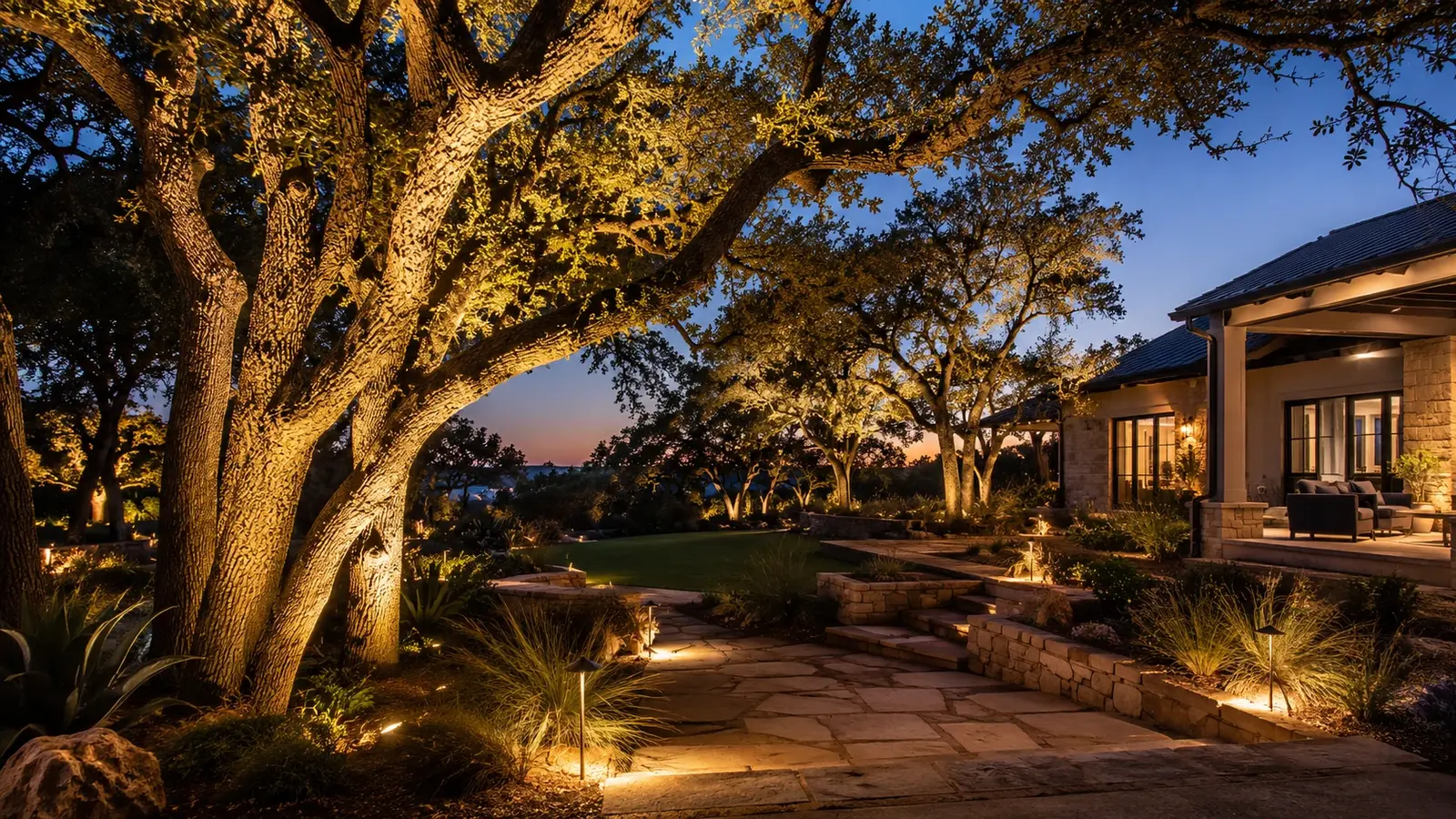
- Species-specific beam and output
- Moonlighting from the canopy
- Tree-safe stainless mounting
- Dark-sky friendly 2700K fixtures
Trees Are the Architecture of an Austin Yard
In most of the country, landscape lighting starts with the house. In Austin it often starts with the tree. A 60-year-old live oak with a 50-foot spread, a grove of cedar elms along a creek lot in Georgetown, a row of crape myrtles screening a Cedar Park driveway: these are the elements that define a property, and they are invisible at night without help. Tree lighting Austin homeowners ask for most is simply a way to keep enjoying those trees after dark, from the patio, the kitchen window or the street.
Garden lighting works alongside it. Agave rosettes, yucca spikes, Texas mountain laurel in bloom and the layered textures of a native bed all respond to light differently than the lawn and the walk, and a few well-placed accents make the whole landscape feel finished. Austin Landscape Lighting has lit several thousand trees across more than 500 projects since 2020, and this page explains how we approach it.
Techniques We Use
Uplighting the trunk and canopy
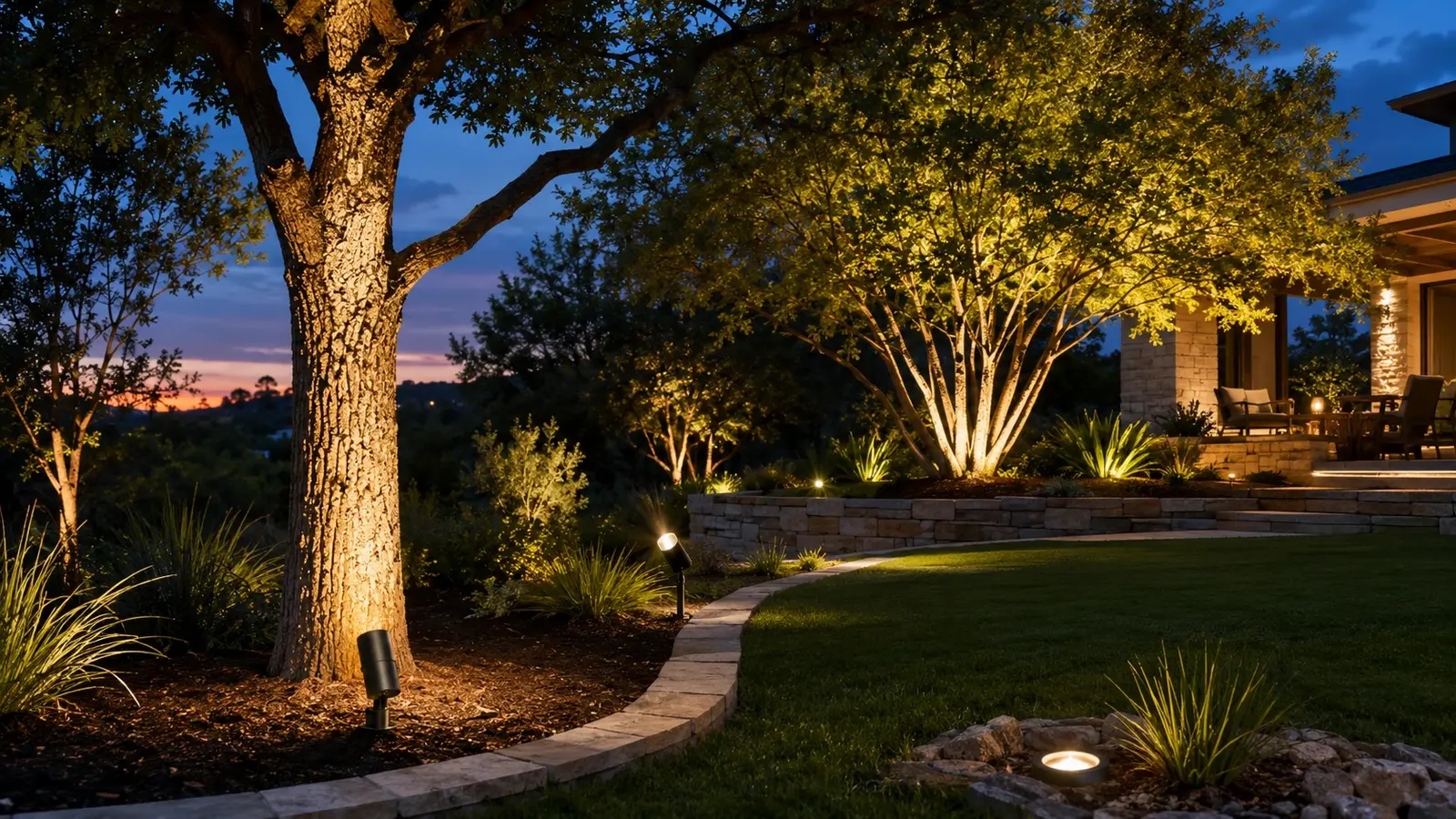
The classic technique sets one to three brass well lights or stake-mounted spots at the base of the tree, aimed up through the branch structure. The light catches the underside of the canopy and the texture of the bark, and the tree appears to glow from within. For a large live oak we typically use two or three fixtures at roughly 120-degree intervals so no side is flat, with 35 to 60 degree beam spreads and 400 to 900 lumens each depending on canopy size. A fixture directly against the trunk shows bark texture; a fixture 4 to 8 feet out reaches more of the canopy.
Moonlighting from above
Moonlighting mounts small shielded downlights 20 to 30 feet up in the tree, aimed down through the lower branches. The result mimics a full moon: soft, dappled light on the lawn, the patio or a path, with branch shadows moving gently in the breeze. It is the most natural-looking technique in landscape lighting and particularly effective under live oaks, whose dense horizontal branching casts beautiful patterns. We mount with stainless steel hardware and leave slack in the cable so the tree can grow without stress on the fixture or the wire.
Garden bed accents and silhouettes
Low-output spots, 100 to 250 lumens, highlight sculptural plants like agave, yucca and sotol. A fixture placed behind a specimen and aimed at a limestone wall produces a silhouette; a fixture in front, set low and close, produces shadow play on the wall. Small well lights flush with the mulch work for groundcover and ornamental grasses. For bedding areas we keep fixture count low and let darkness between accents do the work.
Matching Light to Austin Trees
- Live oak. Wide canopy, dark bark, evergreen. Two or three wide-beam uplights at 2700K plus one or two moonlights. The best tree in Texas to light.
- Cedar elm. Upright, finer texture, drops leaves in winter. One or two medium-beam uplights; the bare winter structure looks striking.
- Crape myrtle. Smooth mottled bark, multi-trunk. A single narrow spot on the trunks is often enough; summer blooms pick up the light.
- Texas mountain laurel. Dense and dark, glossy leaves. A low wide flood from the front; keep lumens modest so the leaves do not glare.
- Bald cypress and pecan. Tall and narrow. A 15 to 25 degree spot with higher output to reach the upper canopy.
- Palms and yucca. One narrow spot at the base aimed straight up gives a dramatic starburst in the fronds.
Color temperature stays at 2700K across nearly every species. It keeps green foliage from looking gray and matches the architectural and path layers so the yard reads as one scene. Our color temperature guide explains why cooler lamps make bark and leaves look washed out.
Austin Conditions That Shape the Design
Tree health comes first. We never drive hardware into the trunk of a live oak where oak wilt is a concern without sealing the entry point, and we prefer strap and standoff mounts where the branch structure allows. Fixtures at the base are set outside the root flare to avoid damaging surface roots in shallow Hill Country soil.
Caliche and rock. Trenching under a mature tree in caliche is slow and must avoid roots. We route cable along bed edges and use shallow, hand-dug runs near trunks.
Deer and wildlife. Low garden accents in Lakeway, Bee Cave and Dripping Springs get bumped by deer. Heavy brass fixtures with stable stakes stay aimed; plastic does not.
Dark-sky courtesy. Uplighting a tree inevitably sends some light upward, so we control it. Fixtures are shielded, aimed so the canopy catches the beam rather than open sky, kept at 2700K and switched off by timer late in the evening. Trees at the edge of a property line are lit from the inside so the beam stays over your lot. This is how tree lighting Austin HOAs and neighbors are comfortable with gets done, and we have never had an installation rejected on review.
Growth. Trees change. Uplights on adjustable stakes can be re-aimed as the canopy fills in, and our maintenance program includes re-aiming and trimming foliage that has grown in front of a fixture.
Timeline, Process and Warranty
Your free on-site design consultation is best scheduled in the hour before sunset, when we can identify which trees deserve attention and test a demonstration fixture on the most important one. You receive a written, no-surprise estimate listing each tree and each garden accent. Licensed and insured technicians install most residential tree and garden lighting in one day, with a return visit after dark to aim and adjust. Austin Landscape Lighting backs the work with a 2-year workmanship warranty, and brass fixtures carry long manufacturer warranties on top of that. Browse our project gallery to see what lit live oaks look like across the neighborhoods we serve.
Budget planning ranges run from a couple of specimen trees to a full property of canopy and bed lighting. Fixture count is the driver, and a single large live oak properly lit usually needs three to five fixtures including moonlights. These are planning figures rather than quotes.
Bring Your Trees Back After Dark
Your live oaks took decades to grow. Lighting them well takes one day. Austin Landscape Lighting will walk your property, show you what each tree can look like and give you a clear written estimate. Call +1 (281) 704-7210 or book your free design consultation today.
Recent garden & tree lighting work
Garden & Tree Lighting FAQ
How many fixtures does a large live oak need?
A mature live oak with a 40 to 60 foot canopy typically needs two or three wide-beam uplights spaced around the trunk plus one or two moonlights mounted in the canopy if you want light on the ground below. Smaller ornamental trees usually need one fixture. Your estimate lists the count for each tree.
Does mounting lights in a tree harm it?
Not when done properly. We use stainless steel hardware, strap or standoff mounts where the structure allows, seal any penetration on oaks because of oak wilt concerns, and leave cable slack so growth does not pull on fixtures or wiring. Base fixtures are kept outside the root flare to protect surface roots.
What is moonlighting and is it worth it?
Moonlighting places small shielded downlights high in the canopy and aims them down, producing soft dappled light and branch shadows on the ground like a full moon. Under a live oak it is the most natural effect available and doubles as path and patio lighting. Most clients who try one fixture ask for more.
Will tree uplighting bother my neighbors or violate dark-sky guidance?
We design to minimize it. Fixtures are shielded, aimed so the canopy absorbs the beam, limited to 2700K warm white and modest lumens, and set on a timer that shuts the system off late in the evening. Trees near a property line are lit from your side so light stays on your lot.
Can you light garden beds without lighting up the whole yard?
Yes, and restraint is the point. Low-output accents of 100 to 250 lumens on sculptural plants like agave, yucca and mountain laurel create focal points while the areas between stay dark. That contrast is what gives a garden depth at night. We usually recommend fewer fixtures than clients expect.