
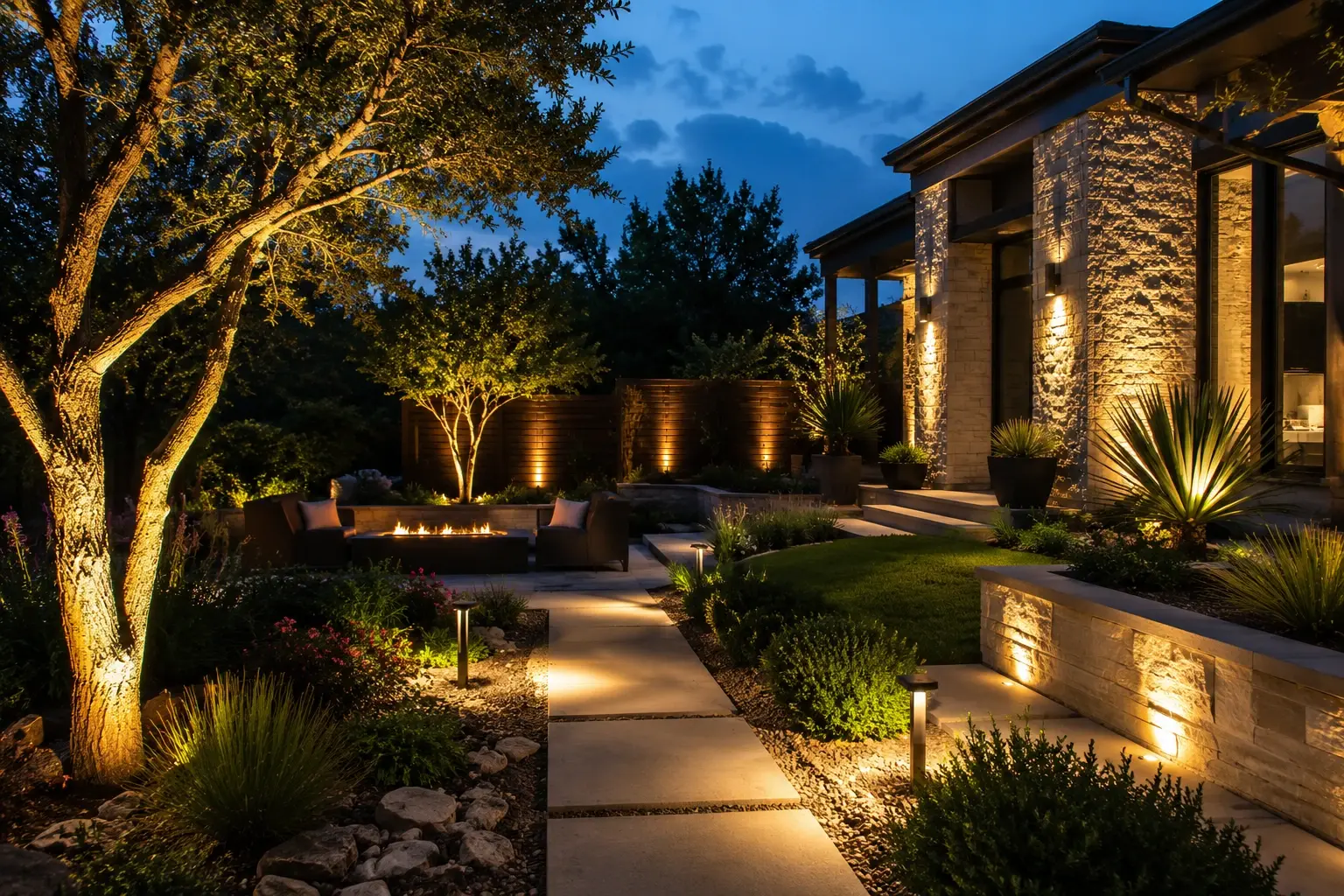
- App, voice and schedule control
- Independent dimmable zones
- Astronomical sunset timing
- Retrofits onto existing systems
What Smart Means for Landscape Lighting
For years the only control on a landscape lighting transformer was a mechanical dial timer that lost fifteen minutes every power blip and had to be reset twice a year for daylight saving. Smart control replaces that with a transformer or controller that knows the date, your location and tonight's sunset, connects to your home network, and lets you adjust everything from a phone. Smart landscape lighting Austin homeowners install today can split a property into zones, dim each one independently, run scenes for different occasions and respond to voice commands or a security system.
The practical benefits are larger than the novelty. A system that comes on at sunset every night, year round, without adjustment, is one you will actually use. Dimming the front elevation to 60 percent after 10pm saves energy and keeps neighbors happy. Being able to light the whole yard from bed when you hear a noise is worth more than any single fixture. Austin Landscape Lighting has been installing connected controls since 2020 and now recommends them on nearly every new system.
Components and How They Work Together
Smart transformers
The simplest path is a 12V transformer with built-in Wi-Fi or Bluetooth control. It replaces your existing unit in the same location, uses the same cable and includes an astronomical timer that calculates sunset for Austin's latitude every day. Most models offer two or more independently switched outputs, which is enough to separate the front yard from the back.
Zone controllers and dimmers
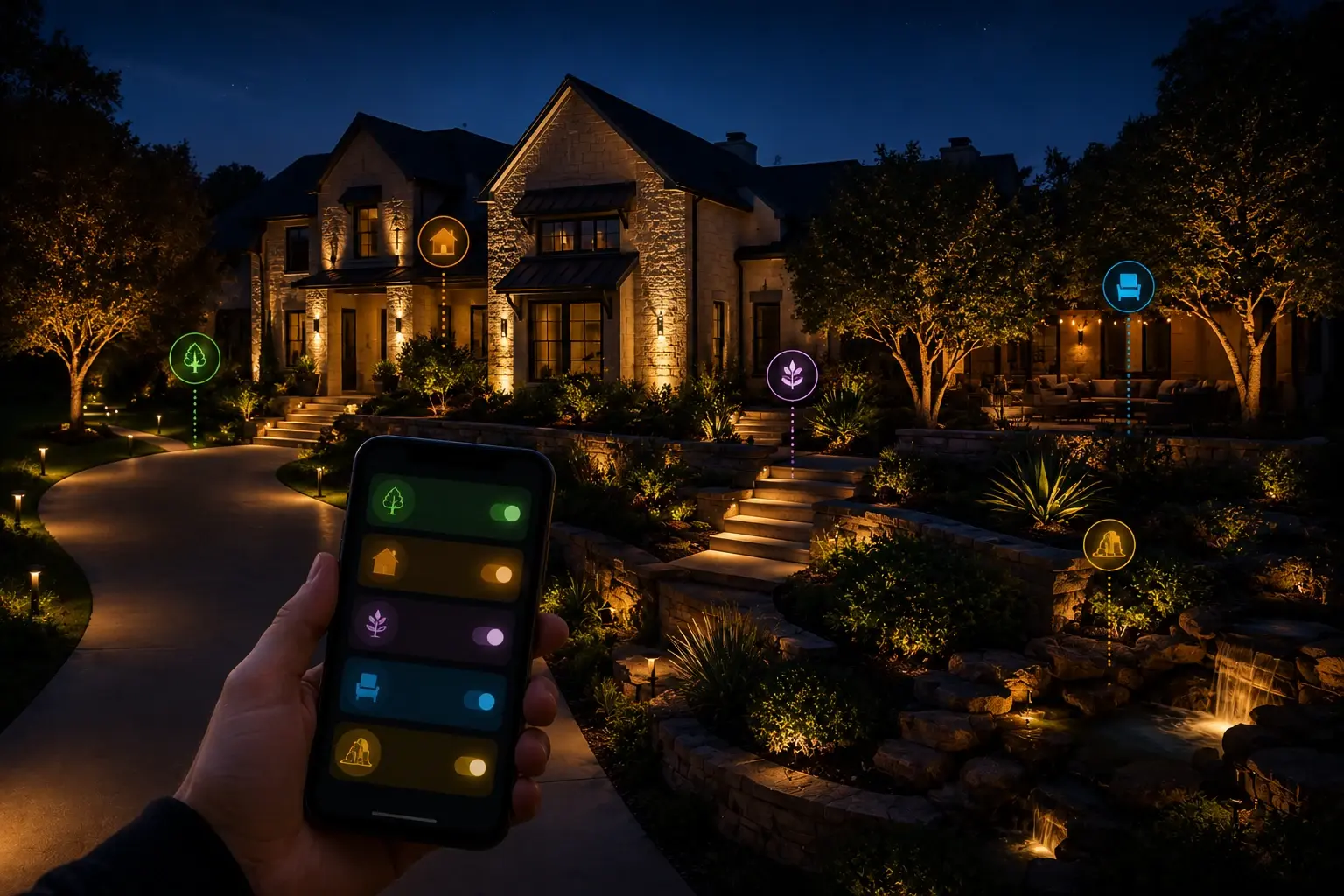
For finer control we add a low-voltage zone controller between the transformer and the fixture circuits. Each zone can be switched and dimmed on its own: architectural uplighting, trees, paths, patio and pool perimeter are typical divisions. Dimming requires fixtures with dimmable LED drivers, which all of the brass fixtures we install already have. Zones can also be built with smart fixtures that carry their own address, which is helpful when the cable layout does not match the zones you want.
Integration with the rest of the house
- Voice assistants. Most controllers work with the common voice platforms so "turn on the patio" just works.
- Home automation hubs. Systems can tie into whole-home platforms for scenes that include interior lights, shades and music.
- Security and cameras. A motion event from a camera or alarm can bring every zone to full brightness, then return to the evening scene.
- Color-tunable fixtures. Optional RGBW fixtures let you shift from 2700K warm white to team colors or holiday schemes for an evening, then back.
Scenes we typically program
A standard setup includes an Evening scene (everything on at design levels from sunset), a Late Night scene (front elevation and paths dimmed, trees and patio off from 11pm), an Entertaining scene (patio and pool perimeter up, paths bright) and an Away scene that varies timing slightly so the house looks occupied. Our sunset timer tool shows how much Austin's sunset shifts across the year and why astronomical timing beats a fixed clock.
Design Rules That Still Apply
Smart control does not replace good design; it protects it. Every fixture is still brass or copper, still 2700K for the default scenes, still shielded and aimed to avoid glare. Zoning is planned around how you use the property rather than around the cable runs. Dimmable drivers are specified from the start so zones can be tuned to the level that looks right rather than the level the fixture happens to produce. If you want to understand the color trade-offs of tunable fixtures, our color temperature guide covers them.
Wiring matters more with zones, not less. Each zone needs its own home run or hub, so on a new install we lay out cable with the zone plan in hand. On a retrofit we trace existing runs, identify what can be separated at the transformer and, where needed, add a short run or a smart fixture to split a circuit that was wired as one.
Austin Considerations
Wi-Fi reach. Transformers often live on a garage wall or side yard at the edge of network coverage. We test signal strength at the mounting location and recommend a mesh node or a controller with a wired connection when it is weak. Limestone and stucco walls attenuate signal more than frame walls.
Heat. Electronics in a transformer enclosure on a west-facing wall in August run hot. We mount in shade where possible, ensure ventilation and choose controllers rated for outdoor ambient temperatures.
Power reliability. Austin storms cause brief outages. Smart controllers with cloud or local time sync recover their schedule automatically, which is a real advantage over the old dial timers that fell out of sync after every flicker.
Dark-sky and HOA. Scheduling is the most dark-sky friendly feature there is. Automatically dimming or shutting off the accent layers late in the evening in Westlake Hills, Bee Cave, Lakeway or Dripping Springs keeps the night sky dark and neighbors content without you remembering to do anything.
What to Expect
During the free on-site design consultation we review your existing system or new design, test network coverage at the transformer location and map out zones based on how you live. The written estimate lists the controller, any zone hardware and the programming included. Installation of smart control on an existing system is usually completed in a few hours by our licensed and insured technicians; on a new system it is simply part of the one-day install. We set up the app on your phone, program the scenes and schedules, and walk you through making changes yourself. The 2-year workmanship warranty from Austin Landscape Lighting covers the installation, and controllers carry their own manufacturer warranties. The planning range above covers control hardware and programming and is a planning figure, not a quote.
Take Control of Your Lighting
Smart landscape lighting Austin homeowners rely on should be invisible on good nights and instantly available when you need it. Austin Landscape Lighting designs the zones, installs the hardware and programs everything so it just works. Call +1 (281) 704-7210 or request your free design consultation to add smart control to your property.
Recent smart lighting systems work
Smart Lighting Systems FAQ
Can I add smart control to my existing landscape lighting?
In most cases, yes. A smart transformer swaps in at the same location using your existing cable, and zone controllers or smart fixtures can split circuits further. During the consultation we check the condition of your fixtures and whether their LED drivers are dimmable, then list the options in your written estimate.
What happens to the schedule if the power or Wi-Fi goes out?
Quality controllers keep their schedule locally and re-sync the clock automatically when power returns, so a brief outage does not shift your sunset timing. Without Wi-Fi the system continues to run its programmed schedule; you simply lose remote app control until the connection is restored.
Do I need a separate hub or subscription?
Most of the controllers we install work from the manufacturer app over your home network with no monthly fee. Integration with a whole-home automation platform may use that platform hub if you already have one. We will explain exactly what hardware and accounts are involved before you commit.
How many zones should a typical Austin home have?
Three to five is common: front architectural and trees, paths and steps, backyard trees and beds, patio or outdoor kitchen, and pool perimeter. Zones are drawn around how you use the property. Paths and security lighting usually stay on later than accent layers, which is the main reason to separate them.
Is color-changing landscape lighting a good idea?
As an option, yes; as the default, no. Tunable RGBW fixtures let you switch to team colors or holiday schemes for an evening while returning to warm 2700K white the rest of the year. We recommend limiting color-capable fixtures to a few focal trees or the pool perimeter so the system stays tasteful and dark-sky friendly.