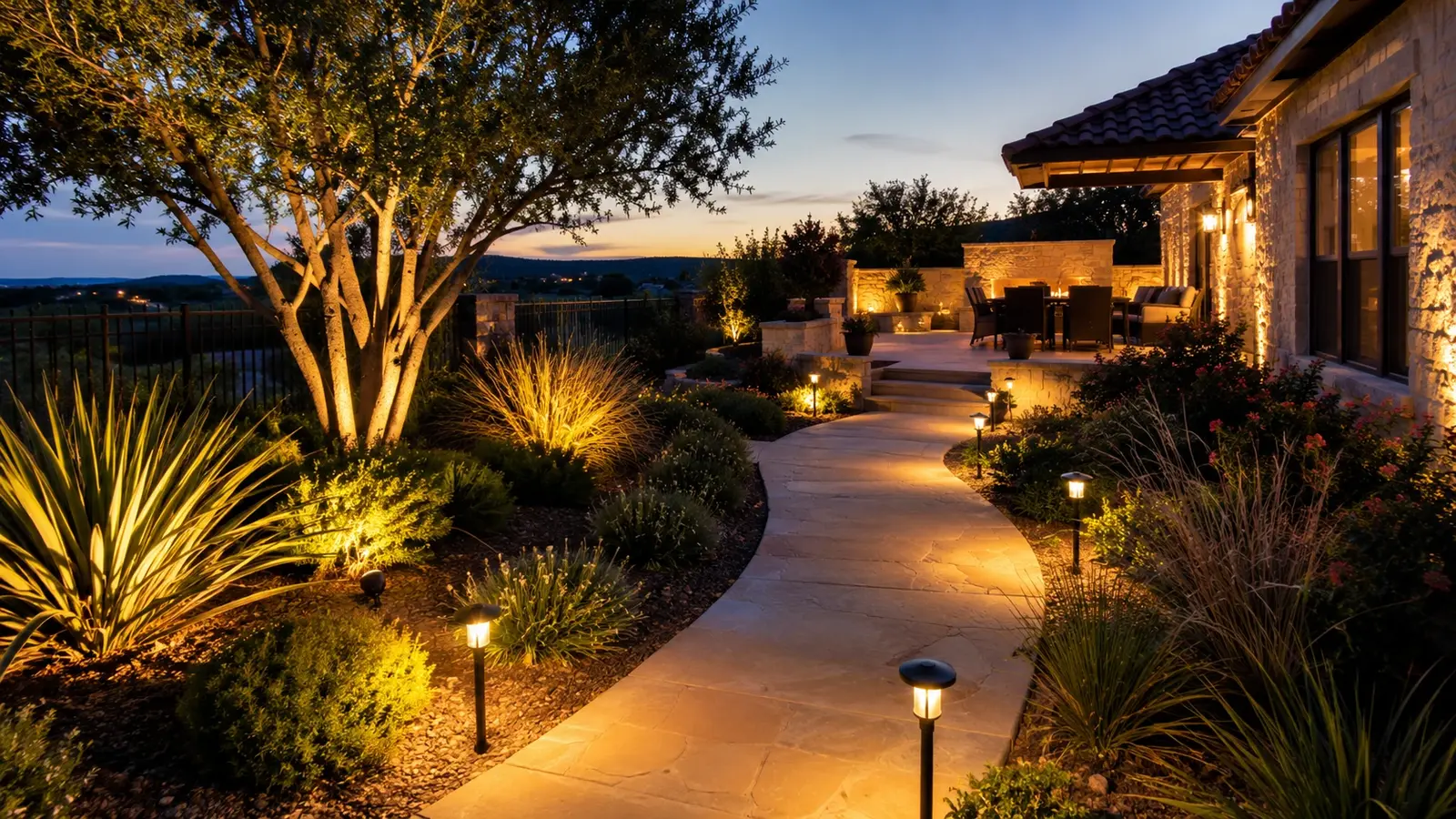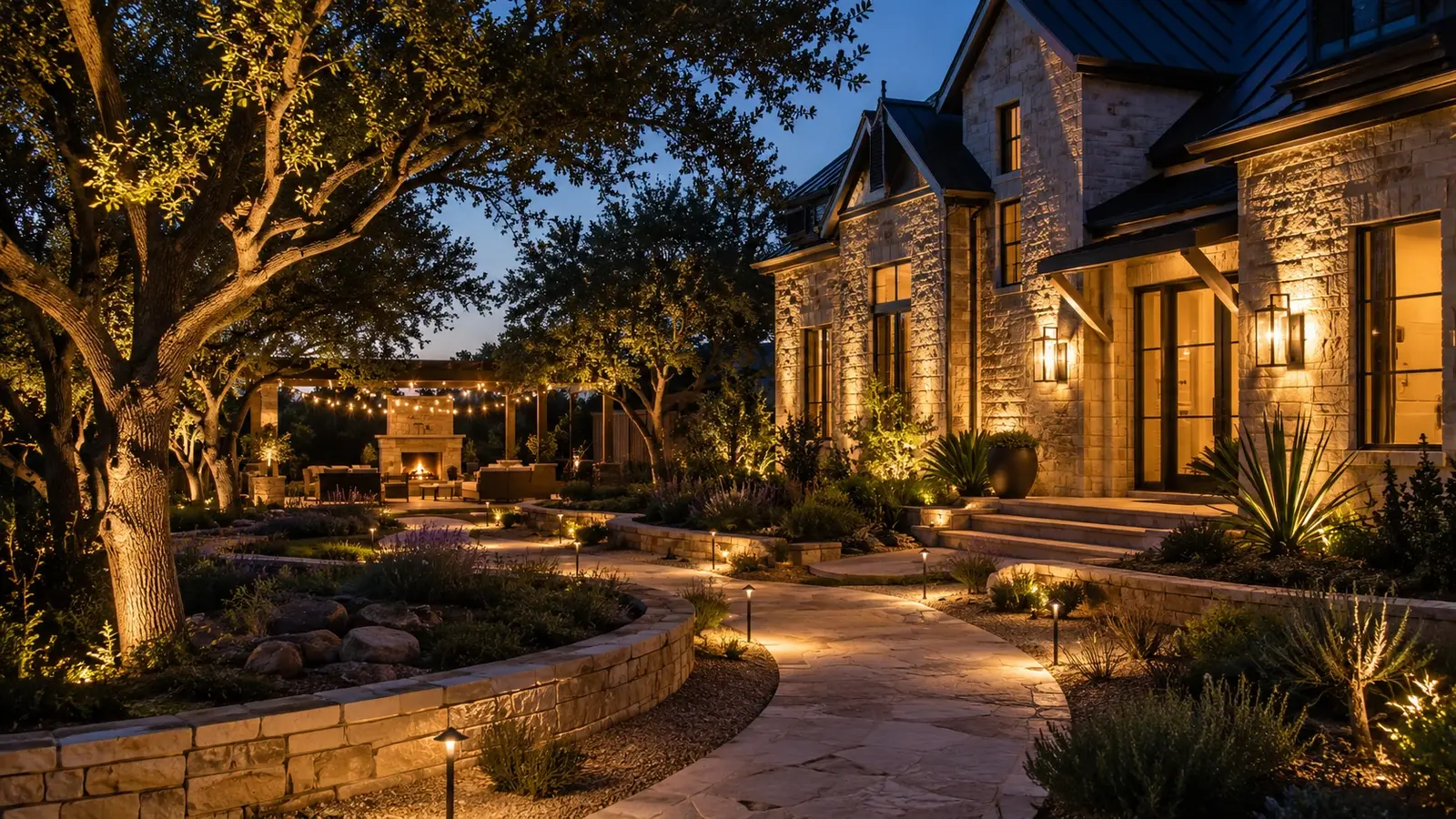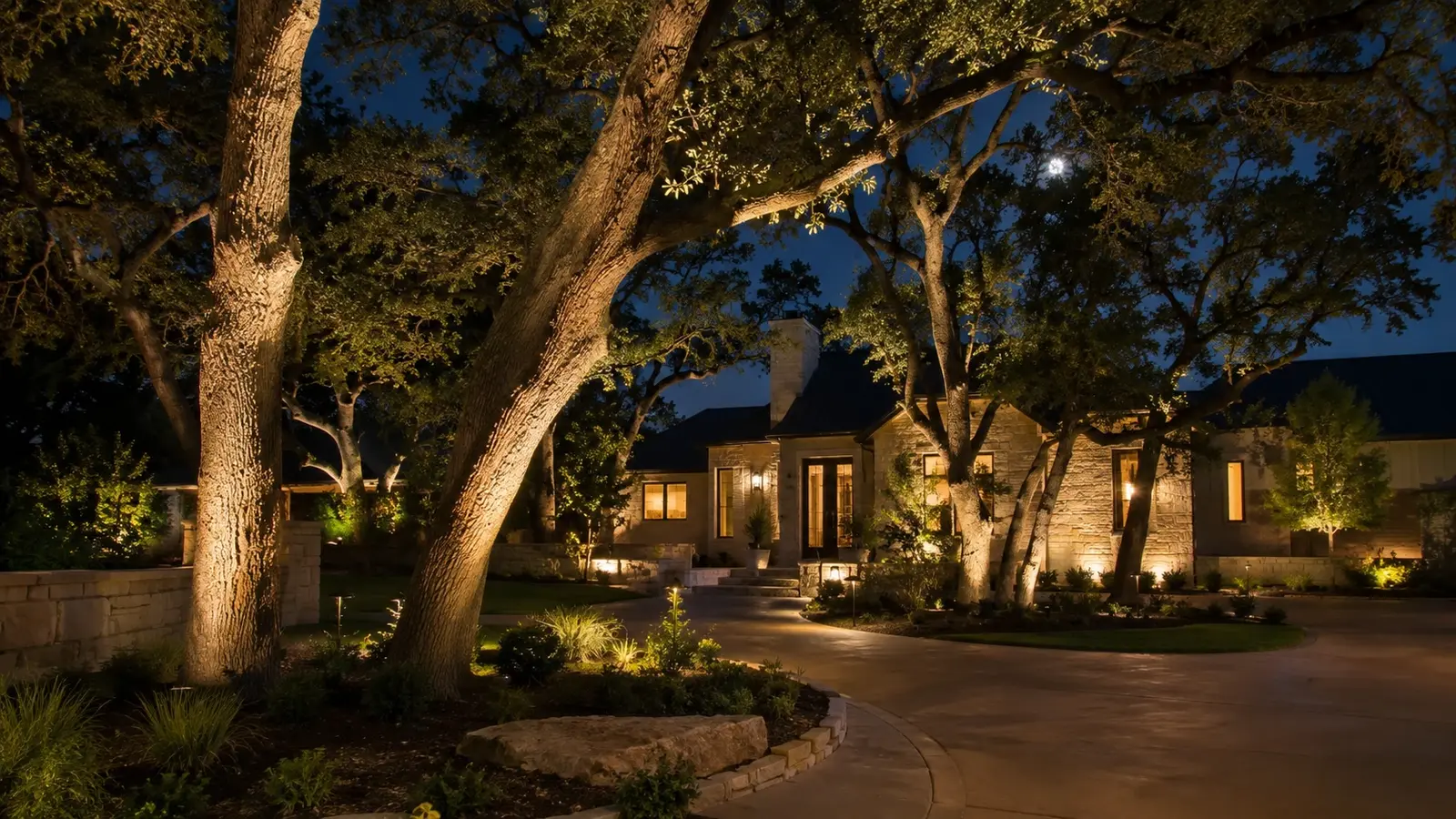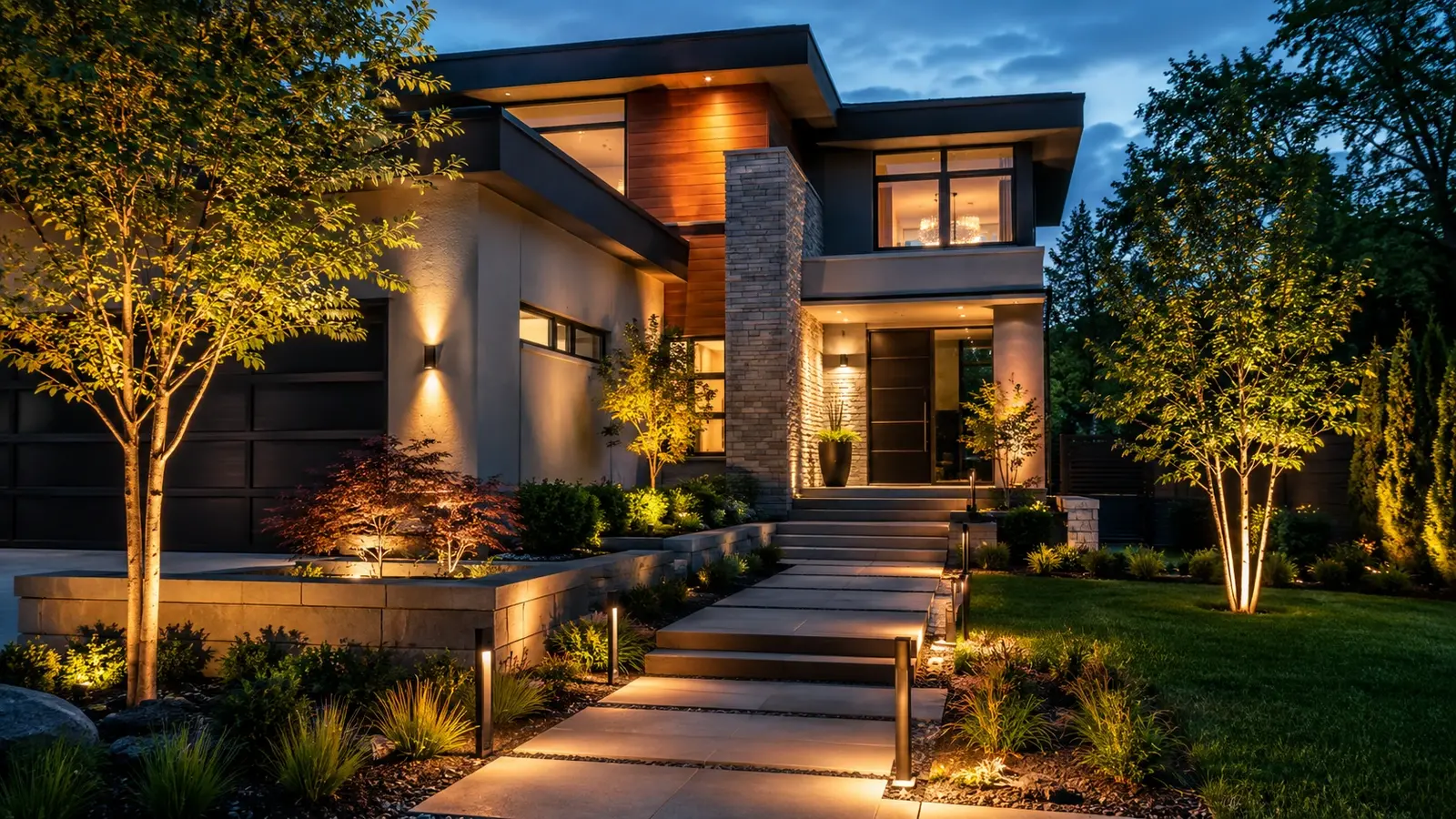
Modern homes in Austin, from the steel-and-glass builds in Tarrytown and Zilker to the flat-roofed stucco houses going up in Mueller and East Austin, are designed around planes, edges and negative space. Light should do the same. The strongest modern landscape lighting ideas share three habits: hide the source, light the surface rather than the object, and use contrast instead of brightness. Here is how Austin Landscape Lighting applies them.
Principle 1: You should never see a fixture
Traditional landscape lighting tolerates a visible brass path light as part of the look. Modern design does not. Fixtures recess into decking, tuck under wall caps, hide behind planters or mount inside the roof overhang. When a ground fixture is unavoidable, it is small, matte black or dark bronze, and shrouded so only the lit surface shows. Fewer, better fixtures is the rule; a modern facade often needs half the count of a traditional one.
Idea 1: Graze the big flat planes
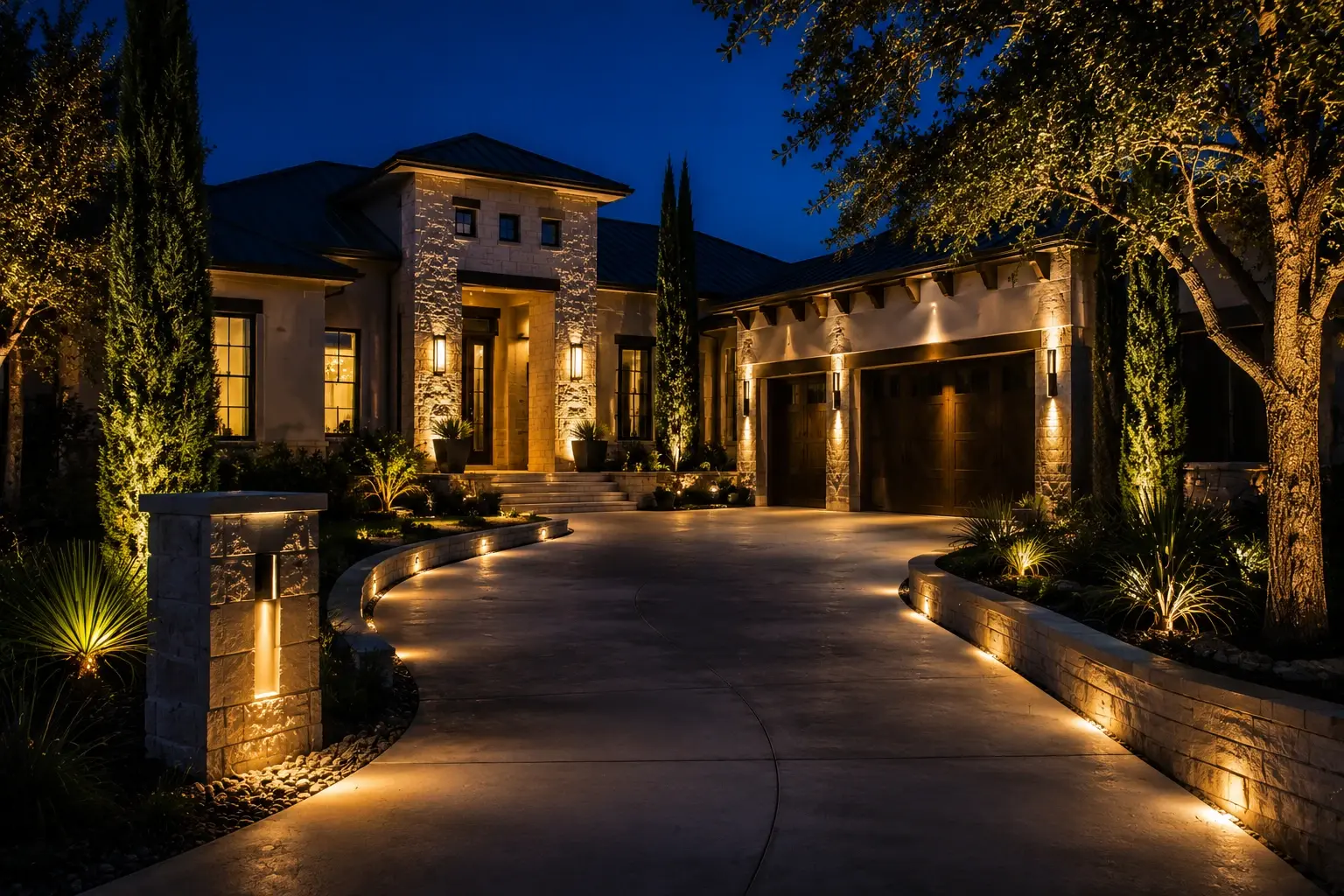
Stucco, board-formed concrete, standing-seam metal and smooth limestone all come alive under grazing light. Place a linear LED or a row of narrow uplights within 6 to 12 inches of the wall base and aim straight up. Every trowel mark and seam throws a shadow and the wall reads as texture instead of a blank. Use a crisp 3000K on gray, white or concrete surfaces; 2700K if the palette leans warm. This is the architectural uplighting technique, applied with tighter beams and closer spacing than on a brick house.
Idea 2: Linear light under floating elements
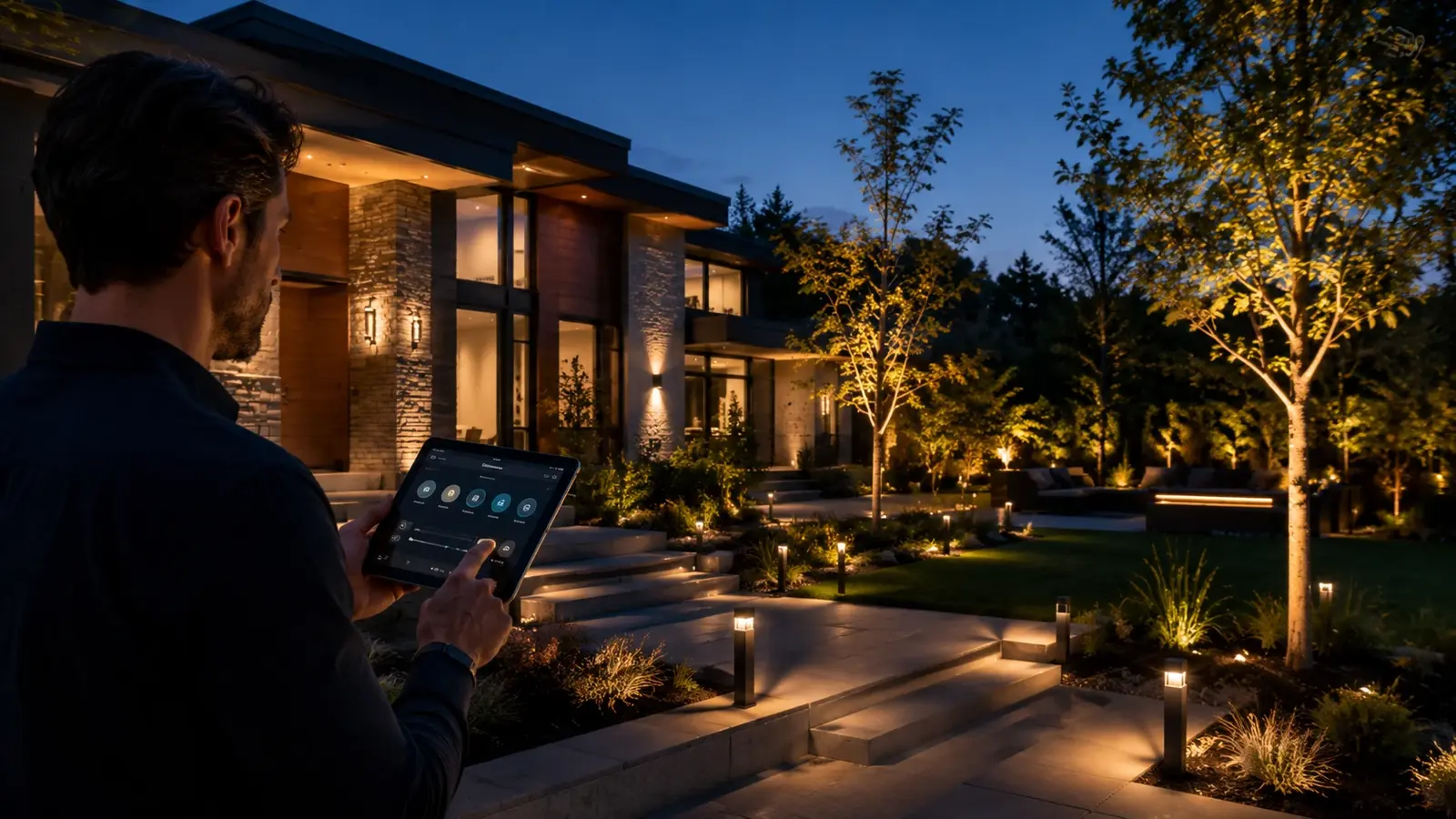
Cantilevered steps, floating benches, a raised planter box, the underside of a roof overhang: anything that appears to hover should glow from beneath. A recessed linear LED strip in a channel gives a continuous line of light with no hot spots. Specify a diffused lens, an IP67 rating and a 12-volt driver on the same transformer as the rest of the system, and keep the strip at the same color temperature as everything else.
Idea 3: Light the sculptural plants only
Modern landscapes in Central Texas lean on agave, yucca, sotol, ornamental grasses, a single specimen tree. Each one is a sculpture; light it that way. One narrow 15 to 24 degree uplight per plant, placed to the side so the form casts shadows, and nothing on the gravel or the lawn around it. Grasses backlit from behind glow like fiber optics. A row of identical agaves in identical planters, each with one identical light, is about as modern as landscape lighting gets.
Idea 4: Steps as light, not lights on steps
Instead of a visible step light on every riser, recess a linear fixture into the underside of each tread nosing so the step edge itself appears to glow. Where that is not possible, a single wall-mounted louvered step light every other riser on one side keeps the look quiet. Either way the deck and path fixtures should be at ankle height and shielded; modern does not mean bright.
Idea 5: A single moonlight instead of a dozen path lights
If the lot has a tall tree, one downlight mounted high in the canopy can light a courtyard, a path and a patio with a single hidden source and the softest shadows on the property. It is the most modern idea on this page precisely because it removes fixtures from the ground. See the tree lighting guide for mounting details.
Idea 6: Water as a light source
A still reflecting pool or a sheer-descent spillway lit from below becomes a lamp for the whole courtyard. Keep the fixture submerged or hidden in the weir, keep the output low and let the ripples do the work. Modern water features are usually geometric; light the long axis so the reflection runs the full length.
Idea 7: Scenes, dimming and restraint
Modern homes almost always get a smart controller. The point is not color-changing novelty; it is dimming. A grazed wall at 100 percent looks like a showroom; at 40 percent it looks like a magazine. Set an evening scene at 60 percent, a late scene at 25 percent with only the steps and entry, and a party scene at full. Tie everything to sunset with an astronomic schedule.
Color temperature for modern architecture
| Surface | Recommended | Why |
|---|---|---|
| White or gray stucco, concrete | 3000K | Keeps whites white; 2700K can look yellow |
| Dark bronze or black metal | 2700K to 3000K | Warm light reveals the finish; cool light disappears |
| Warm wood (ipe, cedar) accents | 2700K | Cooler light turns wood chalky |
| Limestone or Lueders stone | 2700K | Shows the natural warmth and fossil texture |
| Water features | Match the house | A cool fountain in a warm scene looks like an error |
Whatever you choose, use one temperature across the whole property. The color temperature guide lets you preview each value on a stone facade.
What modern lighting costs
Fewer fixtures but better optics, more linear product and more concealment work mean modern projects price differently from traditional ones. A contemporary front elevation with grazed walls, a lit entry and four specimen plants often runs 10 to 14 fixtures plus one or two linear runs, a planning range of roughly $4,500 to $9,000 installed. Larger properties with courtyards, water and smart zones range higher. Use the cost estimator with the premium fixture grade for a closer number; it is a planning range, not a quote.
Design it with us
Modern architecture is unforgiving of a visible fixture or a misaimed beam, which is why Austin Landscape Lighting draws these projects fixture by fixture and aims every one at night. Book a free dusk consultation and we will show you how little light a great modern home actually needs.
Frequently asked questions
How many fixtures does a modern home need?
Usually fewer than a traditional one. A contemporary front elevation often needs 10 to 14 well-placed fixtures plus one or two linear runs, because grazing light on flat planes covers a lot of wall per fixture and modern landscapes have fewer plants.
Is 3000K or 2700K better for a modern house?
3000K on white, gray or concrete surfaces keeps them crisp; 2700K on warm wood, bronze metal and limestone. Pick one for the whole property and only vary it for a deliberate accent.
Can linear LED strips be used outdoors?
Yes, with the right product: an IP67-rated strip in an aluminum channel with a diffused lens, fed by a 12-volt outdoor driver on a GFCI circuit. Cheap indoor strips fail within a season in Austin heat.

Written by the design team at Austin Landscape Lighting. We design, install and maintain low-voltage LED landscape lighting across Austin and the Hill Country. Questions about your property? Book a free dusk consultation or call +1 (281) 704-7210.