Solar landscape lighting is the first thing most homeowners try. The stakes cost a few dollars each, there is no wiring, and the box promises dusk-to-dawn light with zero electricity. Then October arrives, the cedar elms are still leafed out, and the path lights fade by 10 p.m. If you are deciding between solar landscape lighting and a wired 12V low-voltage LED system for an Austin property, this guide lays out the real trade-offs. Austin Landscape Lighting installs low-voltage systems for a living, but we also tell clients when a solar fixture is the sensible choice. Both have a place, and the right answer depends on sun exposure, what you need the light to do, and how long you want it to last.
How Each System Actually Works
A solar landscape light is a self-contained unit. A small photovoltaic panel charges a battery during the day, a photocell switches the LED on at dusk, and the battery runs the light until it drains or the sun comes up. Every fixture is independent, which is why installation is nothing more than pushing a stake into the ground.
A low-voltage system starts at a transformer plugged into a GFCI outlet. The transformer steps household 120V down to 12V, and direct-burial cable carries that power to each fixture. The transformer handles timing through a photocell, an astronomical timer, or an app-connected controller. Fixtures share power, so brightness is consistent and the system runs as long as you tell it to.
Brightness and Beam Control
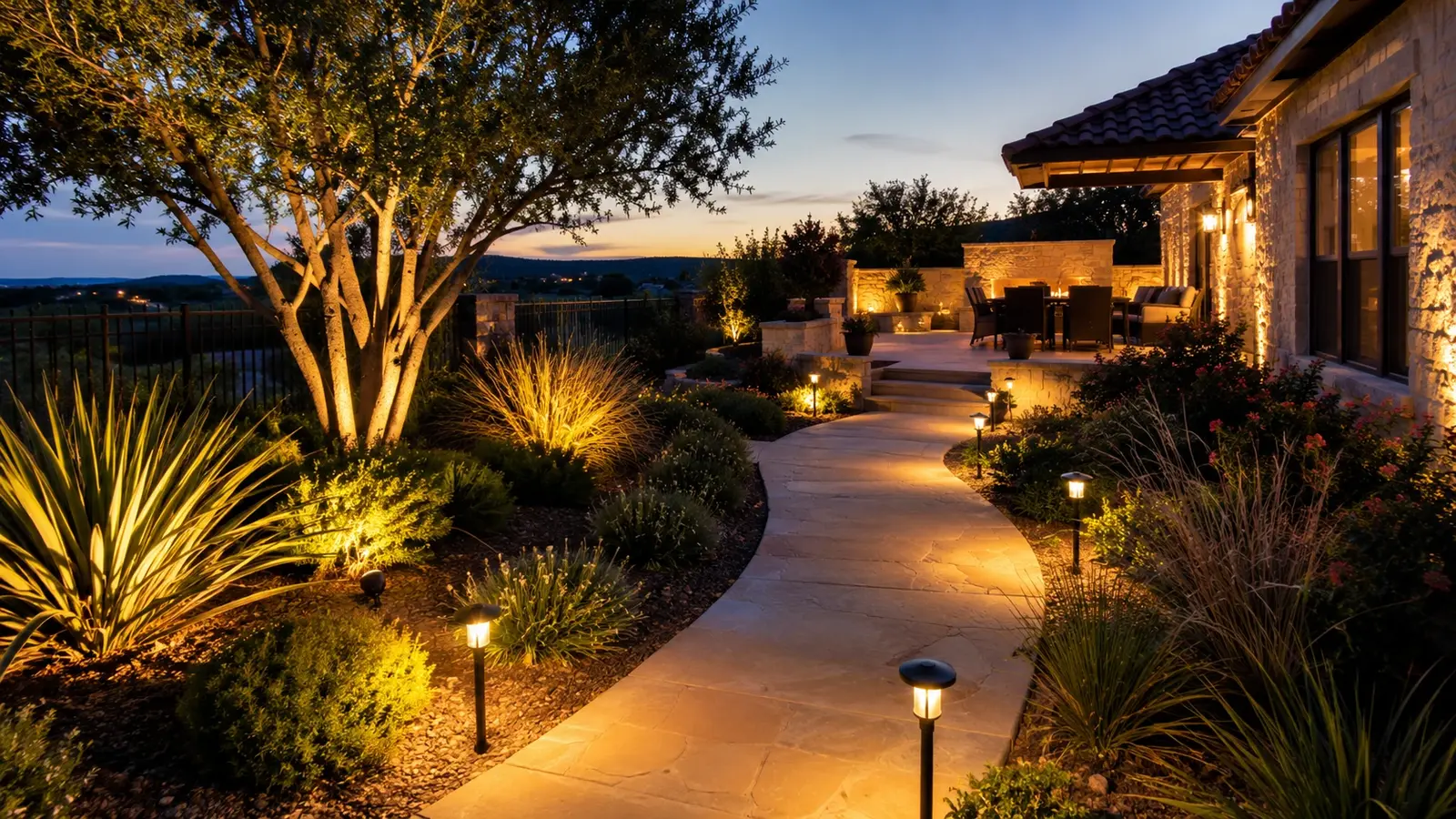
Most retail solar path lights produce 5 to 20 lumens. A typical low-voltage LED path light delivers 100 to 300 lumens, and an uplight for a tree can run 400 to 900 lumens. That is not a small gap. Solar output is enough to mark the edge of a walkway in open sky. It is not enough to light the trunk of a 40-foot live oak, wash a limestone wall, or make a flagstone step safe to use.
Beam control is the second issue. Quality low-voltage fixtures accept interchangeable lamps in 15, 30, 45, and 60 degree spreads, so a designer can put a narrow 15 degree beam up a tall cedar elm trunk and a wide 60 degree wash across an Austin stone facade. Solar fixtures almost always use a fixed, omnidirectional LED with no optics. You get a small puddle of light around the stake and little ability to aim it.
Color temperature also varies. Many solar fixtures ship at 5000K to 6500K, a bluish white that looks harsh against warm stone and foliage. Low-voltage LED lamps are standard at 2700K warm white, which flatters limestone, cedar, and brick. Some premium solar models now offer 2700K to 3000K, so check the spec sheet if you go that route.
The Shade Problem in Austin Yards
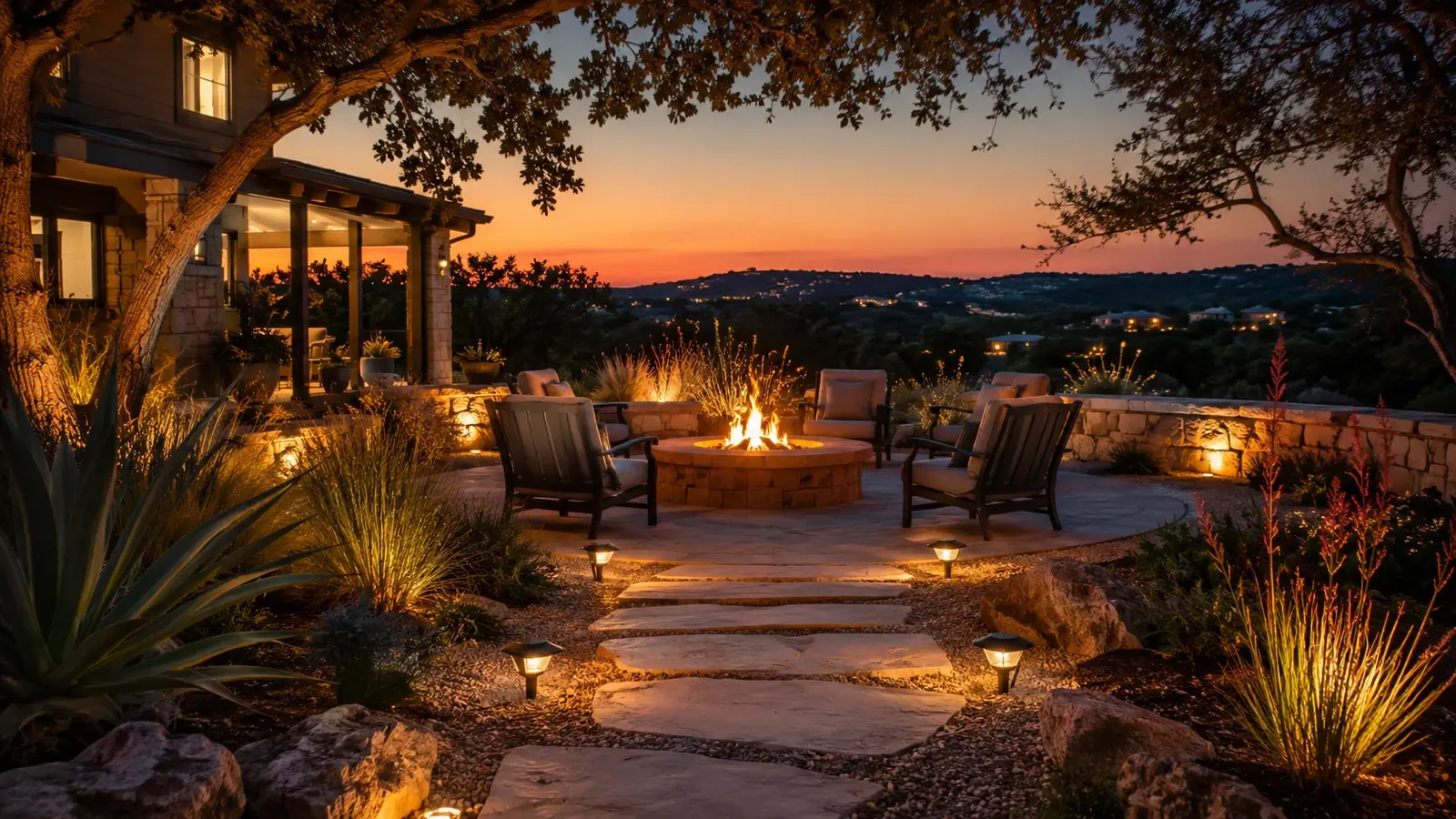
This is where solar landscape lighting most often disappoints local homeowners. A solar panel needs roughly six to eight hours of direct sun to fully charge a battery. Walk through Tarrytown, Allandale, Westlake, or Travis Heights and look up. Mature live oaks hold their leaves year-round, and their canopies can cover an entire front yard. Cedar elms, pecans, and Ashe junipers add more cover. A path light sitting in dappled shade may collect two or three hours of weak charge, enough for a dim glow that quits early.
Winter compounds the issue. Shorter days mean less charging time, yet the fixture needs to run longer because it gets dark by 5:45 p.m. Many solar lights that seemed fine in June are barely visible by December. A string of cloudy days in January can leave them dark altogether.
Summer brings a different stressor. Austin regularly runs 100 degrees or more for weeks. Heat accelerates battery degradation, and the small NiMH or lithium cells in solar stakes typically lose meaningful capacity within one to two years. Replacement batteries cost nearly as much as a new fixture, so most people just replace the light.
Lifespan and Maintenance
A well-built brass or copper low-voltage fixture should last 15 to 25 years. The housing develops a patina but does not corrode, and when the LED lamp eventually dims after 40,000 hours or so, you swap a lamp rather than the fixture. Cable buried 6 inches and connected with waterproof gel-filled connectors rarely fails.
Solar fixtures are mostly plastic or thin aluminum. Panels cloud and scratch, stakes snap when a mower bumps them, and the battery is the weak link. Realistic lifespan for a budget solar light in Central Texas sun is one to three years. Premium solar fixtures with replaceable lithium batteries and glass panels can stretch that to five years or more, but they cost 60 to 150 dollars each, which closes much of the price gap with wired fixtures.
Deer are a factor in Northwest Austin, Steiner Ranch, and the Hill Country edges. A deer stepping on a plastic solar stake ends it. Brass fixtures on 10-inch ground stakes survive the same encounter.
Cost Comparison Over Ten Years
Upfront cost is where solar wins decisively. The following table compares planning ranges for a typical front-yard project with eight path lights and four uplights. These are planning ranges based on local market pricing, not quotes.
| Factor | Retail solar fixtures | Low-voltage LED system |
|---|---|---|
| Upfront cost (12 fixtures) | 150 to 600 dollars | 2,400 to 5,500 dollars installed |
| Typical output per path light | 5 to 20 lumens | 100 to 300 lumens |
| Beam control | Fixed, omnidirectional | 15 to 60 degree interchangeable |
| Color temperature | Often 5000K to 6500K | 2700K warm white standard |
| Fixture lifespan | 1 to 3 years (budget), up to 5 (premium) | 15 to 25 years |
| Annual electricity | 0 dollars | 15 to 40 dollars |
| Replacements over 10 years | 3 to 5 full sets | Lamp swaps only |
| Ten-year planning total | 600 to 2,500 dollars | 2,700 to 6,000 dollars |
| Performance in shade | Poor | Unaffected |
| Warranty | 90 days to 1 year | Fixture lifetime, 2-year workmanship |
Over a decade, solar still costs less in raw dollars, but the gap narrows considerably once you count replacement sets. More importantly, the two columns do not buy the same thing. One marks a path. The other lights a property. You can run your own numbers for a wired system with our cost estimator.
When Solar Landscape Lighting Makes Sense
Solar is not a bad product. It is a product with a narrow sweet spot, and inside that sweet spot it is the right call.
Remote spots with no power
A back fence line 200 feet from the house, a mailbox at the end of a long Hill Country driveway, or a garden shed on an acreage lot may be impractical to wire. Voltage drop on a 12V run that long requires heavy 10-gauge cable or a second transformer, and trenching that far adds cost. A couple of premium solar fixtures with good sun exposure solve the problem for a fraction of the price.
Full-sun beds and open lots
New-construction neighborhoods in Pflugerville, Manor, Kyle, and Leander often have young trees and open sky. Solar fixtures charge fully there and can perform reasonably for several years. Once the trees mature, you may want to revisit the plan.
Rentals and temporary needs
If you are renting, staging a home for sale, or lighting a seasonal display, a wired system is more than you need. Solar lets you add and remove fixtures with no commitment.
Decorative accents, not task lighting
Solar string lights over a patio or small solar lanterns on a garden table add ambiance. They are not expected to make steps safe or deter anyone, so their low output is not a flaw.
When Low-Voltage LED Is the Right Investment
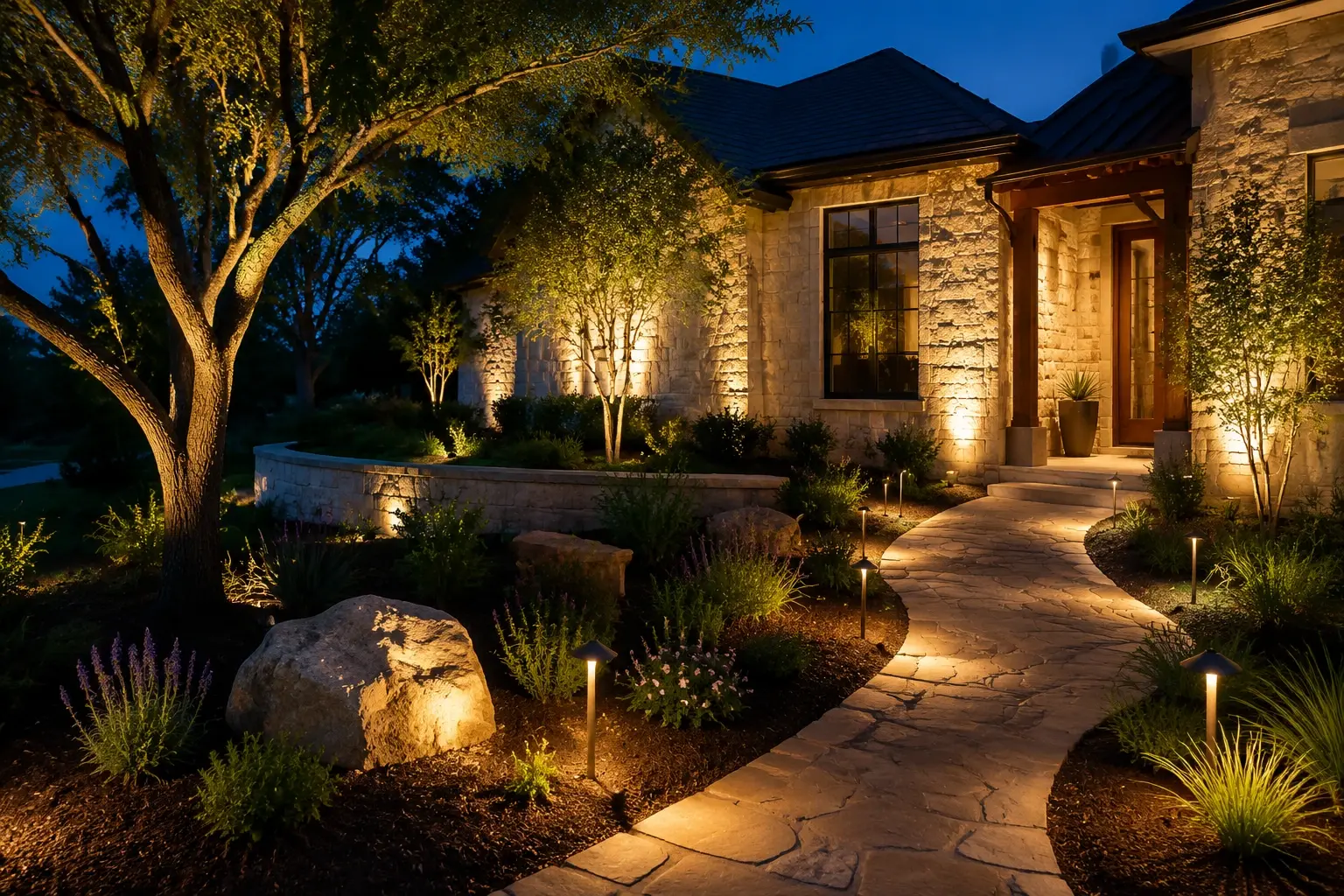
If you want the property to look designed after dark rather than dotted with small glowing stakes, wired low-voltage is the only realistic path. A few specific situations make the case clearly.
Tree and architectural lighting
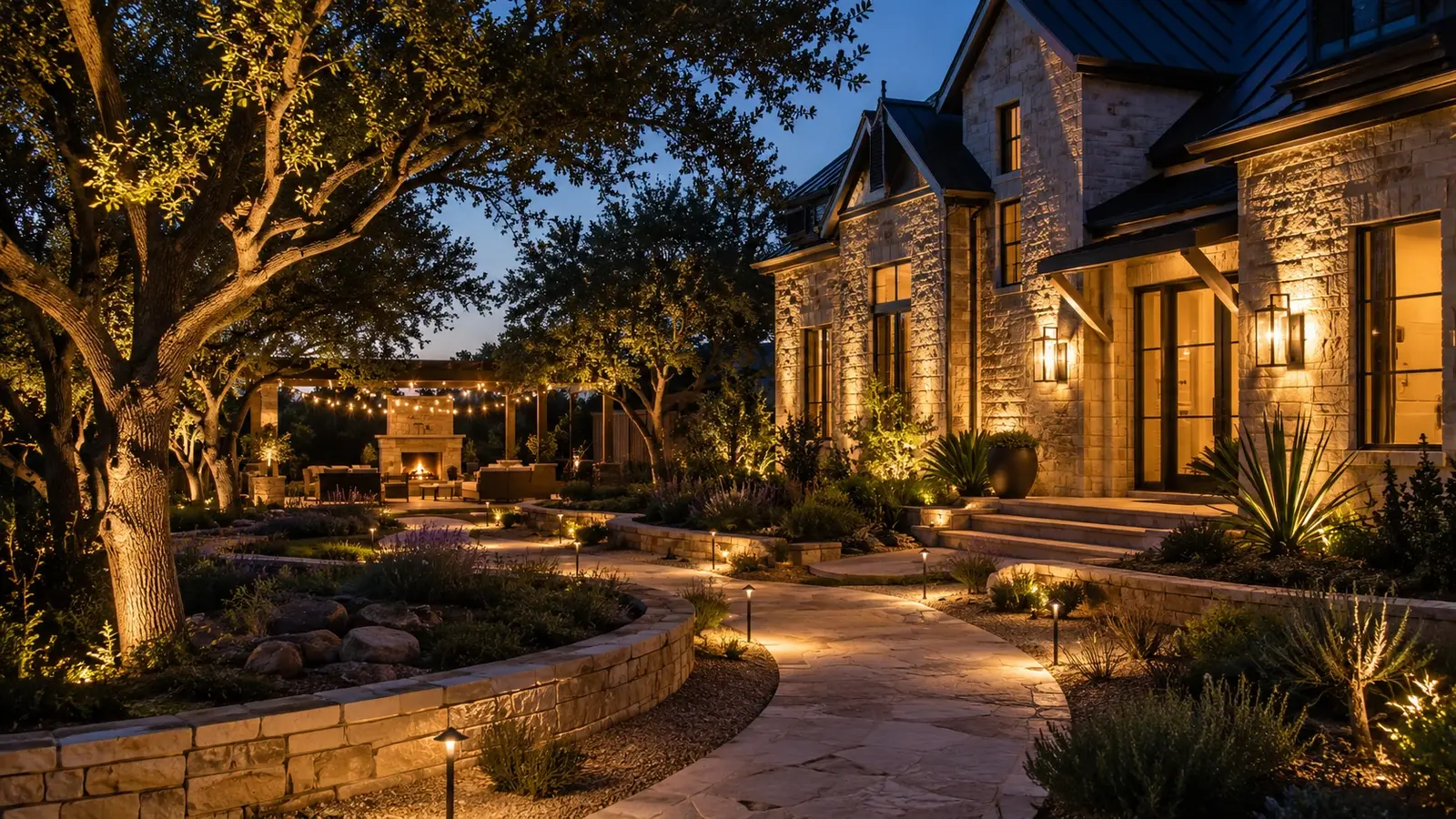
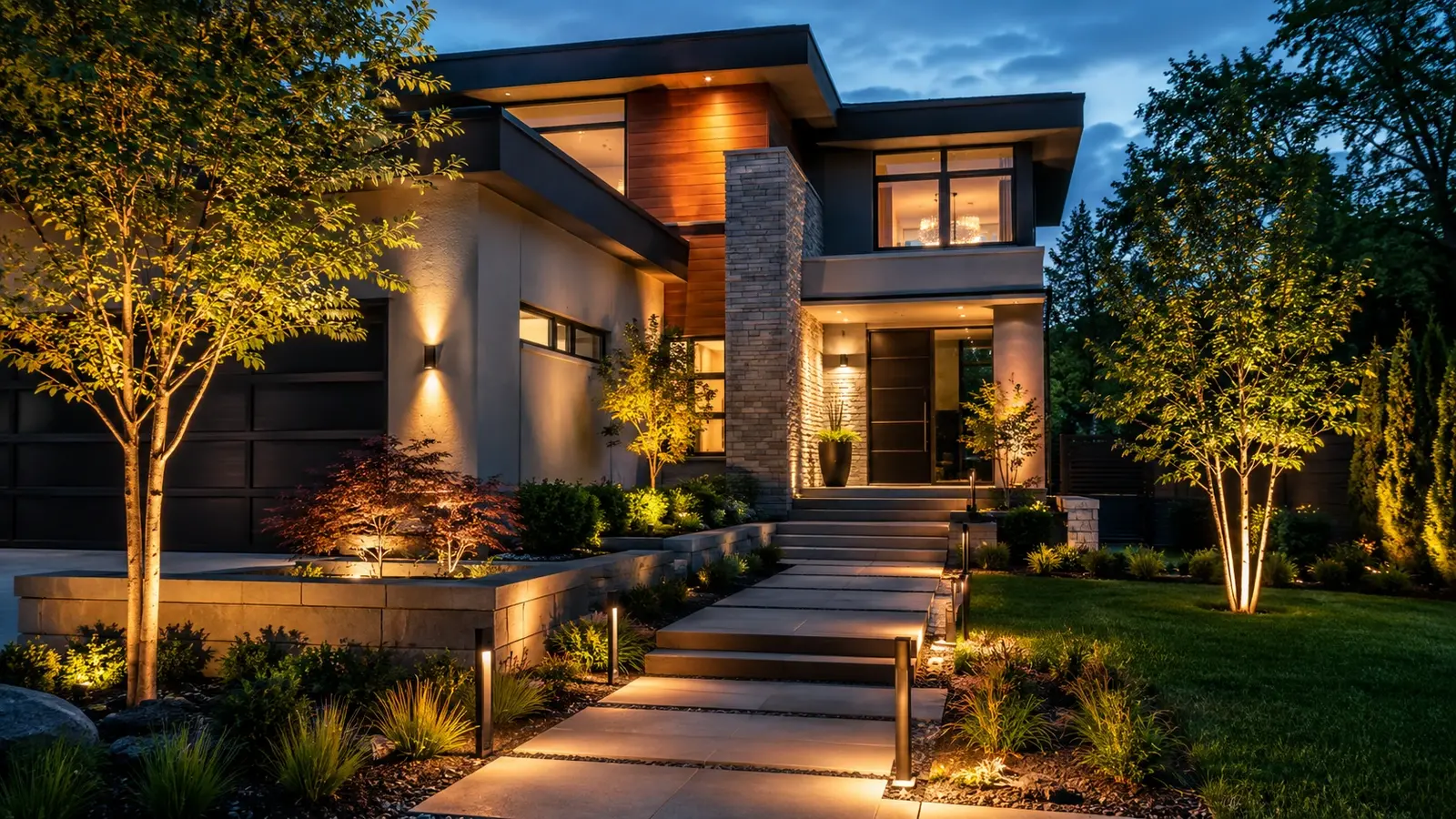
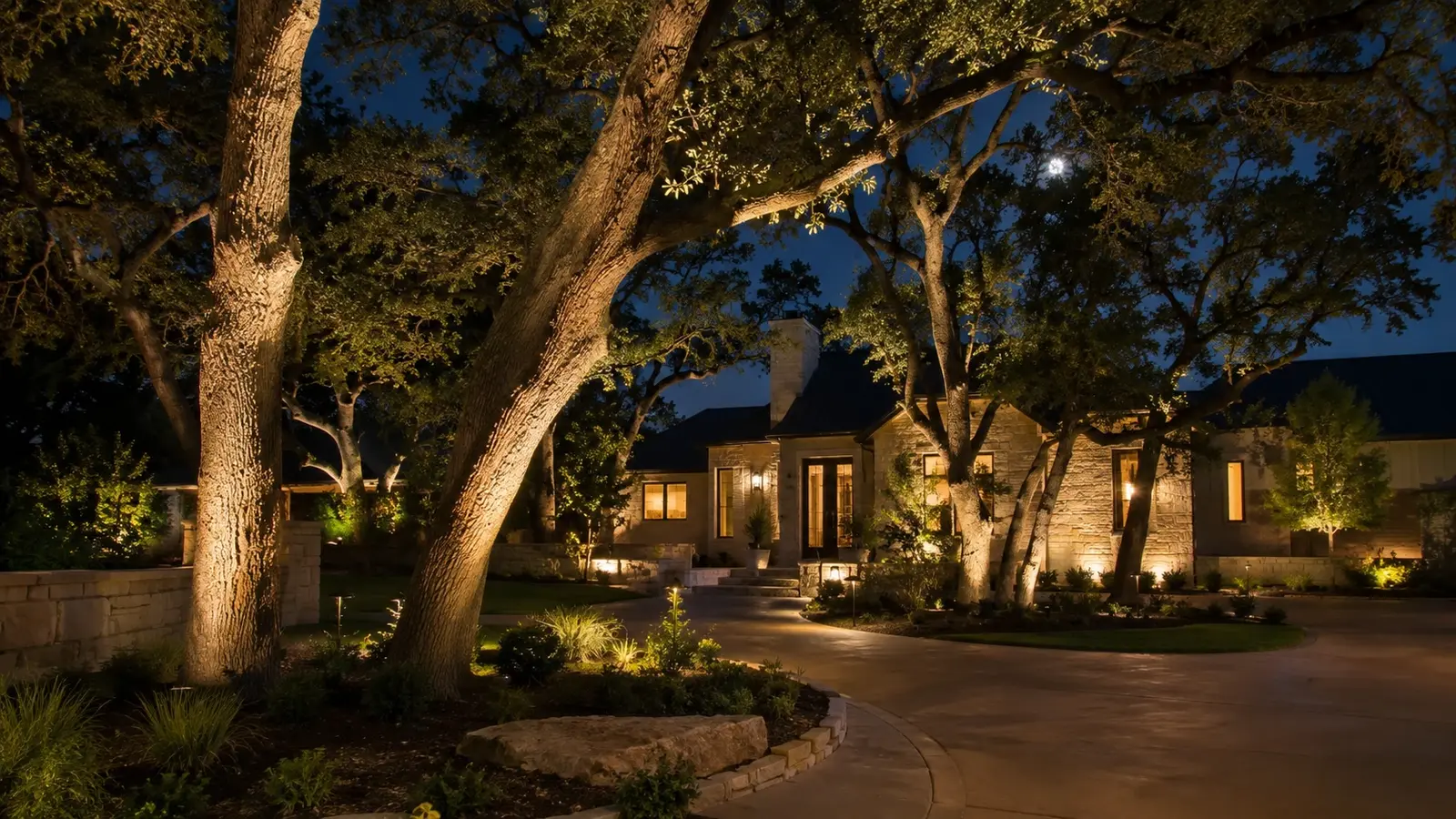
Uplighting a live oak canopy takes a 400 to 900 lumen fixture with a 30 to 45 degree beam, aimed carefully and shielded so the light stays on the tree. Grazing Austin stone with a fixture set 8 to 12 inches from the wall brings out every shadow in the texture. Both require real output and real optics. Our garden and tree lighting service is built around these techniques.
Safety on steps and slopes
Hill Country lots in Westlake, Barton Creek, and Lakeway come with grade changes. Steps and retaining walls need consistent, reliable light every night of the year. A path light staggered every 6 to 8 feet along a walkway and a recessed step light under each tread cannot depend on yesterday's weather.
Control and scheduling
A low-voltage transformer with an astronomical timer turns on at sunset and off at a time you choose, every day, adjusting automatically through the seasons. An app-connected controller adds zones, dimming, and scenes, so the patio can run late while the front yard shuts down at 11 p.m. Solar fixtures offer none of this, which also matters for dark-sky friendly operation and for HOAs that ask for lights off after a set hour.
Resale value and curb appeal
Buyers and appraisers notice a professionally lit facade. A set of plastic solar stakes along the walk does not register the same way, and a listing agent may ask you to pull them.
A Hybrid Approach That Works
Plenty of Austin Landscape Lighting clients end up with both systems. The wired low-voltage system handles the house, the trees, the paths, and the patio. Premium solar fixtures mark the far corners of the lot, the back gate, or a sunny raised bed near the alley where a cable run makes no sense. The key is choosing solar fixtures that match the wired system in color temperature so the property reads as one design rather than two.
If you are ready to upgrade, a low-voltage landscape lighting installation reuses nothing from the solar set, so there is no sunk cost beyond the fixtures themselves.
Austin Landscape Lighting has designed and installed more than 500 low-voltage systems across Central Texas since 2020, and we are happy to tell you if solar is the better fit for part of your property. Schedule a free on-site consultation and night demonstration by calling +1 (281) 704-7210 or contacting us online. You will get a written estimate and a clear recommendation, not a sales pitch.
Frequently asked questions
Are solar landscape lights bright enough to light a walkway?
Most retail solar path lights produce 5 to 20 lumens, which marks the edge of a path in open sky but does not illuminate the walking surface well. Low-voltage LED path lights deliver 100 to 300 lumens with controlled beam spreads. For steps, slopes, or any area where footing matters, a wired low-voltage fixture is the safer choice.
Why do my solar lights stop working in winter?
Winter brings shorter days, lower sun angles, and more cloud cover, so the small panel collects less energy while the fixture needs to run longer. In Austin yards, year-round live oak canopy makes this worse. Batteries also degrade after a year or two of summer heat, so an older fixture may hold only a fraction of its original charge.
Can I mix solar and low-voltage landscape lighting?
Yes, and many Austin homeowners do. Use the wired low-voltage system for the house, trees, paths, and patio where output and control matter, and place premium solar fixtures in sunny, remote spots like a back fence or mailbox. Match color temperatures, ideally 2700K warm white, so the property looks like one cohesive design.
How much more does low-voltage lighting cost than solar?
A professionally installed low-voltage system with twelve fixtures typically falls in a planning range of 2,400 to 5,500 dollars, compared to 150 to 600 dollars for retail solar stakes. Over ten years, solar replacement sets narrow the gap, and the wired system delivers far more light, better control, and a 15 to 25 year fixture lifespan.

Written by the design team at Austin Landscape Lighting. We design, install and maintain low-voltage LED landscape lighting across Austin and the Hill Country. Questions about your property? Book a free dusk consultation or call +1 (281) 704-7210.