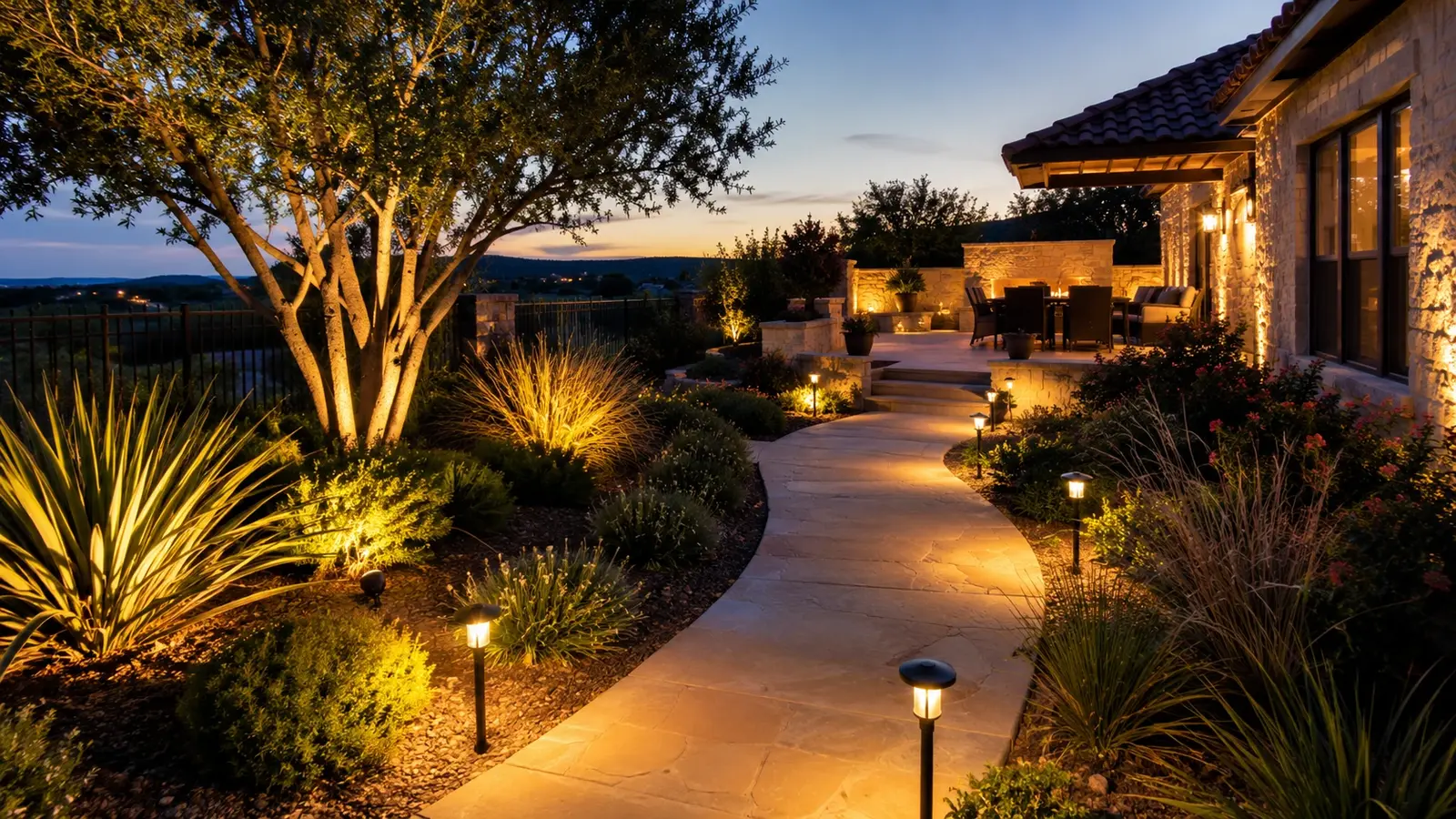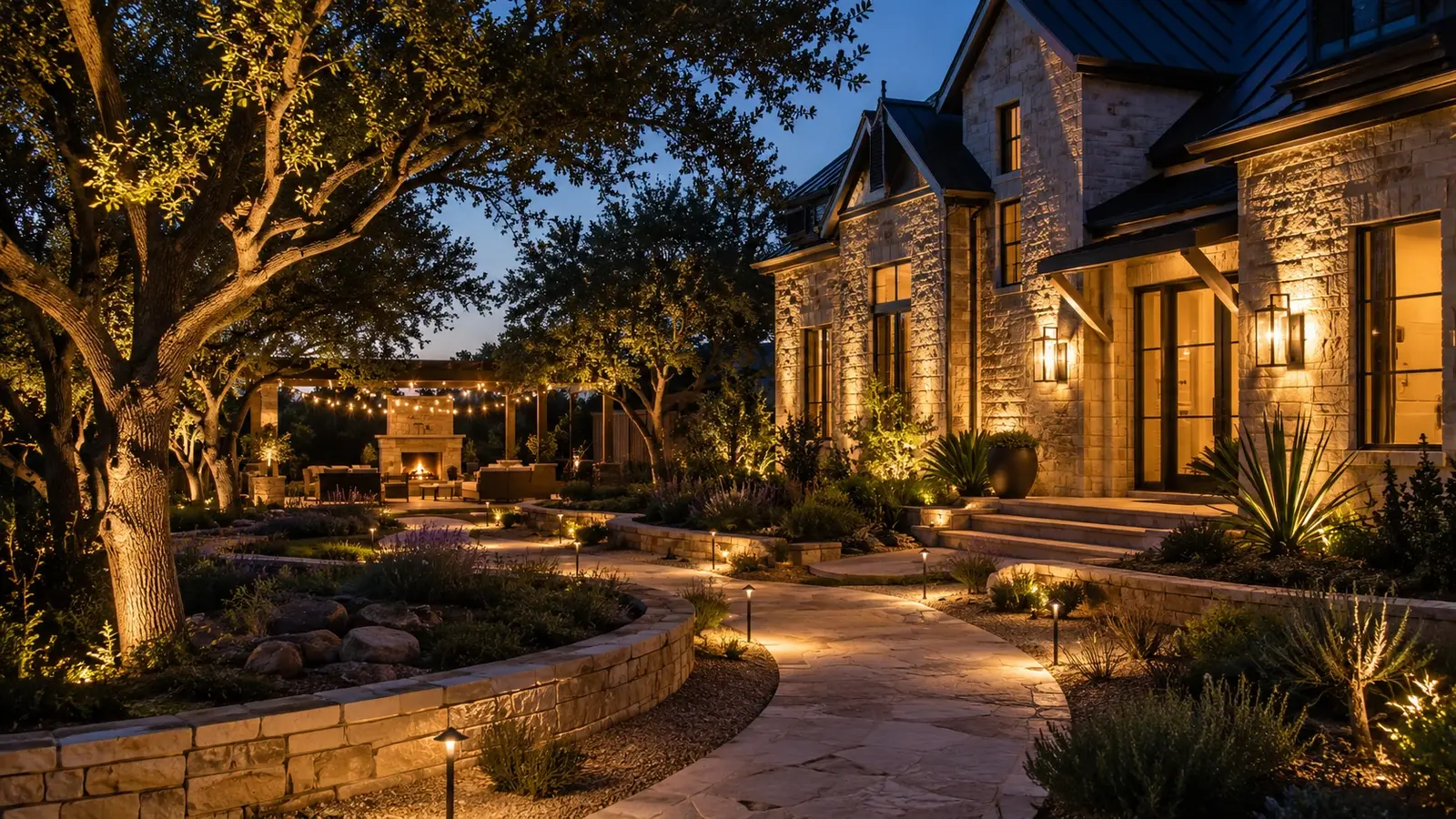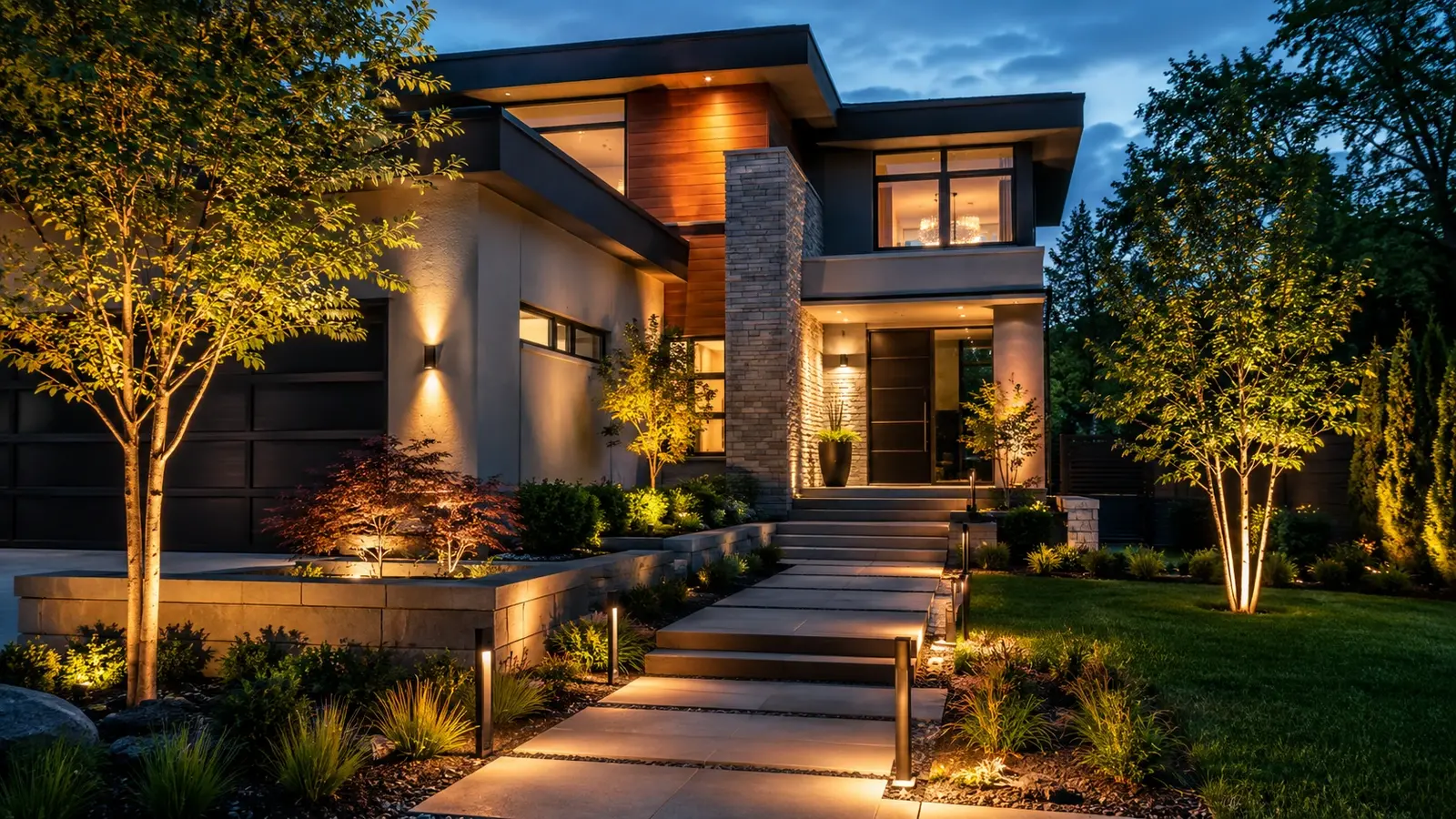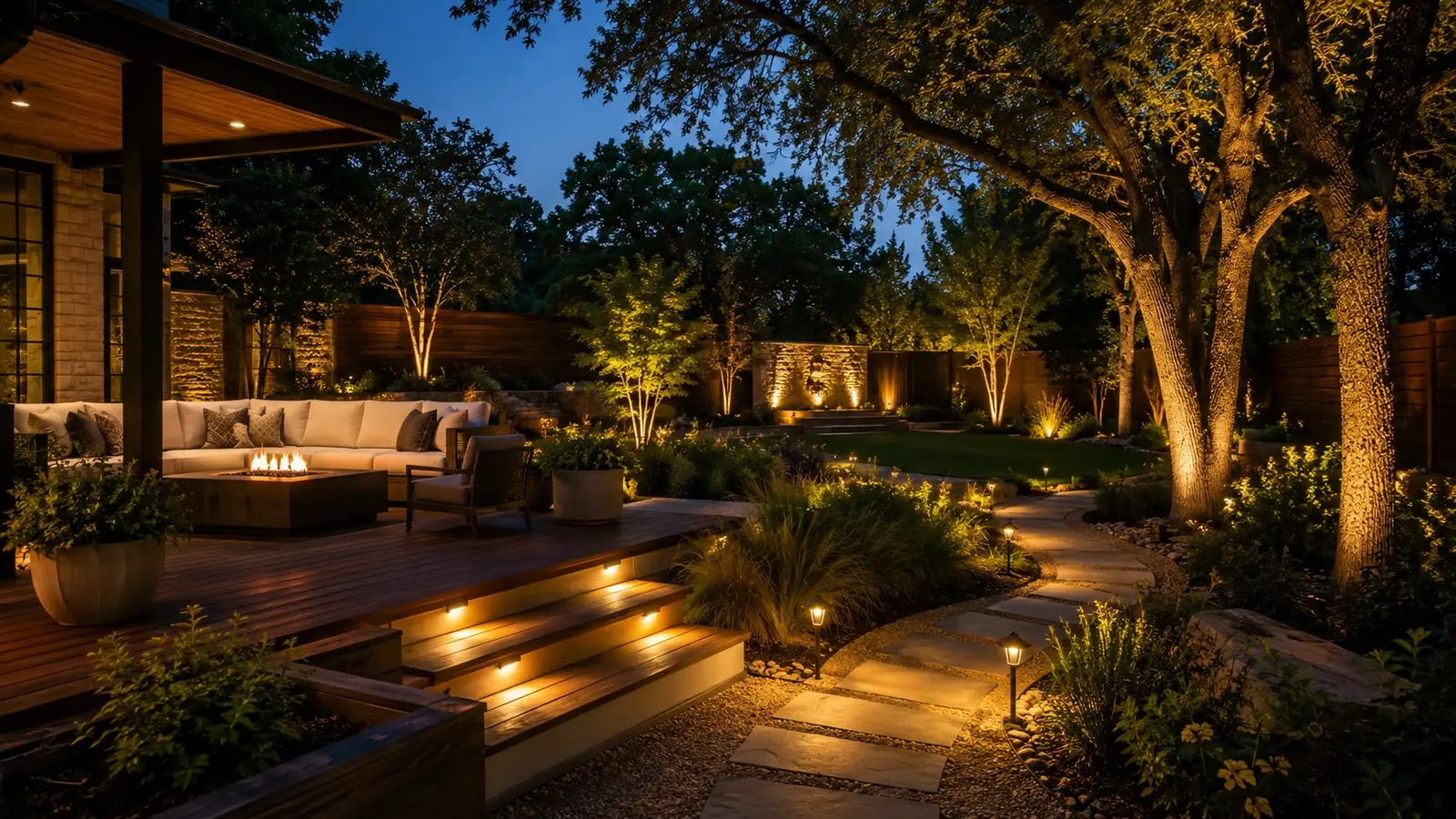
In Austin the backyard is where evenings happen. From March to November the patio is cooler than the kitchen once the sun drops, and that is exactly when most yards go dark. The best backyard landscape lighting ideas do not flood the space; they layer a few deliberate sources so the patio reads as a room, the trees give it walls and a ceiling, and the paths tell you where to walk. Austin Landscape Lighting designs backyards in that order, and the ideas below follow it.
Start with how you use the yard after dark
Before any fixture is chosen, list the scenes you want: dinner for six on the patio, kids in the pool until nine, a quiet drink by the fire pit, a dog let out at midnight. Each scene needs a different amount of light and, ideally, its own zone so you are not lighting the whole yard to find the gate. A good backyard plan has three to five zones on a smart controller or a multi-circuit timer.
- Dining and cooking: enough light to see food and faces, from above or from the side, never from fixtures at eye level.
- Lounging: low, warm, indirect. Think candlelight levels.
- Circulation: paths, steps and the route to the trash cans, lit at ankle height.
- Backdrop: trees, fences and walls that give the space depth and keep it from feeling like a lit island in a black void.
Idea 1: Moonlight the big trees
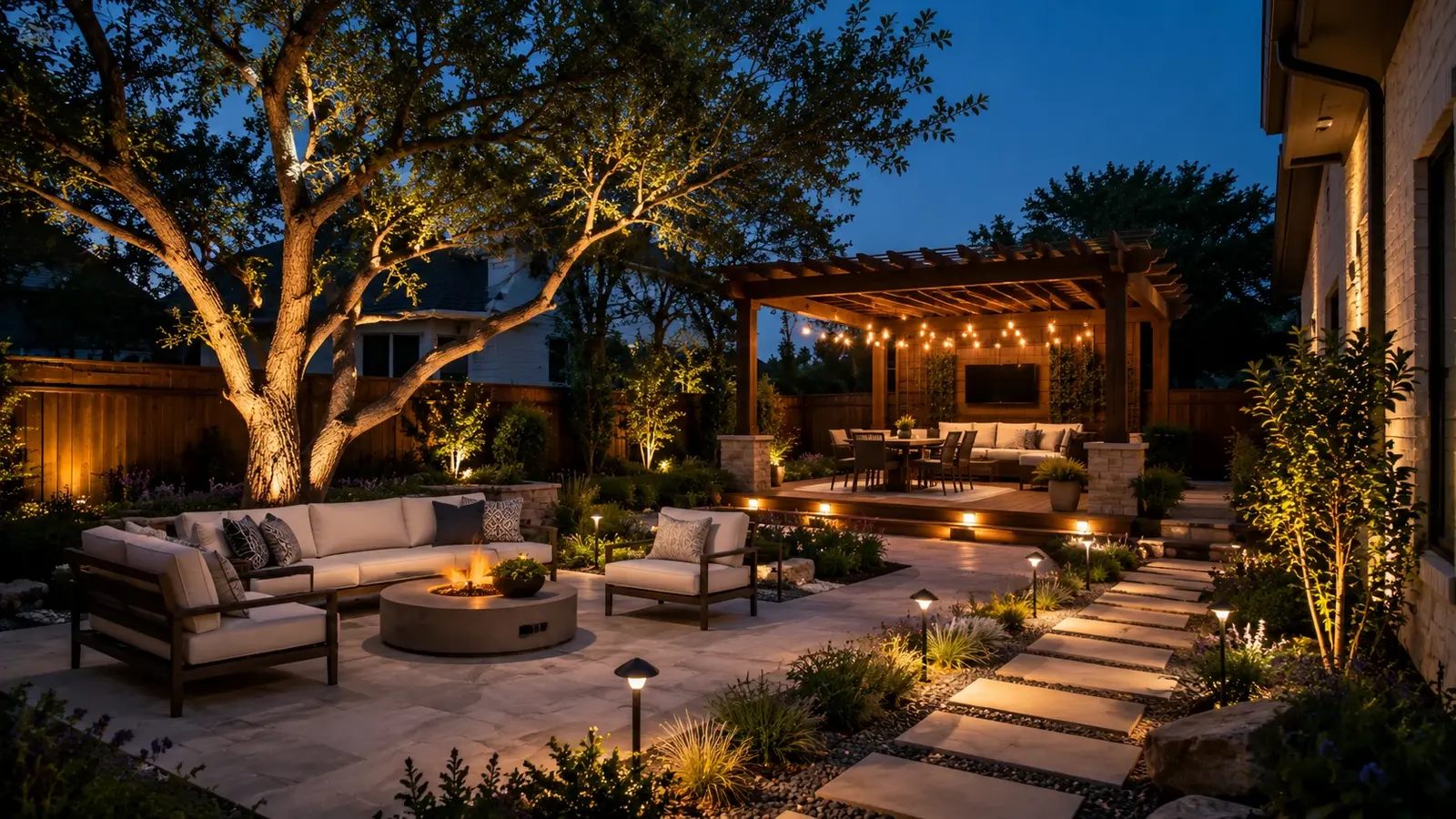
If your yard has a mature live oak, cedar elm or pecan, it is your best lighting asset. A fixture mounted 20 to 30 feet up, aimed down through the branches, casts dappled shadows across the lawn and patio that look exactly like a full moon. Use a wide 60-degree beam at 2700K, keep the fixture shielded so you never see the source, and run the wire up the back of the trunk with stand-off mounts that let the tree grow. One or two moonlights often replace a half-dozen ground fixtures and are the single most requested idea in our garden and tree lighting work.
Idea 2: Light the patio from the edges, not the middle
The mistake we fix most often is a bright flood on the back wall of the house pointed at the seating area. It blinds everyone and leaves the yard beyond it black. Instead, put light on the perimeter: under-cap lights on seat walls, small wash lights grazing a planter wall, a downlight tucked in the pergola beam, and sconces on the house dimmed to a glow. Faces are lit by reflected light, the yard beyond stays visible and the patio feels enclosed.
On a deck, recessed riser lights every other step and a few post-cap or rail lights are plenty. Keep everything at 2700K and on a dimmer so dinner and late-night modes are one tap apart.
Idea 3: Silhouette and graze the fence line
Most Austin backyards are bounded by a cedar privacy fence or a limestone wall. Lit, it becomes the room's walls; unlit, it is the edge of the known world. Two techniques work. Grazing places fixtures close to the base of a textured wall and aims straight up, pulling out every stone and board. Silhouetting places a wash behind a plant or sculpture so its outline shows dark against a lit surface. Alternate them along a long fence so it does not read as a runway.
Idea 4: Give the pool its own quiet layer
Underwater lights are part of the pool equipment, not the landscape system, but the area around the water is ours. Light the trees and walls beyond the pool so the water reflects them, keep path lights well back from the coping to avoid glare off wet stone, and use step lights on any change in elevation. The pool lighting guide goes deeper, and the pool and water feature service covers fountains and spillways too.
Idea 5: Fire pit and seating circles
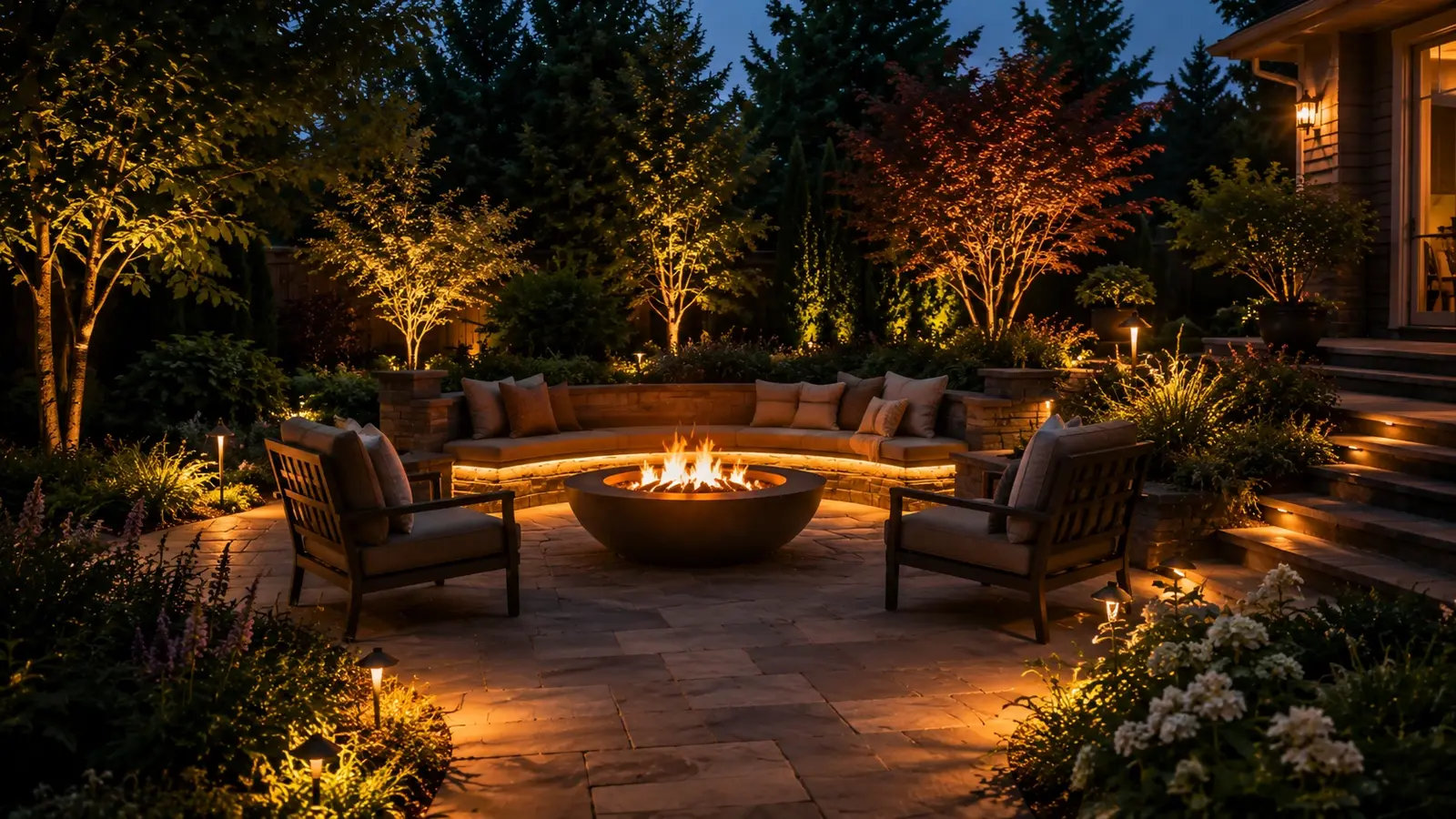
The fire is already the focal point, so surrounding light should be low and indirect. A pair of wide-beam fixtures on nearby trees, hardscape lights under a seat wall cap and nothing else. If the circle sits at the far end of the yard, a path of staggered lights gets people there without a flashlight.
Idea 6: Plant beds and garden accents
Resist lighting every shrub. Pick the three or four plants with real structure after dark: an agave, a Texas mountain laurel, a crape myrtle with good bark, a sago palm. One narrow-beam uplight each, aimed from the side so the texture reads. Bed lights every 15 feet along the border give the garden rhythm without competing with the specimens.
Idea 7: Paths, steps and the practical stuff
Every backyard has a service route: gate to trash cans, back door to pool equipment, patio to the shed. Light it honestly with shielded path lights every 6 to 8 feet, staggered, and a step light on every riser. Put this circuit on a photocell so it runs dusk to dawn even when the decorative zones go off at eleven.
Backyard fixture plan for a typical Austin lot
The table below is a planning sketch for a 60 by 80 foot backyard with a covered patio, two large trees, a fence on three sides and a path to the gate. Counts shift with your layout; use the fixture calculator for your own numbers.
| Zone | Fixtures | Technique | Beam / output |
|---|---|---|---|
| Two large trees | 4 uplights + 2 moonlights | Cross-light trunks, downlight canopy | 36° up, 60° down, 5 to 7 W |
| Covered patio | 4 under-cap + 2 pergola downlights | Indirect perimeter | Dimmable, 2 to 4 W |
| Fence and wall | 6 wash lights | Alternate graze and silhouette | 60° wash, 4 W |
| Beds and specimens | 4 uplights | Side-aimed accents | 15° to 24°, 4 W |
| Path and steps | 6 path + 3 step lights | Staggered, shielded | 3 W each |
| Total | 31 fixtures | 3 zones | About 140 W, 300 W transformer |
A system like this falls in a planning range of roughly $8,500 to $14,000 installed in Austin, depending on fixture grade and controls. It is a range, not a quote; the cost estimator lets you move the levers.
Austin-specific notes
- Heat. Brass and copper fixtures shrug off 105-degree afternoons; powder-coated aluminum fades and seals fail. Buy once.
- Deer and dogs. Ground fixtures on brass stakes survive traffic; thin aluminum path lights do not.
- Dark-sky courtesy. Shield every fixture, aim at the house or the plant and keep output modest. Your neighbors and the stars will thank you.
- Mosquito season. Warm 2700K light attracts fewer insects than cooler white, one more reason to avoid 4000K floods.
Bring the ideas to your yard
The fastest way to see which of these backyard landscape lighting ideas fit your property is a free dusk walkthrough. Austin Landscape Lighting will demo fixtures on your actual trees and patio, draw a zone plan and give you a written estimate. Schedule your consultation and start staying outside later.
Frequently asked questions
How many lights does a backyard need?
A typical Austin backyard with a patio, two trees and a path uses 20 to 35 fixtures split into three zones. Small yards with one focal tree can look finished with 10 to 12. The count depends on how many scenes you want, not square footage.
Should backyard lights be on a timer or a photocell?
Both. Put the practical path and step circuit on a photocell so it runs dusk to dawn, and put the decorative patio, tree and wall zones on an astronomic timer or app controller that turns them off at a set hour.
What color temperature is best for a backyard?
Warm white at 2700K for nearly everything. It flatters skin, wood and stone, attracts fewer insects than cooler light and matches typical patio sconces. Some patios look good with 2400K accents for a candlelit feel.

Written by the design team at Austin Landscape Lighting. We design, install and maintain low-voltage LED landscape lighting across Austin and the Hill Country. Questions about your property? Book a free dusk consultation or call +1 (281) 704-7210.