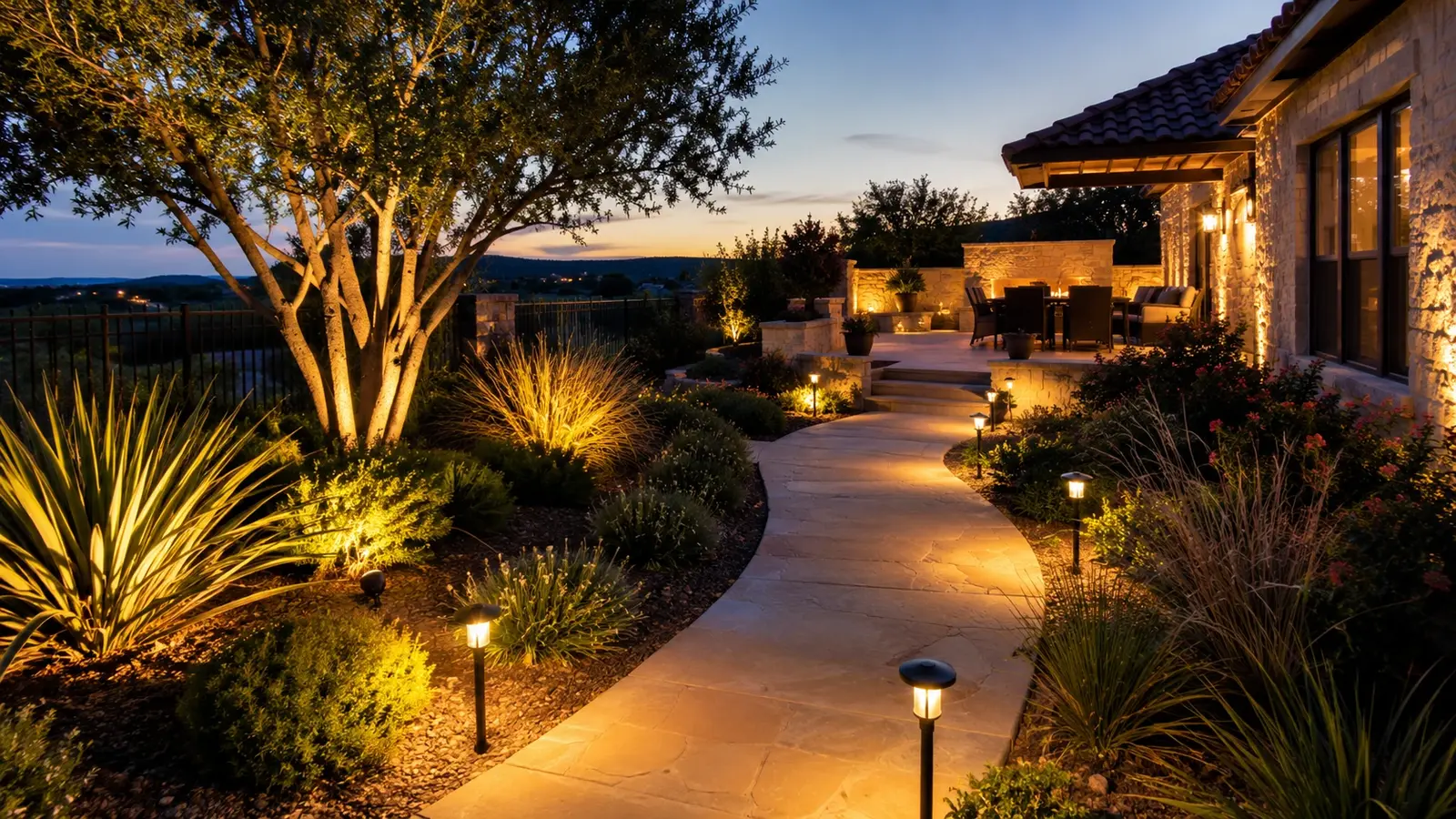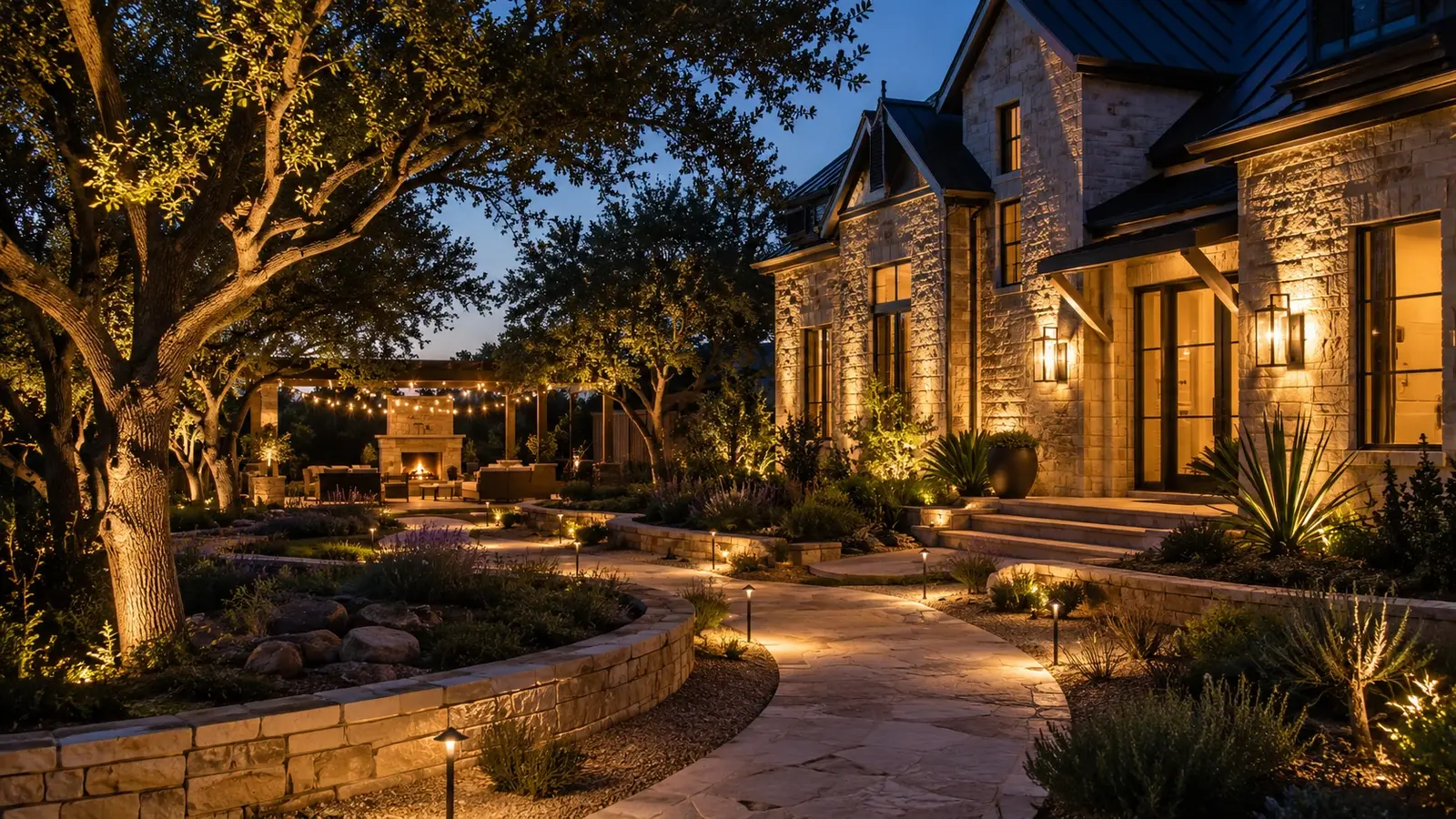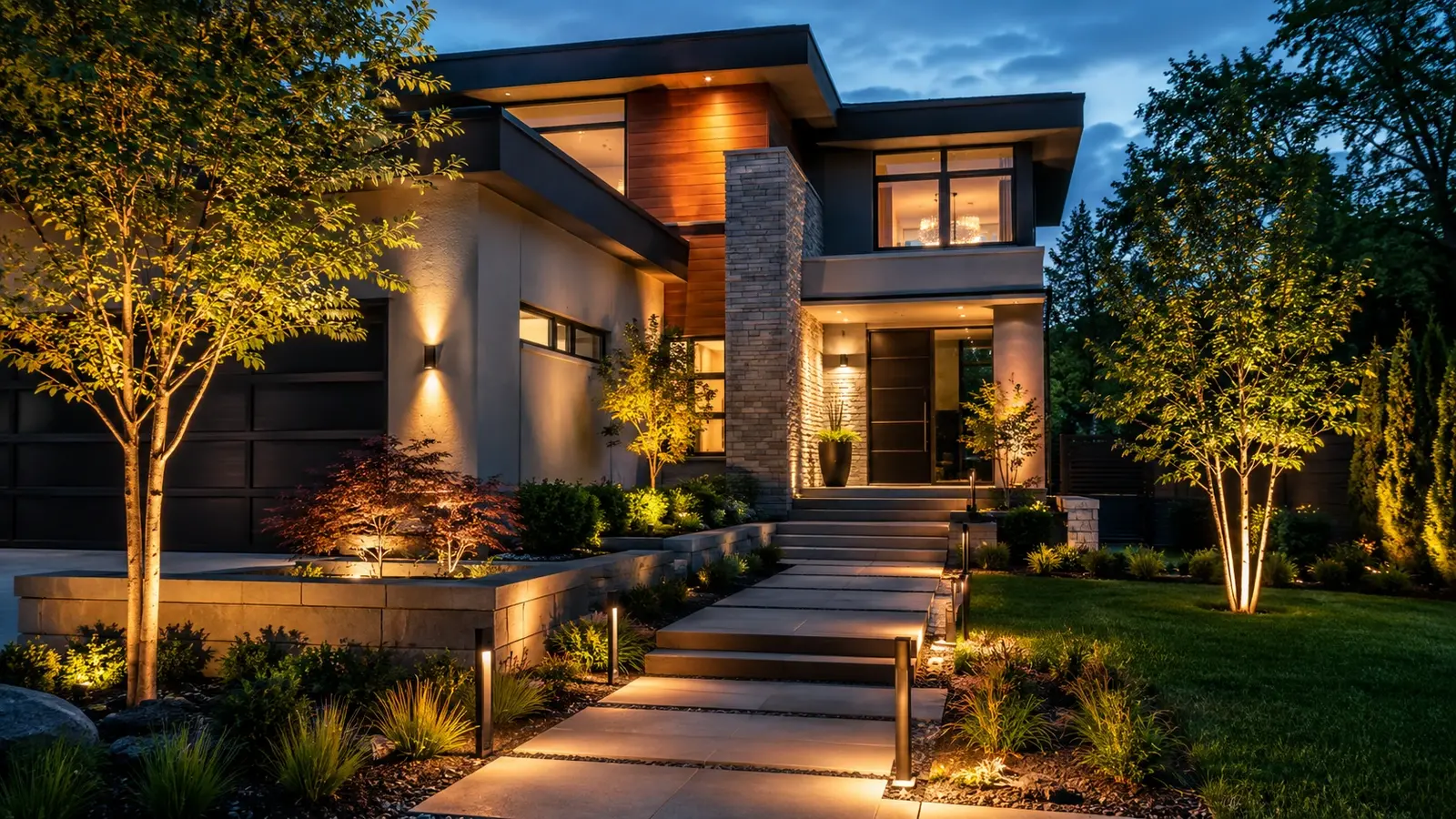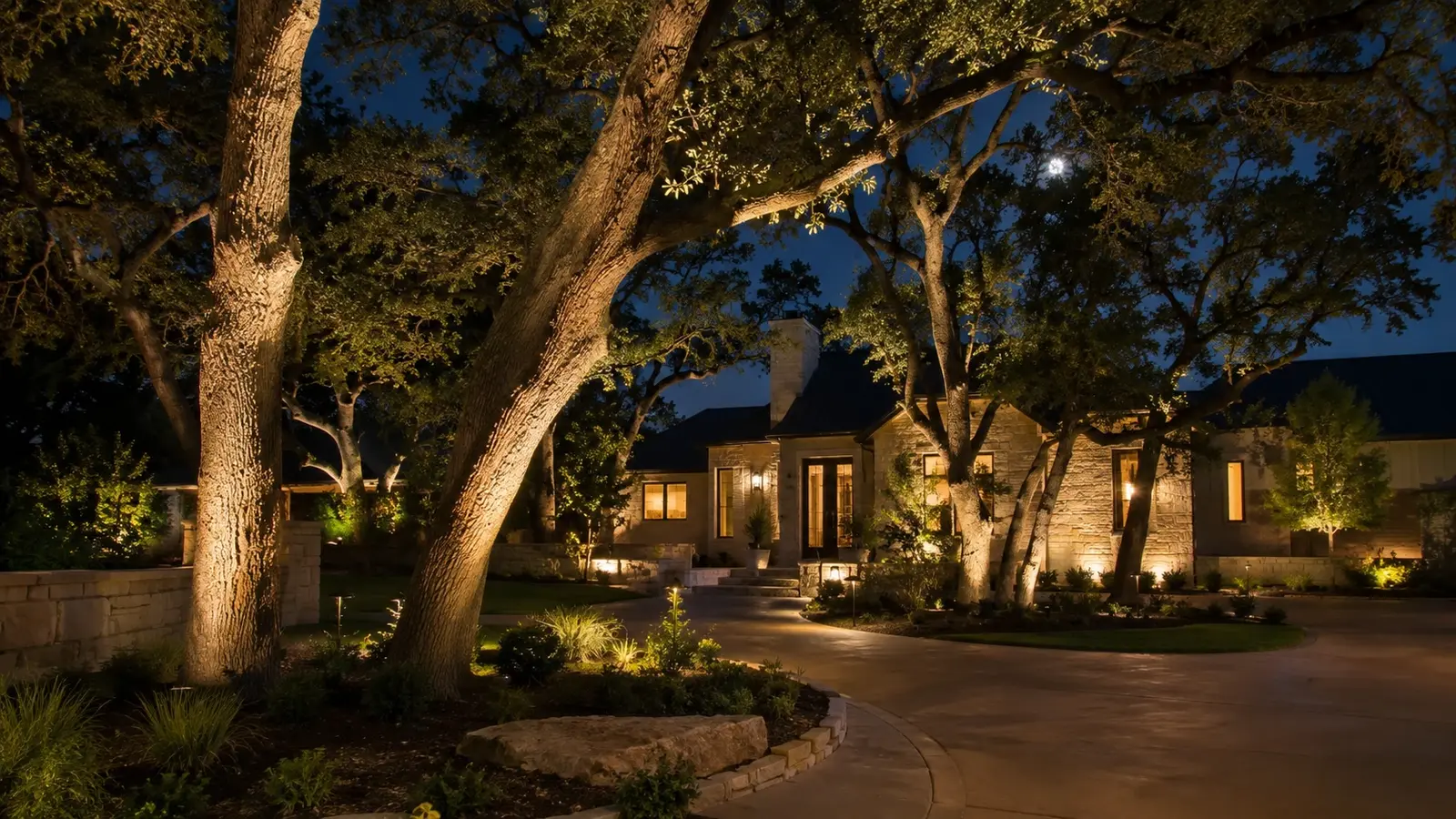
Austin is a city of trees: live oaks that sprawl across whole lots, cedar elms, pecans, bald cypress along the creeks, and the smaller ornamentals that fill newer subdivisions. The best landscape lighting ideas for trees respect how each species is built, because a technique that makes a live oak look monumental can make a crape myrtle look like a lollipop. Below is how the designers at Austin Landscape Lighting approach trees, from the biggest canopy to the smallest accent.
Why trees come first in a lighting design
A lit tree does three jobs at once. It gives the property height and depth that a lit facade alone cannot. It reflects soft light back onto the lawn and patio so you need fewer fixtures elsewhere. And it is the view from inside the house, which is where you spend most of the evening. We often start a design at the tree you see from the kitchen sink.
Uplighting: the classic
Fixtures at the base of the trunk aim up into the canopy. The rules that separate professional results from a bright blob:
- Use two or three fixtures on any tree over 15 feet, placed at different angles so one side never goes flat. A single uplight creates a hard shadow line and a bald back side.
- Match the beam to the canopy. Narrow 15 to 24 degree beams punch up tall, upright trees like cypress and cedar elm. Wider 36 to 60 degree beams fill the broad crown of a live oak.
- Keep fixtures 2 to 4 feet off the trunk for a textured bark wash, further for a softer canopy glow. Too close and only the bark lights; too far and the beam spills past the tree.
- Output: 4 to 7 watts LED for most residential trees, up to 9 or 12 watts for a 50-foot pecan. More than that reads as a parking lot.
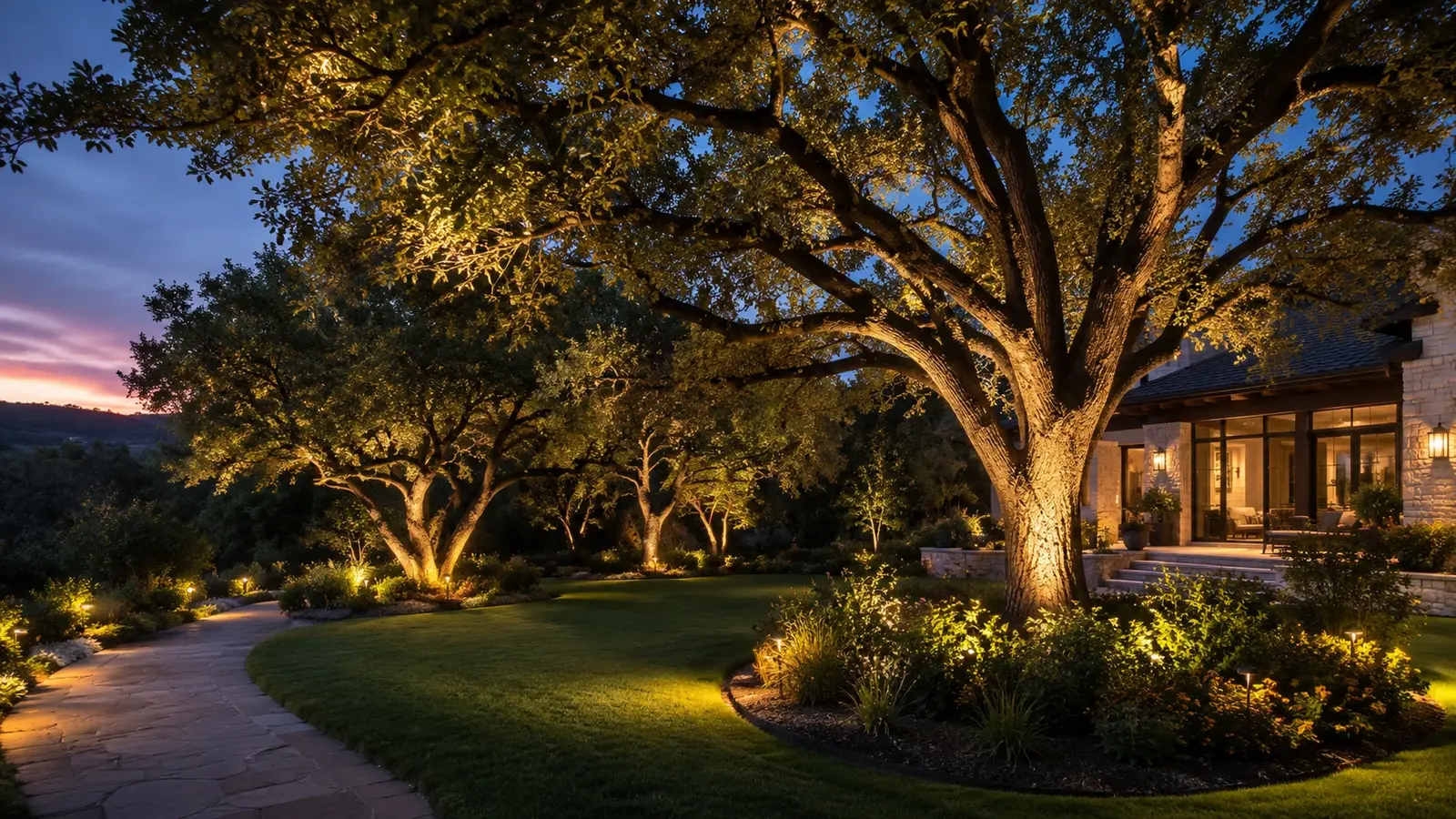
Moonlighting: light from inside the canopy
This is the technique Austin homeowners ask about by name after they see it at a neighbor's. A fixture is mounted high in the tree, 20 to 35 feet up, aimed down through the branches. Leaves and limbs break the beam into dappled shadows that move with the wind, exactly like moonlight. Use a wide 60-degree beam, a slightly cooler 3000K lamp if you want a true moon tone or 2700K to match the rest of the yard, and a long shroud so the source stays hidden from below. Mount with stand-offs and leave a service loop so the tree can grow. One moonlight can light a patio, a path and a lawn at once, which makes it the most efficient idea on this page. It is a core part of our garden and tree lighting service.
Silhouetting and shadowing
For trees with strong outlines, such as a Japanese maple, a yucca or a twisted mountain laurel, put the light behind the plant and wash the wall or fence beyond it. The tree shows as a dark shape against a lit surface. Shadowing is the reverse: light the plant from the front so it throws a magnified shadow onto the wall. Both work best on smaller trees within 6 feet of a flat surface and both are ways to light a tree with only one fixture.
Ideas by Austin species
| Tree | Best technique | Fixtures | Notes |
|---|---|---|---|
| Live oak (mature) | Cross-light uplighting plus moonlight | 2 to 3 up, 1 to 2 down | Light the structure of the limbs, not just the leaves |
| Cedar elm, pecan | Uplighting, narrow beams | 2 to 3 | Tall and upright; 24° beams reach the crown |
| Bald cypress | Single narrow uplight per trunk | 1 to 2 | Columnar shape; feathery foliage glows |
| Crape myrtle | Grazing the bark, soft uplight | 1 to 2 | Exfoliating bark is the feature; keep output low |
| Texas mountain laurel, yaupon | Silhouette or shadow | 1 | Multi-trunk forms read best as outlines |
| Palms, agave, yucca | Narrow uplight from below | 1 | Sculptural; 15° beam straight up the trunk |
| Young subdivision trees | Soft wide uplight | 1 | Plan the wire for a second fixture as it grows |
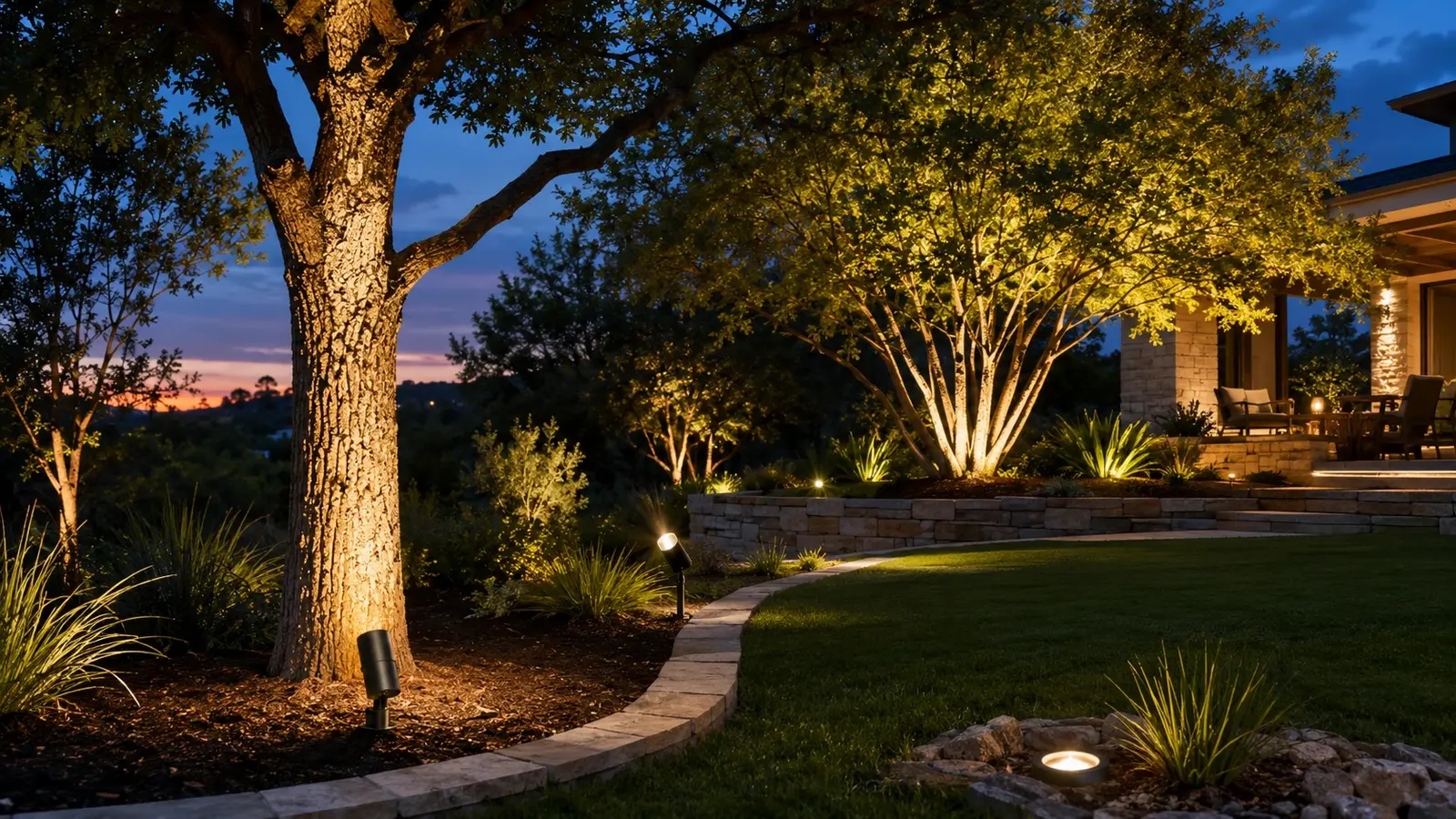
Grouping trees and the lawn between them
With several trees, decide which is the star and give it the most light. Secondary trees get one soft fixture each or none, so the eye moves across the yard in a hierarchy instead of a line of equal spotlights. Leave the lawn between them dark on purpose; the contrast is what makes the lit trees look dramatic.
Mistakes we fix most often
- One fixture per tree, straight up. Flat, with a hot spot on the trunk.
- Fixtures too bright. A 35-watt halogen on a 12-foot crape myrtle. Swap to a 3-watt LED and the bark appears.
- Blue light. 4000K and up turns oak leaves gray. Stay at 2700K to 3000K.
- Glare into windows. Walk inside and check every fixture. A shroud or a few degrees of re-aim fixes most.
- No plan for growth. Trees get wider; fixtures need to move out over the years. Leave slack in the wire and expect a re-aim visit every couple of seasons, which our maintenance plans cover.
Power, wire and transformer for tree lighting
Trees are usually the furthest fixtures from the house, so voltage drop matters. Run 12-gauge wire to a hub at the tree and short leads to each fixture, or use 10-gauge for runs over 150 feet. A pair of oaks with three uplights and a moonlight each draws about 50 watts; size the transformer with 25 percent headroom using the transformer tool. Moonlight wiring should run up the shaded back of the trunk with UV-stable cable and stainless or brass hardware.
See it on your trees
Trees are the one feature that cannot be judged from a catalog photo; the same fixture looks different on every canopy. Austin Landscape Lighting brings demo fixtures to a free dusk consultation and lights your actual trees before you decide on anything. Book a consultation and see what your oaks have been hiding.
Frequently asked questions
How many lights does a large live oak need?
Plan on two or three uplights cross-lighting the trunk and canopy, plus one or two moonlights mounted in the branches if you want dappled light on the ground below. Smaller oaks can look complete with two fixtures.
Does mounting fixtures in a tree hurt it?
Not when done correctly. We use stainless or brass stand-off mounts that hold the fixture away from the bark, leave slack so the tree can grow, and avoid girdling straps. A certified arborist can inspect the mounting on request.
What beam angle should I use for tree uplighting?
Narrow 15 to 24 degree beams for tall, columnar trees like cypress and cedar elm; wider 36 to 60 degree beams for broad canopies like live oak. Most designs mix angles on the same tree.

Written by the design team at Austin Landscape Lighting. We design, install and maintain low-voltage LED landscape lighting across Austin and the Hill Country. Questions about your property? Book a free dusk consultation or call +1 (281) 704-7210.